Malus' Law
Key idea: Use Malus’ law (I ∝ cos²θ) to calculate intensity and amplitude of plane-polarised light after a polarising filter (A Level Physics).
Continue where you stopped
The core idea
On this page
Learning objectives
- Explain polarisation and apply Malus’ law to amplitude and intensity.
1. Definitions (Must Know)
A. Plane-polarised wave
A plane-polarised wave is a transverse wave whose oscillations are restricted to one plane.
B. Polarising filter (polariser / analyser)
A polarising filter has a transmission axis. It only transmits the component of the wave’s electric field along this axis.
C. Angle, θ
θ is the angle between the incident polarisation direction and the polariser’s transmission axis.
D. Intensity, I (W m⁻²)
Intensity, I, is power per unit area carried by the wave.
2. Key Ideas (What Earns Marks)
- After transmission through a polariser:
- amplitude scales as A = A₀ cos θ
- intensity scales as I = I₀ cos² θ
- This is Malus’ law.
- Quick checks:
- θ = 0°: I = I₀ (maximum transmission)
- θ = 90°: I = 0 (crossed polarisers)
- θ = 45°: I = (1/2)I₀
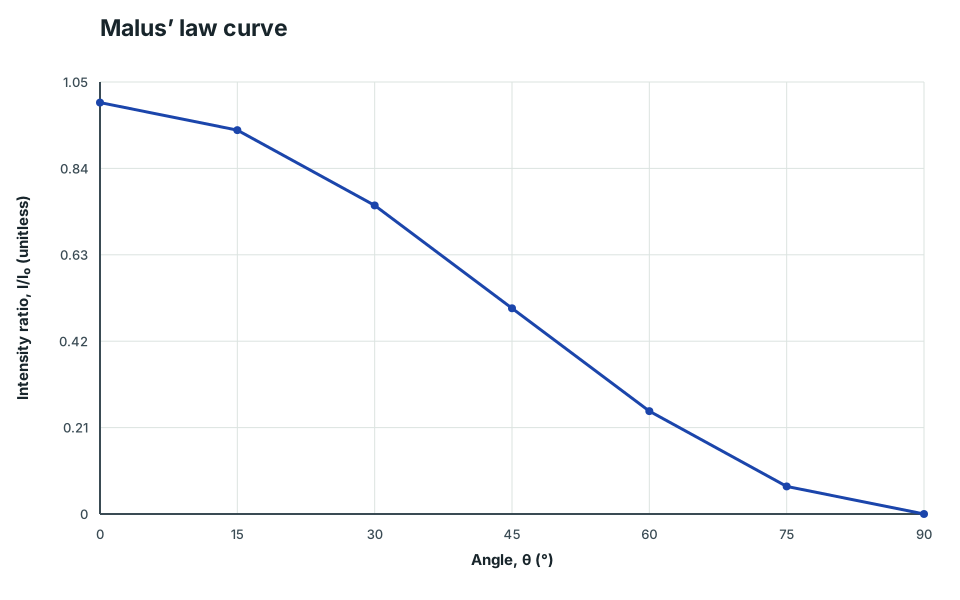
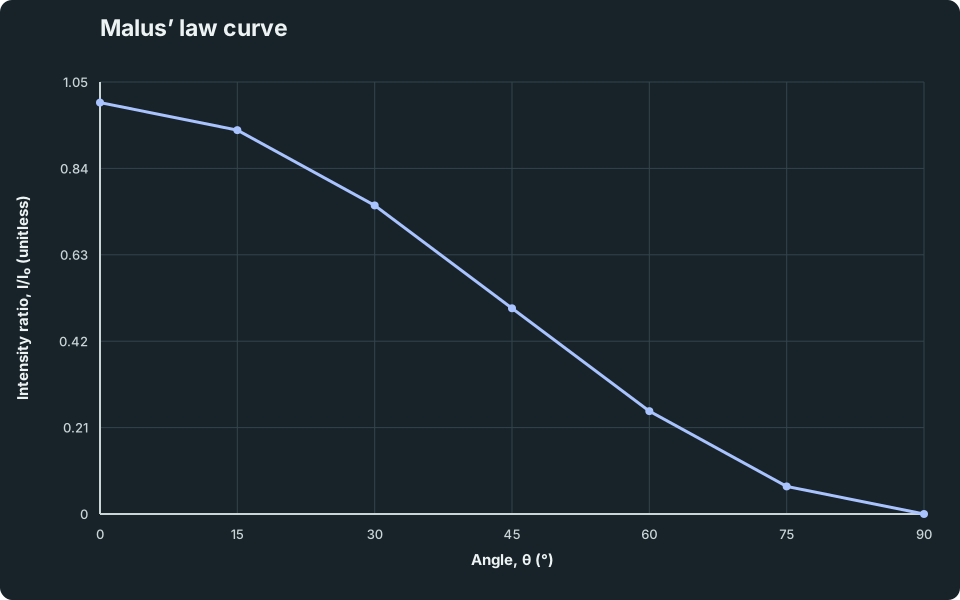
Malus’ law curve
Transmitted intensity follows cos squared of the angle between polarisation direction and polariser axis.
Scroll across the graph to read all labels.
View figure data
| Angle, θ (°) | Series 1 |
|---|---|
| 0 | 1 |
| 15 | 0.933 |
| 30 | 0.75 |
| 45 | 0.5 |
| 60 | 0.25 |
| 75 | 0.067 |
| 90 | 0 |
3. Detailed Explanations
A. Why the cosine appears
A polariser only transmits the component of the electric field along its transmission axis.
If the incident field amplitude is A₀ and the axis makes angle θ, the transmitted component is the projection: A = A₀ cos θ
B. From amplitude to intensity
For electromagnetic waves, intensity is proportional to the square of the field amplitude: I ∝ A²
So:
4. Common Mistakes
- Using I = I₀ cos θ instead of I = I₀ cos² θ.
- Mixing degrees and radians on a calculator (use degrees unless specified).
- Measuring θ from the wrong reference line (it must be between polarisation direction and transmission axis).
5. Exam Tips
- Write the correct form immediately: I = I₀ cos² θ.
- If the question asks for amplitude after the polariser, use A = A₀ cos θ (not the squared version).
- If multiple polarisers are in series, apply Malus’ law step-by-step to each stage.
6. Worked Examples
Modelled example 1
Intensity after a polariser
Problem
Study the worked solution
Choose the intensity relation
Method
Use I = I₀ cos² θ.Reason
The incident light is already plane-polarised and the angle is relative to the transmission axis.Working
I = I₀ cos² θProject and square
Method
cos 60° = 0.50, so the intensity factor is 0.25.Reason
Field amplitude is projected by cosine and intensity depends on amplitude squared.Working
cos² 60° = (0.50)² = 0.25Calculate
Method
The transmitted intensity is 2.0 W m⁻².Reason
One quarter of 8.0 is 2.0.Working
I = 8.0(0.25) = 2.0 W m⁻²
Guided practice 2
Angle for a given fraction of intensity
Problem
Try this before viewing the solution
Hints
Hint 1: undo the square first
View solution step by step
Form the intensity fraction
Method
cos² θ = 0.25.Reason
Malus’ law directly relates the transmitted fraction to the squared cosine.Working
I/I₀ = cos² θUndo the square
Method
cos θ = 0.50.Reason
The angle is taken in the physical 0° to 90° range.Working
square root of 0.25 = 0.50Find the angle
Method
θ = 60°.Reason
cos⁻¹ (0.50) = 60°.Working
θ = 60°
Common misconception 3
Amplitude after a polariser
Learner claim
Try this before viewing the solution
View solution step by step
Relate the ratios
Method
I/I₀ = (A/A₀)².Reason
Electromagnetic intensity depends on the square of field amplitude.Working
0.36 = (A/A₀)²Recover amplitude
Method
A/A₀ = 0.60.Reason
Amplitude is the positive magnitude of the field projection.Working
A/A₀ = square root of 0.36 = 0.60
Examiner practice 4
Angle for 75% transmission
Examination question
Try this before viewing the solution
View solution step by step
Apply Malus' law
1 markMethod
cos² θ = 0.75.Reason
The given quantity is an intensity fraction.Working
I/I₀ = cos² θFind the cosine
1 markMethod
cos θ = 0.866.Reason
Take the positive square root for an acute angle.Working
square root of 0.75 = 0.866Find the angle
1 markMethod
θ ≈ 30°.Reason
Use inverse cosine in degree mode.Working
θ = cos⁻¹ (0.866) ≈ 30°
Self-mark with the mark scheme
Compare your response with each mark point. Select a point only when your response contains that evidence.
Self-mark the Malus relation, square root and final angle.
Challenge 5
Find the incident intensity
Independent transfer
Try this before viewing the solution
Hints
Hint 1: reverse Malus' law
View solution step by step
Evaluate the transmission factor
Method
cos² 45° = 1/2.Reason
The 45° field projection has magnitude 1/square root of 2.Working
I = I₀/2Solve backwards
Method
The incident intensity is 4.0 W m⁻².Reason
The measured transmitted value is half of the incident value.Working
I₀ = 2I = 4.0 W m⁻²
7. Mind Stretchers
Mind stretcher 1: Two polarisers in seriesExtension
Plane-polarised light of intensity I₀ passes through two polarisers. The first is aligned with the incident polarisation. The second is at 30° to the first. Find the final intensity.
Show Answer
After the first polariser (aligned): I₁ = I₀.
After the second polariser: I₂ = I₁ cos² 30° = I₀((square root of 3)/2)² = (3/4)I₀
Mind stretcher 2: Adding a third polariserExtension
Plane-polarised light of intensity I₀ passes through three ideal polarisers with axes at 0°, 45°, and 90°. Find the final intensity.
Show Answer
First polariser is aligned: I₁ = I₀.
Second polariser at 45°: I₂ = I₁ cos² 45° = I₀(1/(square root of 2))² = (1/2)I₀
Third polariser is 45° relative to the second: I₃ = I₂ cos² 45° = ((1/2)I₀)(1/2) = (1/4)I₀
Continue with the next resource in this course.
Course and syllabus information
- Course
- GCE A-Level H2 Physics
- Edition
- GCE A-Level H2 Physics 2027