Electric Fields in Conductors
Key idea: Key H3 results for conductors in electrostatic equilibrium: E=0 inside, equipotential volume, surface field normal, and charge on surfaces.
Continue where you stopped
The core idea
On this page
Learning objectives
- show an understanding that ideal conductors form an equipotential volume, and that the electric field within an ideal conductor is zero
- show an understanding that electric charge accumulates on the surfaces of a conductor, and that the electric field at the surface of a conductor is normal to the surface
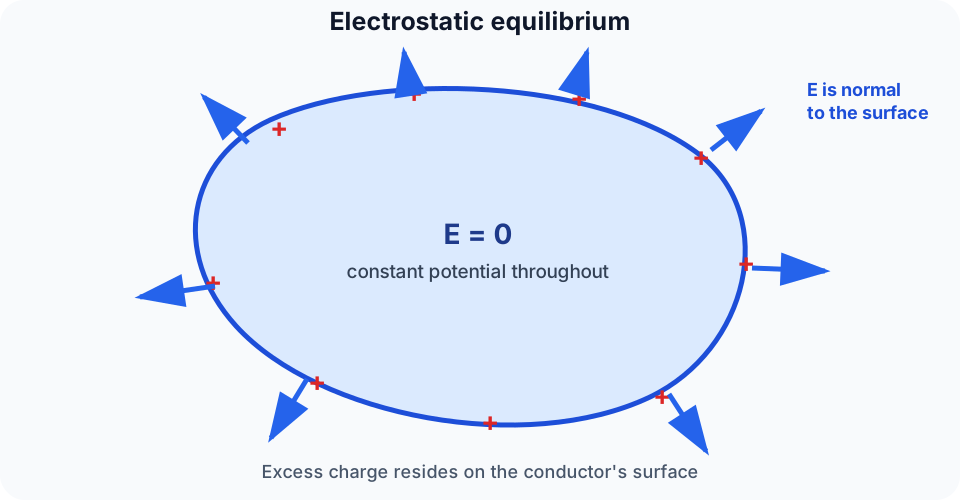
In electrostatics, an ideal conductor contains free charges that can move. This creates three high-yield results in H3:
- the conductor is an equipotential volume,
- the electric field inside the conductor is zero, and
- the electric field at the surface is normal to the surface. Any excess charge resides on a surface; with an empty enclosed cavity, it resides on the outer surface.
1. Definitions (Must Know)
- Ideal conductor: a material with mobile charges that can move freely in response to an electric field.
- Electrostatic equilibrium: charges are at rest (no net drift).
- Equipotential volume: electric potential V is the same everywhere inside the conductor and on its surface.
- Electric field inside an ideal conductor (electrostatic): vector E = vector 0.
- Field at conductor surface: the electric field has no tangential component, so it is perpendicular (normal) to the surface.
- Symbols used in this lesson: vector E electric field (N C⁻¹ or V m⁻¹), Eₜ tangential field component at a surface (V m⁻¹), V electric potential (V), q charge (C), vector F force (N).
2. Key Ideas (What Earns Marks)
- If vector E ≠ vector 0 inside a conductor, free charges experience a force and move, so it cannot be electrostatic equilibrium.
- In equilibrium, the surface of a conductor is an equipotential; otherwise charges would move along the surface.
- The “vector E is normal to the surface” statement is really: tangential component Eₜ = 0 at the surface.
Quick comparison:
| Claim (electrostatics) | Conductor in electrostatic equilibrium | Insulator (general) |
|---|---|---|
| Charges are free to move | Yes | No (or very limited) |
| Electric field inside the material | vector E = vector 0 | Can be non-zero |
| Potential inside the material | Constant (equipotential) | Can vary with position |
3. Detailed Explanations
A. Why vector E = vector 0 inside a conductor (electrostatic equilibrium)
If an electric field existed inside the conductor, a free charge q would experience: vector F = q vector E So charges would accelerate and redistribute until the internal field cancels to zero.
Therefore, in electrostatic equilibrium: vector E_inside = vector 0
B. Why a conductor is an equipotential volume
Electric field relates to potential gradient: vector E = - vector ∇V If vector E = vector 0 everywhere inside the conductor, then the potential cannot change with position inside it. So V is constant throughout the conductor (an equipotential volume).
C. Why vector E is perpendicular to the surface
Suppose the electric field at the surface had a non-zero tangential component Eₜ along the surface. A surface charge would then feel a tangential force and move along the surface, contradicting electrostatic equilibrium.
So at the surface: Eₜ = 0 and the field is purely normal to the surface.
4. Common Mistakes
- Forgetting the condition “electrostatic equilibrium” (if charges are moving or fields vary with time, the conclusions can change).
- Saying “the field is zero at the surface” (false in general; it is the tangential component that is zero).
- Mixing “equipotential surface” with “no electric field”: equipotential only implies no field component along the surface.
5. Exam Tips
- Use mark-scheme-safe phrasing:
- “In electrostatic equilibrium, vector E = 0 inside an ideal conductor.”
- “Charge resides on the surface; the field at the surface is normal to the surface.”
- If asked “why?”, always state the driver: “otherwise charges would move”.
- Link idea: equipotential ⇒ no tangential component of vector E.
6. Worked Examples
Modelled example 1
Quick concept check: field inside a conductor
Problem
Study the worked solution
Assume a non-zero field
Method
A free charge would experience vector F = q vector E.Reason
Mobile charges in a conductor respond to an internal electric field.Working
vector E ≠ 0 ⇒ vector F ≠ 0Apply equilibrium
Method
Continued charge motion would contradict electrostatic equilibrium.Reason
Equilibrium requires no net drift or redistribution.Working
electrostatic equilibrium ⇒ charges at restState the field
Method
vector E = vector 0 everywhere inside the conducting material.Reason
Charges redistribute until their field cancels the internal field.Working
vector E_inside = vector 0
Guided practice 2
Field direction at the surface
Problem
Try this before viewing the solution
Hints
Hint 1: test a tangential component
View solution step by step
Resolve the field
Method
Separate normal and tangential components.Reason
The equilibrium restriction applies directly to motion along the surface.Working
vector E = Eₙn hat + Eₜt hatEliminate tangential field
Method
Eₜ = 0.Reason
A non-zero tangential field would exert a tangential force and move free charge.Working
Fₜ = qEₜ = 0State direction
Method
Any non-zero field at the surface is perpendicular to it.Reason
Only the normal component may remain.Working
vector E = Eₙn hat
Common misconception 3
Equipotential reasoning
Learner claim
Try this before viewing the solution
View solution step by step
Interpret equipotential
Method
Potential does not change along the surface.Reason
Every point on the conductor surface has the same V.Working
∂ V/∂ s = 0Infer the constrained component
Method
The tangential field component is zero.Reason
vector E = - vector ∇ V makes the field component along the surface equal to the negative tangential potential gradient.Working
Eₜ = -∂ V/∂ s = 0Correct the claim
Method
The normal component just outside can be non-zero.Reason
Potential may vary with distance normal to the surface even while remaining constant along it.Working
Eₙ = -∂ V/∂ n ≠ 0 is possible
Examiner practice 4
Potential difference inside a conductor
Examination question
Try this before viewing the solution
View solution step by step
Use the internal field
1 markMethod
vector E = 0 inside the conductor.Reason
The block is in electrostatic equilibrium.Working
vector E = - vector ∇ V = 0State interior potential
1 markMethod
V = 120 V everywhere inside.Reason
Zero potential gradient makes the interior and surface one equipotential volume.Working
V_inside = V_surface = 120 VFind potential difference
1 markMethod
Δ V = 0 V between any two interior points.Reason
Both points have the same potential.Working
Δ V = 120-120 = 0 V
Self-mark with the mark scheme
Compare your response with each mark point. Select a point only when your response contains that evidence.
Self-mark the equilibrium field, interior potential and potential difference.
Challenge 5
Tangential field at the surface (showing “not equilibrium”)
Independent transfer
Try this before viewing the solution
Hints
Hint 1: apply force to surface charge
View solution step by step
Calculate the qualitative force
Method
A surface charge would feel a non-zero tangential force.Reason
Eₜ = 4.0 V m⁻¹ is not zero.Working
Fₜ = qEₜ ≠ 0Test equilibrium
Method
The charge would move along the surface.Reason
Mobile conductor charges respond to that force.Working
Fₜ ≠ 0 ⇒ surface redistributionState the conclusion
Method
The situation is not electrostatic equilibrium; at equilibrium Eₜ = 0.Reason
Charge motion contradicts the equilibrium premise.Working
Eₜ = 0 at electrostatic equilibrium
7. Mind Stretchers
Mind stretcher 1: Cavities and charge placement (qualitative)Extension
An ideal conductor has a hollow cavity inside it. The conductor is in electrostatic equilibrium and there is no charge inside the cavity.
Where would any excess charge placed on the conductor end up: on the cavity surface, on the outer surface, or both?
One H3-safe answer (qualitative)
On the outer surface. In electrostatic equilibrium with no charge inside the cavity, charges redistribute so that the field inside the conductor material is zero and there is no need for charge to sit on the cavity surface.
Mind stretcher 2: Why charge crowds at sharp points (qualitative)Extension
Lightning rods and sharp conductors tend to accumulate more surface charge near sharp tips. Explain qualitatively what this implies about the field strength just outside sharp points.
Answer
Sharper curvature tends to produce higher surface charge density near the tip. Higher surface charge density means a stronger electric field just outside the surface in that region. So sharp points create locally stronger fields, which is why they promote ionisation/leakage and make discharge more likely.
8. Optional/Enrichment
A. Quantitative “just outside the surface” result (Gauss law)
Using Gauss’s law with a small “pillbox” surface gives a quantitative relation for the field just outside a conductor in vacuum in terms of surface charge density. This derivation is not needed for this lesson; it fits better under Gauss’s law.
For a deeper (university) treatment:
For the A Level potential/field link (equipotentials and tangential components):
Next step
Continue to Gauss’s Law to turn these conductor results into a closed-surface flux method.
Continue with the next resource in this course.
Course and syllabus information
- Course
- GCE A-Level H3 Physics
- Edition
- GCE A-Level H3 Physics 2027