Gauss’s Law
Key idea: Use Gauss’s law in integral form to compute electric fields for symmetric charge distributions (spherical, cylindrical, planar), with worked examples.
Continue where you stopped
The core idea
On this page
Learning objectives
- recall and apply Gauss’s law 6 for electric and magnetic fields (knowledge of the differential form of Gauss’s law is not required), and
- recall and apply Ampère’s law 7 relating the line integral of the magnetic field (in a vacuum) around a closed loop with the electric current enclosed by the loop to solve problems involving symmetric field configurations (knowledge of the differential form of Ampère’s law is not required) [Note further that candidates are not required to know Maxwell’s generalisation of Ampère’s law including the term related to the rate of change of electric flux, nor the Biot-Savart law.]
- solve problems involving symmetric charge distributions by relating the electric flux (in a vacuum) through a closed surface with the charge enclosed by that surface (ii) show an understanding that the magnetic flux through a closed surface is always zero, suggesting the non-existence of magnetic monopoles
Gauss’s law links the electric flux through a closed surface to the charge enclosed. In H3, you use its integral form to compute vector E efficiently for highly symmetric charge distributions.
1. Definitions (Must Know)
- Electric flux, Φ_E (N m² C⁻¹): Φ_E = ∮ vector E · d vector A where d vector A points outward normal to the surface.
- Gauss’s law (electric, integral form): ∮ vector E · d vector A = Q_encl/ε₀
- Gauss’s law (magnetic, integral form): ∮ vector B · d vector A = 0 This zero net magnetic flux is consistent with the non-existence of magnetic monopoles in the syllabus model.
- Gaussian surface: an imaginary closed surface chosen to exploit symmetry.
- Vacuum permittivity: ε₀ ≈ 8.85 × 10⁻¹² F m⁻¹.
- Symbols used in this lesson: vector E (N C⁻¹), vector B (T), Q_encl (C), ε₀ (F m⁻¹), λ (C m⁻¹), σ (C m⁻²), ρ (C m⁻³), r (m), R (m), A (m²).
2. Key Ideas (What Earns Marks)
- Gauss’s law is always true, but it is only useful when symmetry lets you pull E out of the surface integral.
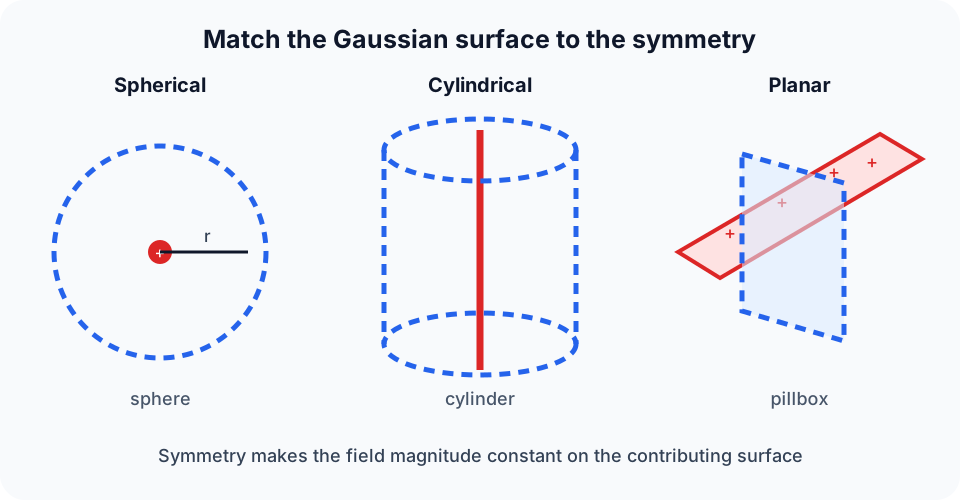
- The Gaussian surface must match the symmetry of the charge distribution (spherical / cylindrical / planar).
- Q_encl means “charge inside the surface”; charges outside do not contribute to the RHS (though they can still affect vector E on the surface).
- Magnetic version: flux through any closed surface is zero, so magnetic field lines do not begin or end in this model.
Symmetry → Gaussian surface (quick table):
| Symmetry in the charge distribution | Choose Gaussian surface | Typical result shape |
|---|---|---|
| Spherical | Sphere radius r | E ∝ 1/r² (outside) |
| Cylindrical | Cylinder radius r, length L | E ∝ 1/r (outside) |
| Planar | Pillbox area A | E constant (magnitude) |
3. Detailed Explanations
A. What Gauss’s law is telling you
Electric flux measures how much the electric field “pierces” a surface. Gauss’s law says: the net outward flux through a closed surface depends only on how much charge is enclosed.
B. When you can turn the integral into EA
If, on your chosen Gaussian surface:
- E has constant magnitude, and
- vector E is everywhere parallel to d vector A (so vector E · d vector A = E dA),
then: ∮ vector E · d vector A = E∮ dA = EA and you can solve for E quickly.
C. Canonical symmetries (what surfaces to choose)
- Spherical symmetry (point charge, uniformly charged sphere, conducting sphere): choose a sphere of radius r.
- Cylindrical symmetry (infinite line charge): choose a cylinder of radius r and length L.
- Planar symmetry (infinite plane sheet): choose a “pillbox” straddling the sheet.
H3 questions typically signal “infinite / very long / uniform / symmetric” to tell you Gauss’s law will be efficient.
4. Common Mistakes
- Using a Gaussian surface that does not match the symmetry, then incorrectly treating E as constant.
- Forgetting that vector E · d vector A uses the normal component of vector E.
- Mixing up A (area) with dA (infinitesimal area element).
- Treating the magnetic form as ∮ vector B · d vector A = μ₀ I (that’s Ampère’s law, different integral).
5. Exam Tips
- Start with a 3-line template:
- “Choose Gaussian surface: …”
- “By symmetry, vector E is … and has constant magnitude on the surface.”
- “So ∮ vector E · d vector A = EA (or 2EA, etc.).”
- Always state the enclosed charge explicitly before substituting.
- Keep ε₀ symbolic until the final step unless asked for a number.
6. Worked Examples
Modelled example 1
Point charge (spherical symmetry)
Problem
Study the worked solution
Choose the surface
Method
Use a sphere of radius r centred on the charge.Reason
The charge distribution has spherical symmetry.Working
A = 4π r²Use symmetry
Method
vector E is radial and has constant magnitude over the sphere.Reason
All points at radius r are equivalent.Working
∮ vector E · d vector A = E(4π r²)Apply Gauss's law
Method
E = Q/(4πε₀r²).Reason
The Gaussian surface encloses charge Q.Working
E(4π r²) = Q/ε₀ ⇒ E = Q/4πε₀r²
Guided practice 2
Infinite line charge (cylindrical symmetry)
Problem
Try this before viewing the solution
Hints
Hint 1: separate curved face and caps
Hint 2: write enclosed charge
View solution step by step
Use cylindrical symmetry
Method
E is radial and constant on the curved face.Reason
Rotations about and translations along the infinite line leave the distribution unchanged.Working
Φ_curved = E(2π rL)Eliminate cap flux
Method
The two end caps contribute zero flux.Reason
The radial field is parallel to their planes and perpendicular to their area normals.Working
vector E · d vector A = 0 on capsApply enclosed charge
Method
E = λ/(2πε₀r).Reason
Q_encl = λ L and L cancels.Working
E(2π rL) = (λ L)/ε₀ ⇒ E = λ/2πε₀r
Common misconception 3
Magnetic Gauss law (concept check)
Learner claim
Try this before viewing the solution
View solution step by step
Separate local field from net flux
Method
A non-zero magnetic field can cross the surface inward in some places and outward in others.Reason
The surface integral sums signed normal components over the whole closed surface.Working
Φ_B = Φₒᵤₜ + Φᵢₙ = 0Interpret zero net flux
Method
There is no net magnetic source or sink enclosed.Reason
Magnetic field lines do not begin or end on magnetic monopoles in this model.Working
∮ vector B · d vector A = 0State the field-line picture
Method
Magnetic field lines form closed loops.Reason
Every line entering a closed surface must leave it again.Working
inward crossings = outward crossings
Examiner practice 4
Infinite plane sheet (planar symmetry)
Examination question
Try this before viewing the solution
View solution step by step
State symmetry
1 markMethod
vector E is normal to the sheet with equal magnitude on both sides.Reason
The infinite uniform plane has planar symmetry.Working
E₊ = E₋ = ECalculate flux
1 markMethod
Φ_E = 2EA.Reason
Each flat face contributes EA and the side contributes zero.Working
Φ_E = EA + EA = 2EAState enclosed charge
1 markMethod
Q_encl = σ A.Reason
The pillbox encloses sheet area A.Working
Q_encl = σ AApply Gauss's law
1 markMethod
E = σ/(2ε₀).Reason
The face area cancels between flux and enclosed charge.Working
2EA = (σ A)/ε₀ ⇒ E = σ/2ε₀
Self-mark with the mark scheme
Compare your response with each mark point. Select a point only when your response contains that evidence.
Self-mark symmetry, flux, enclosed charge and derived field.
Challenge 5
Uniformly charged solid sphere (inside vs outside)
Independent transfer
Try this before viewing the solution
Hints
Hint 1: change only enclosed charge
View solution step by step
Fix the flux form
Method
Φ_E = E(4π r²) in either region.Reason
Spherical symmetry makes E radial and constant on a radius-r Gaussian sphere.Working
∮ vector E · d vector A = E(4π r²)Outside enclosed charge
Method
For r ≥ R, Q_encl = ρ(4π R³/3).Reason
The Gaussian surface contains the whole charged sphere.Working
Q_encl = ρ(4/3)π R³Outside field
Method
E = ρ R³/(3ε₀r²).Reason
Apply Gauss’s law with the total charge.Working
E(4π r²) = ρ(4π R³/3)/ε₀Inside enclosed charge
Method
For 0 ≤ r ≤ R, Q_encl = ρ(4π r³/3).Reason
Only charge within the Gaussian radius is enclosed.Working
Q_encl = ρ(4/3)π r³Inside field
Method
E = ρ r/(3ε₀).Reason
The enclosed r³ divided by flux area r² leaves linear dependence on r.Working
E(4π r²) = ρ(4π r³/3)/ε₀
7. Mind Stretchers
Mind stretcher 1: “Charges outside don’t matter” — but fields canExtension
Gauss’s law says only enclosed charge appears on the RHS. Yet charges outside can change vector E on the surface.
Is this a contradiction?
Answer
No. Gauss’s law constrains the net flux through the closed surface, not the field at each point. External charges can reshape the field pattern on the surface while keeping the total flux consistent with Q_encl/ε₀.
Mind stretcher 2: Why the field inside a conductor is zero (Gauss-law angle)Extension
A conductor is in electrostatic equilibrium. Consider a Gaussian surface that lies entirely within the conducting material (not crossing the outer surface).
What does Gauss’s law imply about Q_encl there, and how does this support the statement “vector E = vector 0 inside the conductor”?
Answer
In electrostatic equilibrium, any excess charge resides on the surface, so a Gaussian surface entirely within the conductor encloses Q_encl = 0. Gauss’s law then gives ∮ vector E · d vector A = 0. For a conductor in equilibrium, the field cannot have a non-zero value inside (or charges would move), so the consistent conclusion is vector E = vector 0 throughout the conducting material.
8. Optional/Enrichment
A. Field “just outside a conductor” (pillbox)
A standard application uses a tiny pillbox Gaussian surface across a conductor surface to relate the field just outside to surface charge density. This is useful, but H3 questions may not require the full derivation.
For a deeper (university) walkthrough:
B. Differential form (not required)
The syllabus does not require the differential form of Gauss’s law; stay with the integral forms unless explicitly guided.
Next step
Continue to Ampère’s Law, where the same symmetry strategy is applied to circulation around a closed path.
Continue with the next resource in this course.
Course and syllabus information
- Course
- GCE A-Level H3 Physics
- Edition
- GCE A-Level H3 Physics 2027