Ampère’s Law
Key idea: Use Ampère’s law in integral form to compute magnetic fields for symmetric current distributions, with worked examples and exam tips.
Continue where you stopped
The core idea
On this page
Learning objectives
- show an understanding that ideal conductors form an equipotential volume, and that the electric field within an ideal conductor is zero
- show an understanding that electric charge accumulates on the surfaces of a conductor, and that the electric field at the surface of a conductor is normal to the surface
- recall and apply Gauss’s law 6 for electric and magnetic fields (knowledge of the differential form of Gauss’s law is not required), and
- recall and apply Ampère’s law 7 relating the line integral of the magnetic field (in a vacuum) around a closed loop with the electric current enclosed by the loop to solve problems involving symmetric field configurations (knowledge of the differential form of Ampère’s law is not required) [Note further that candidates are not required to know Maxwell’s generalisation of Ampère’s law including the term related to the rate of change of electric flux, nor the Biot-Savart law.]
- define the magnitude of the electric dipole moment as the product of the charge and the separation
- show an understanding of and use the torque on an electric dipole and the potential energy of an electric dipole to solve related problems
- define the magnitude of the magnetic dipole moment for a current loop as the product of the current and the area of the loop
- show an understanding of and use the torque on a magnetic dipole and the potential energy of a magnetic dipole to solve related problems
- solve problems involving symmetric charge distributions by relating the electric flux (in a vacuum) through a closed surface with the charge enclosed by that surface (ii) show an understanding that the magnetic flux through a closed surface is always zero, suggesting the non-existence of magnetic monopoles
Ampère’s law links the circulation of the magnetic field around a closed loop to the steady current enclosed. In H3, you use its magnetostatic integral form to calculate vector B for symmetric current distributions in vacuum.
1. Definitions (Must Know)
- Line integral / circulation of vector B: ∮ vector B · d vector l where d vector l is a tangential vector element along the chosen loop.
- Ampère’s law (integral form, in vacuum): ∮ vector B · d vector l = μ₀ I_encl
- Enclosed current, I_encl: net current passing through any surface bounded by the loop (sign from right-hand rule orientation).
- Vacuum permeability: μ₀ = 4π × 10⁻⁷ N A⁻².
- Symbols used in this lesson: vector B (T), d vector l (m), I current (A), I_encl enclosed current (A), n turns per unit length (m⁻¹), μ₀ (N A⁻²), r (m).
2. Key Ideas (What Earns Marks)
- In the H3 magnetostatic model, Ampère’s law applies to steady currents. It is computationally powerful when symmetry makes vector B · d vector l easy.
- Choose an Amperian loop that matches the symmetry so that:
- B is constant on the loop, and
- vector B is parallel to d vector l where it contributes.
- Sign matters: the direction you integrate is linked to the current direction by the right-hand rule.
- H3 note: you are not required to include Maxwell’s correction (displacement current) or use Biot–Savart.
Common symmetry setups (quick table):
| Current distribution | Best Amperian loop | What simplifies |
|---|---|---|
| Long straight wire | Circle radius r | B constant and tangent |
| Long solenoid (inside field) | Rectangle loop | Outside field approximated ~0, inside ~uniform |
| Coaxial cable (equal/opposite currents) | Circle radius r | I_encl depends on region |
3. Detailed Explanations
A. What Ampère’s law is telling you
The integral ∮ vector B · d vector l measures the “total tendency” of vector B to circulate around the loop. Ampère’s law says this circulation is set by the net current threading the loop.
B. The classic symmetric case: long straight wire
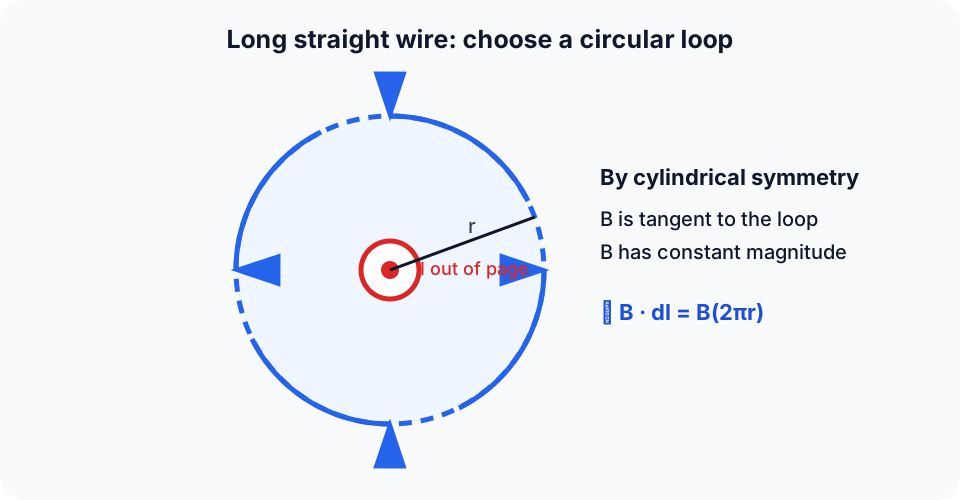
For a long straight current-carrying wire, symmetry tells you:
- vector B is tangent to circles centred on the wire,
- B depends only on the radius r.
Choose a circular Amperian loop of radius r: ∮ vector B · d vector l = B∮ dl = B(2π r) So: B(2π r) = μ₀ I ⇒ B = (μ₀ I)/(2π r)
C. When the loop encloses no net current
If I_encl = 0, Ampère’s law gives: ∮ vector B · d vector l = 0 This does not mean vector B = vector 0 everywhere on the loop; it means the signed circulation cancels.
4. Common Mistakes
- Confusing Ampère’s law with Gauss’s law for magnetism (∮ vector B · d vector A = 0).
- Choosing a loop where B is not constant and then incorrectly pulling B out of the integral.
- Forgetting that d vector l is tangential: only the component of vector B along the loop contributes.
- Treating ∮ vector B · d vector l = μ₀I as true for any time-varying situation without guidance (H3 scope keeps it simple and symmetric).
5. Exam Tips
- Write a short “symmetry justification”: “By symmetry, vector B is tangent to … and has constant magnitude on …”
- For straight-wire problems, the circular loop is almost always the intended choice.
- Quote the result cleanly with units: B = (μ₀ I)/(2π r) (T)
6. Worked Examples
Modelled example 1
Field around a long straight wire
Problem
Study the worked solution
Choose the loop
Method
Use a circle of radius r centred on the wire.Reason
Cylindrical symmetry makes B constant and tangent around this loop.Working
∮ vector B · d vector l = B(2π r)Apply Ampère's law
Method
B = μ₀I/(2π r).Reason
The loop encloses the full current I.Working
B(2π r) = μ₀ISubstitute
Method
B = 5.0 × 10⁻⁵ T.Reason
Use SI units before evaluating.Working
B = ((4π × 10⁻⁷)(5.0))/2π(0.020) = 5.0 × 10⁻⁵ T
Guided practice 2
Loop encloses zero net current
Problem
Try this before viewing the solution
Hints
Hint 1: find net current first
Hint 2: apply the law
View solution step by step
Sum enclosed current
Method
I_encl = 0.Reason
The equal currents pass through the bounded surface in opposite signed directions.Working
I_encl = 3 + (-3) = 0 AFind circulation
Method
∮ vector B · d vector l = 0.Reason
Ampère’s law depends on net enclosed current.Working
∮ vector B · d vector l = μ₀(0) = 0
Common misconception 3
Concept check: what does “zero circulation” mean?
Learner claim
Try this before viewing the solution
View solution step by step
Identify the measured quantity
Method
The integral sums the tangential component of vector B around the loop.Reason
Each contribution is the signed dot product vector B · d vector l.Working
∮ B_∥ dlInterpret a zero sum
Method
Positive and negative contributions may cancel even if B is locally non-zero.Reason
A zero integral constrains the total, not every integrand value.Working
non-zero terms can have signed sum 0Correct the claim
Method
Only additional symmetry could turn zero circulation into B = 0 for a particular loop.Reason
For example, constant tangential B would give B∮ dl = 0.Working
∮ vector B · d vector l = 0not ⇒ vector B = vector 0
Examiner practice 4
Field inside a long solenoid (standard result)
Examination question
Try this before viewing the solution
View solution step by step
State the long-solenoid result
1 markMethod
B = μ₀nI.Reason
A suitable rectangular Amperian loop has one contributing length inside; the enclosed current is the number of turns crossed times I.Working
Bl = μ₀(nl)I ⇒ B = μ₀nISubstitute
1 markMethod
Insert the turn density and current in SI units.Reason
n is already in m⁻¹.Working
B = (4π × 10⁻⁷)(800)(0.50)Report the field
1 markMethod
B = 5.0 × 10⁻⁴ T.Reason
The value is given to two significant figures with the magnetic-field unit.Working
B = 5.0 × 10⁻⁴ T
Self-mark with the mark scheme
Compare your response with each mark point. Select a point only when your response contains that evidence.
Self-mark the relation, substitution and final value.
Challenge 5
Coaxial cable: why the external field can be zero
Independent transfer
Try this before viewing the solution
Hints
Hint 1: combine the currents
View solution step by step
Find enclosed current
Method
I_encl = 0.Reason
The equal inner and outer currents have opposite directions.Working
I_encl = +I + (-I) = 0Apply Ampère's law
Method
The circulation is zero.Reason
It equals μ₀I_encl.Working
∮ vector B · d vector l = 0Use cylindrical symmetry
Method
B is tangent to the circle and has constant magnitude.Reason
The ideal concentric current distribution is cylindrically symmetric.Working
∮ vector B · d vector l = B(2π r)Conclude
Method
B = 0 outside the ideal cable.Reason
Here symmetry prevents non-zero tangential contributions from cancelling around the circle.Working
B(2π r) = 0 ⇒ B = 0
7. Mind Stretchers
Mind stretcher 1: Choosing a better loopExtension
You choose a rectangular loop around a long straight wire and get stuck because B is not constant along the loop.
What loop choice makes the integral easy, and why?
Answer
A circular loop centred on the wire. Symmetry makes B constant along the circle and tangent to the path, so ∮ vector B · d vector l = B(2π r).
Mind stretcher 2: “I_encl = 0” doesn’t always mean “B = 0”Extension
In some geometries, you can have ∮ vector B · d vector l = 0 but still have a non-zero B at points on the loop.
What does this tell you about interpreting the integral equation?
Answer
It tells you Ampère’s law constrains the net circulation around the loop. Zero circulation means the signed contributions cancel; it does not guarantee the field is zero at every point unless symmetry lets you argue B is constant and tangent along the path.
8. Optional/Enrichment
A. Syllabus boundary
The H3 syllabus uses Ampère’s law for symmetric steady-current configurations. Maxwell’s displacement-current term and the Biot–Savart law are explicitly outside the required scope.
For a university-level walkthrough:
Next step
Continue to Electric Dipoles to move from field symmetry to the torque and energy of an oriented source.
Continue with the next resource in this course.
Course and syllabus information
- Course
- GCE A-Level H3 Physics
- Edition
- GCE A-Level H3 Physics 2027