Electric Dipoles
Key idea: Learn electric dipole moment, torque in a uniform electric field, and dipole potential energy, with worked examples and exam tips.
Continue where you stopped
The core idea
On this page
Learning objectives
- define the magnitude of the electric dipole moment as the product of the charge and the separation
- show an understanding of and use the torque on an electric dipole and the potential energy of an electric dipole to solve related problems
- define the magnitude of the magnetic dipole moment for a current loop as the product of the current and the area of the loop
- show an understanding of and use the torque on a magnetic dipole and the potential energy of a magnetic dipole to solve related problems
An electric dipole is a pair of equal and opposite charges separated by a small distance. In H3, the key skills are:
- define the dipole moment, and
- use torque and potential energy of a dipole in a (uniform) electric field.
1. Definitions (Must Know)
- Electric dipole: charges + q and -q separated by distance d.
- Dipole moment (magnitude): p = qd Unit: C m.
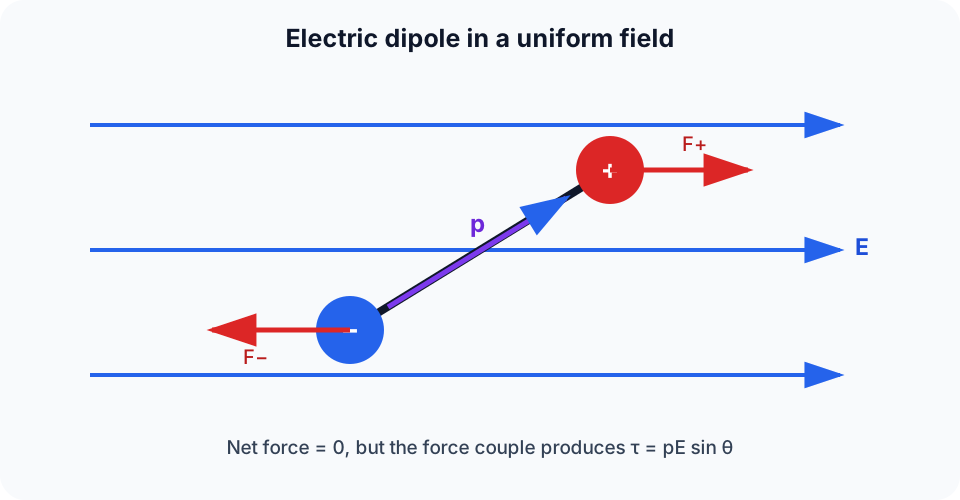
- Dipole moment vector, vector p: points from -q to + q, with magnitude p = qd.
- Uniform electric field: vector E has constant magnitude and direction in the region of interest.
- Torque on a dipole in a uniform field (magnitude): τ = pE sin θ where θ is the angle between vector p and vector E.
- Potential energy of a dipole in a uniform field: U = - vector p · vector E = -pE cos θ
- Symbols used in this lesson: q (C), d (m), p (C m), vector E (N C⁻¹), τ (N m), U (J), W work done (J), θ (rad).
2. Key Ideas (What Earns Marks)
- A uniform field exerts zero net force on an ideal dipole (forces cancel), but a non-zero torque (forces form a couple).
- The torque tends to align vector p with vector E (stable at θ = 0).
- Use energy to identify stable/unstable orientations:
- minimum U at θ = 0 (aligned),
- maximum U at θ = π (anti-aligned).
Quick comparison (uniform field):
| Quantity | Result | What it means |
|---|---|---|
| Net force on ideal dipole | 0 | Translation doesn’t accelerate (in uniform vector E) |
| Torque on dipole | τ = pE sin θ | Tends to rotate to align vector p with vector E |
| Potential energy | U = -pE cos θ | Stable at minimum (θ = 0) |
3. Detailed Explanations
A. Why there is torque but no net force (uniform field)
Forces on the charges are: vector F₊ = +q vector E, vector F₋ = -q vector E So the net force is: vector Fₙₑₜ = vector F₊ + vector F₋ = vector 0
But the forces act at different points, producing a turning effect (a couple). The torque magnitude is: τ = pE sin θ
B. Potential energy and equilibrium angles
The potential energy is: U(θ) = -pE cos θ So:
- θ = 0 gives Uₘᵢₙ = -pE (stable equilibrium),
- θ = π gives Uₘₐₓ = +pE (unstable equilibrium).
4. Common Mistakes
- Using p = q/d (wrong); it is p = qd.
- Getting the direction of vector p wrong (it points from -q to + q).
- Treating τ = pE regardless of angle (must include sin θ).
- Forgetting the minus sign in U = -pE cos θ.
5. Exam Tips
- Sketch the dipole and mark vector p and vector E; it prevents sign/direction errors.
- Use torque for “rotating/turning” questions; use energy for “stable/unstable” or “work done to rotate”.
- If the field is not uniform, the net force may not be zero (that is beyond this lesson unless stated).
6. Worked Examples
Modelled example 1
Dipole moment calculation
Problem
Study the worked solution
Use the dipole definition
Method
p = qd.Reason
Dipole-moment magnitude is charge magnitude times charge separation.Working
p = qdConvert units
Method
q = 2.0 × 10⁻⁹ C and d = 3.0 × 10⁻³ m.Reason
The SI unit of dipole moment is coulomb metre.Working
nC = 10⁻⁹ C; mm = 10⁻³ mCalculate
Method
p = 6.0 × 10⁻¹² C m.Reason
Multiply the converted charge and separation.Working
p = (2.0 × 10⁻⁹)(3.0 × 10⁻³) = 6.0 × 10⁻¹² C m
Guided practice 2
Torque in a uniform field
Problem
Try this before viewing the solution
Hints
Hint 1: include the angular factor
View solution step by step
Choose the relation
Method
τ = pE sin θ.Reason
Only the component perpendicular to the dipole moment produces torque.Working
τ = pE sin θCalculate
Method
τ = 4.0 × 10⁻³ N m.Reason
pE = 8.0 × 10⁻³ N m and sin 30° = 0.5.Working
τ = (4.0 × 10⁻⁸)(2.0 × 10⁵)(0.5) = 4.0 × 10⁻³ N m
Common misconception 3
Energy change on rotation
Learner claim
Try this before viewing the solution
View solution step by step
Find the initial energy
Method
Uᵢ = -0.20 J.Reason
U = -pE cos θ and cos 0° = 1.Working
Uᵢ = -0.20(1) = -0.20 JFind the final energy
Method
U_f = -0.10 J.Reason
cos 60° = 0.5.Working
U_f = -0.20(0.5) = -0.10 JCompare signed values
Method
Δ U = +0.10 J, so potential energy increases.Reason
-0.10 J is greater than -0.20 J.Working
Δ U = U_f-Uᵢ = (-0.10)-(-0.20) = +0.10 J
Examiner practice 4
Work done to rotate a dipole
Examination question
Try this before viewing the solution
View solution step by step
Link work and energy
1 markMethod
Wₑₓₜ = Δ U.Reason
Slow rotation with no kinetic-energy change makes external work equal the potential-energy increase.Working
Wₑₓₜ = U₂-U₁Initial energy
1 markMethod
U₁ = -0.260 J.Reason
Apply U = -pE cos θ at 30°.Working
U₁ = -0.30 cos 30° = -0.260 JFinal energy
1 markMethod
U₂ = +0.150 J.Reason
cos 120° = -0.5 and the energy relation has a leading minus sign.Working
U₂ = -0.30 cos 120° = +0.150 JCalculate work
1 markMethod
Wₑₓₜ = 0.41 J.Reason
The energy rises from a negative to a positive value.Working
Wₑₓₜ = 0.150-(-0.260) = 0.410 J
Self-mark with the mark scheme
Compare your response with each mark point. Select a point only when your response contains that evidence.
Self-mark the work–energy link, both endpoint energies and final work.
Challenge 5
Angle for maximum torque
Independent transfer
Try this before viewing the solution
Hints
Hint 1: maximise the angular factor
View solution step by step
Isolate the variable factor
Method
τ = pE sin θ.Reason
Only sin θ changes with orientation for fixed p and E.Working
|τ| = pE| sin θ|Maximise
Method
The torque magnitude is maximum at θ = 90°.Reason
| sin θ| = 1 at a right angle in the 0° to 180° orientation range.Working
sin 90° = 1 ⇒ τₘₐₓ = pE
7. Mind Stretchers
Mind stretcher 1: Which orientation is stable?Extension
Explain using energy why θ = 0 is stable but θ = π is unstable.
Answer
At θ = 0, U is a minimum. A small angular displacement increases U, so the system tends to return to the minimum (stable).
At θ = π, U is a maximum. A small displacement decreases U, so the dipole moves away from that orientation (unstable).
Mind stretcher 2: Why a non-uniform field can pull a dipoleExtension
In a uniform field, the net force on an ideal dipole is zero. Explain qualitatively why a dipole can experience a net force in a non-uniform electric field.
Answer
The forces on + q and -q have magnitudes qE evaluated at their positions. In a non-uniform field, the two charges sit in slightly different field strengths, so the forces no longer cancel perfectly and a net force can result (in addition to any torque).
8. Optional/Enrichment: Dipole Field in Space
The electric field of a dipole varies with position and falls roughly as 1/r³ far from the dipole. Detailed dipole-field expressions are not required for the H3 learning outcomes listed for this section unless the question provides the formula or explicitly guides you.
Next step
Continue to Magnetic Dipoles and reuse the same torque-and-energy structure with a current-loop moment.
Continue with the next resource in this course.
Course and syllabus information
- Course
- GCE A-Level H3 Physics
- Edition
- GCE A-Level H3 Physics 2027