Magnetic Dipoles
Key idea: Model magnetic dipoles as current loops, compute μ=IA, and use torque and potential energy in a uniform magnetic field, with worked examples.
Continue where you stopped
The core idea
On this page
Learning objectives
- show an understanding that ideal conductors form an equipotential volume, and that the electric field within an ideal conductor is zero
- show an understanding that electric charge accumulates on the surfaces of a conductor, and that the electric field at the surface of a conductor is normal to the surface
- recall and apply Gauss’s law 6 for electric and magnetic fields (knowledge of the differential form of Gauss’s law is not required), and
- recall and apply Ampère’s law 7 relating the line integral of the magnetic field (in a vacuum) around a closed loop with the electric current enclosed by the loop to solve problems involving symmetric field configurations (knowledge of the differential form of Ampère’s law is not required) [Note further that candidates are not required to know Maxwell’s generalisation of Ampère’s law including the term related to the rate of change of electric flux, nor the Biot-Savart law.]
- define the magnitude of the electric dipole moment as the product of the charge and the separation
- show an understanding of and use the torque on an electric dipole and the potential energy of an electric dipole to solve related problems
- define the magnitude of the magnetic dipole moment for a current loop as the product of the current and the area of the loop
- show an understanding of and use the torque on a magnetic dipole and the potential energy of a magnetic dipole to solve related problems
- solve problems involving symmetric charge distributions by relating the electric flux (in a vacuum) through a closed surface with the charge enclosed by that surface (ii) show an understanding that the magnetic flux through a closed surface is always zero, suggesting the non-existence of magnetic monopoles
A magnetic dipole can be modelled at this level as a small current loop. It behaves analogously to an electric dipole in torque and energy, while the syllabus framework does not admit magnetic monopoles.
1. Definitions (Must Know)
- Magnetic dipole moment (magnitude) for a current loop: μ = IA where I is current and A is the area of the loop.
- For a coil of N identical turns, the moments add: μ = NIA.
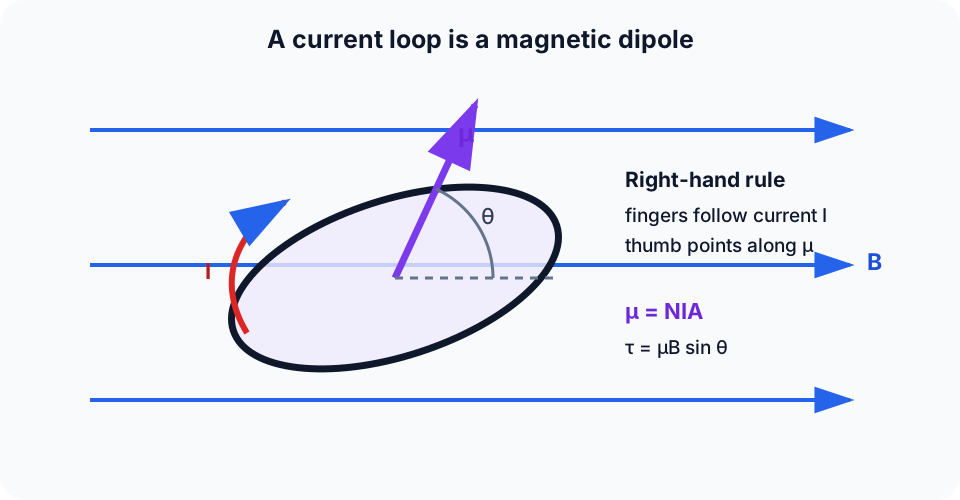
- Magnetic dipole moment vector, vector μ: direction is given by the right-hand rule (curl fingers with current; thumb points along vector μ).
- Torque on a magnetic dipole in a uniform magnetic field (magnitude): τ = μ B sin θ where θ is the angle between vector μ and vector B.
- Potential energy of a magnetic dipole in a uniform field: U = - vector μ · vector B = -μ B cos θ
- Symbols used in this lesson: I (A), A (m²), μ (A m²), vector B (T), τ (N m), U (J), θ (rad).
2. Key Ideas (What Earns Marks)
- A current loop in a uniform vector B experiences a torque that tends to align vector μ with vector B.
- Stable equilibrium is aligned (θ = 0), unstable is anti-aligned (θ = π).
- The analogy with electric dipoles is strong for torque and energy, but the model has no isolated magnetic charges: magnetic field lines form closed loops.
Quick comparison (uniform fields):
| Dipole type | Dipole moment | Torque magnitude | Potential energy |
|---|---|---|---|
| Electric | p = qd | τ = pE sin θ | U = -pE cos θ |
| Magnetic | μ = IA | τ = μ B sin θ | U = -μ B cos θ |
3. Detailed Explanations
A. Why a current loop has a dipole moment
Currents in a loop produce a magnetic field pattern similar (at distances large compared to loop size) to the field of a magnetic dipole. The loop is therefore characterised by a single vector vector μ with magnitude μ = IA.
B. Torque and potential energy in uniform fields
In a uniform field, the dipole experiences: τ = μ B sin θ and potential energy: U(θ) = -μ B cos θ
Energy picture:
- θ = 0 ⇒ Uₘᵢₙ = -μ B (stable),
- θ = π ⇒ Uₘₐₓ = +μ B (unstable).
C. The key limitation of the analogy (no monopoles)
Electric dipoles are made of + q and -q, so isolated charges exist. For magnetism at this level, there is no evidence of isolated “north” or “south” poles acting as monopoles; instead: ∮ vector B · d vector A = 0 and magnetic field lines do not begin or end.
4. Common Mistakes
- Mixing up symbols: μ (dipole moment) vs μ₀ (vacuum permeability).
- Using μ = I/A (wrong); it is μ = IA.
- Forgetting the right-hand rule direction for vector μ.
- Dropping the sin θ in torque or the minus sign in energy.
5. Exam Tips
- Sketch the loop and use the right-hand rule to label vector μ.
- Use torque for “turning” questions, energy for “stable/unstable” and “work done to rotate”.
- When asked about analogy limits, mention “no magnetic monopoles / field lines form closed loops”.
6. Worked Examples
Modelled example 1
Magnetic dipole moment of a loop
Problem
Study the worked solution
Find loop area
Method
A = 7.9 × 10⁻³ m².Reason
The dipole relation uses area, not radius.Working
A = π r² = π(0.050)² = 7.9 × 10⁻³ m²Apply the dipole relation
Method
μ = 6.3 × 10⁻³ A m².Reason
For a single-turn loop, μ = IA.Working
μ = (0.80)(7.9 × 10⁻³) = 6.3 × 10⁻³ A m²
Guided practice 2
Torque in a uniform magnetic field
Problem
Try this before viewing the solution
Hints
Hint 1: identify the angle
Hint 2: choose the relation
View solution step by step
Choose the torque relation
Method
τ = μ B sin θ.Reason
Torque is the turning effect in a uniform magnetic field.Working
τ = μ B sin 60°Evaluate
Method
τ = 1.0 × 10⁻² N m.Reason
All quantities are already in SI units.Working
τ = (3.0 × 10⁻²)(0.40) sin 60° = 1.0 × 10⁻² N m
Common misconception 3
Potential energy difference
Learner claim
Try this before viewing the solution
View solution step by step
Find initial energy
Method
Uᵢ = -0.12 J.Reason
U = -μ B cos θ and cos 0° = 1.Working
Uᵢ = -0.12 cos 0° = -0.12 JFind final energy
Method
U_f = 0.Reason
cos 90° = 0.Working
U_f = -0.12 cos 90° = 0Use final minus initial
Method
Δ U = +0.12 J.Reason
Energy change is defined as U_f-Uᵢ.Working
Δ U = 0-(-0.12) = +0.12 J
Examiner practice 4
Required current for a target dipole moment
Examination question
Try this before viewing the solution
View solution step by step
State the relation
1 markMethod
μ = IA for a single-turn loop.Reason
The loop has one turn, so no factor of N is needed.Working
μ = IARearrange and substitute
1 markMethod
I = μ/A.Reason
Current is the required unknown.Working
I = (1.0 × 10⁻²)/(2.5 × 10⁻³)Report the current
1 markMethod
I = 4.0 A.Reason
The ratio has units of amperes.Working
I = 4.0 A
Self-mark with the mark scheme
Compare your response with each mark point. Select a point only when your response contains that evidence.
Self-mark the relation, rearrangement/substitution and final current.
Challenge 5
Earth’s field torque (order-of-magnitude)
Independent transfer
Try this before viewing the solution
Hints
Hint 1: use the angular factor
View solution step by step
Use the perpendicular orientation
Method
sin 90° = 1.Reason
This is the largest possible value of the angular factor.Working
τₘₐₓ = μ BCalculate
Method
τ = 1.0 × 10⁻⁶ N m.Reason
The microtesla field has already been converted to tesla.Working
τ = (0.020)(5.0 × 10⁻⁵) = 1.0 × 10⁻⁶ N mInterpret
Method
The loop experiences a small but maximum-magnitude aligning torque at this angle.Reason
Torque is greatest when vector μ is perpendicular to vector B.Working
τ = μ B sin θ
7. Mind Stretchers
Mind stretcher 1: Why “north” and “south” can’t be separated (classical picture)Extension
If you cut a bar magnet in half, do you get an isolated north pole and an isolated south pole? What do you actually get, and how does this connect to Gauss’s law for magnetism?
Answer
You get two smaller magnets, each with both a north and south pole. This is consistent with ∮ vector B · d vector A = 0: magnetic field lines form closed loops and there are no monopoles in this model.
Mind stretcher 2: Why a dipole can be pulled into a strong-field regionExtension
A small bar magnet is attracted to a region of stronger magnetic field (e.g. near a magnet’s pole). Explain qualitatively why this is possible even if the magnet is already aligned (so the torque is near zero).
Answer
Even when aligned (small torque), a dipole in a non-uniform field can experience a net force because its potential energy U ≈ -μ B depends on position through B. The system tends to move toward lower potential energy, i.e. toward regions of larger B when aligned.
8. Optional/Enrichment: Force on a Dipole in a Non-uniform Field
In a non-uniform field, a dipole can experience a net force (basis of attraction to strong-field regions). This is beyond the uniform-field torque/energy learning outcomes unless the question provides the necessary field variation details.
Next step
Return to the Electric and Magnetic Fields hub for mixed revision, then continue to RLC Circuits.
Continue with the next resource in this course.
Course and syllabus information
- Course
- GCE A-Level H3 Physics
- Edition
- GCE A-Level H3 Physics 2027