Collision Problems in Centre of Mass Frame
Key idea: Solve 1D collision questions faster using the centre of mass frame: transform, apply elastic/inelastic rules in COM, then transform back.
Continue where you stopped
The core idea
On this page
Learning objectives
- state that a frame of reference is a set of coordinates that can be used to determine positions and times of events in that frame
- show an understanding that Newton’s laws of motion are obeyed in all inertial frames of reference
- recall and apply the Galilean transformation equations to solve problems relating observations in different inertial frames of reference
- show an understanding that the centre of mass frame (or zero momentum frame) is the inertial frame in which the total linear momentum of the system is zero
- solve one-dimensional collision problems by considering velocities relative to the centre of mass of the system (i.e. in the zero-momentum frame)
Solving 1D collisions in the centre of mass (COM) frame often turns a messy algebra problem into a symmetry problem. In the COM frame, the total momentum is zero, which gives you a strong constraint before and after the collision.
1. Definitions (Must Know)
- Total momentum (1D): Pₜₒₜ = ∑ mᵢ vᵢ (kg m s⁻¹).
- COM velocity (1D): V_cm = (∑ mᵢ vᵢ)/(∑ mᵢ)
- COM-frame velocity: vᵢ' = vᵢ - V_cm.
- COM frame / zero-momentum frame: the inertial frame where Pₜₒₜ' = 0.
- Perfectly elastic (1D): total momentum and total kinetic energy are conserved.
- Completely inelastic: objects stick together and move with the same final velocity.
- Kinetic energy: K = (1/2)mv² (J).
Prerequisite: 1D momentum conservation from H2/H3 foundations:
2. Key Ideas (What Earns Marks)
- Transforming to the COM frame does not change relative velocities: (v₂-v₁) = (v₂'-v₁')
- In the COM frame, total momentum is zero both before and after: P'_before = P'_after = 0.
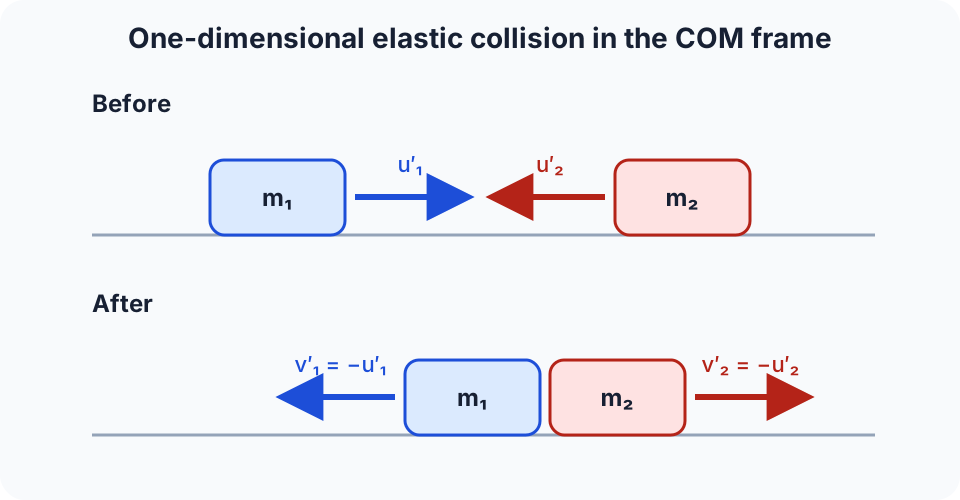
- For a perfectly elastic 1D collision, the COM-frame velocities simply reverse: v₁' = -u₁', v₂' = -u₂'
- After solving in COM, convert back to the lab frame: vᵢ = vᵢ' + V_cm
Quick comparison (1D, COM frame viewpoint):
| Collision type | What happens in COM frame | What you do |
|---|---|---|
| Perfectly elastic | Speeds keep same magnitudes, directions reverse | v₁' = -u₁', v₂' = -u₂' |
| Completely inelastic (stick) | Both end with the same velocity (often 0 in COM) | Set final COM velocities equal, then transform back |
3. Detailed Explanations
A. Workflow (the COM-frame method)
- Choose a sign convention (e.g. right is +).
- Compute the COM velocity: V_cm = (m₁u₁ + m₂u₂)/(m₁ + m₂)
- Transform each initial velocity into the COM frame using uᵢ' = uᵢ-V_cm.
- Apply the collision rule in the COM frame (elastic: reverse; stick: common velocity).
- Transform each result back using vᵢ = vᵢ' + V_cm.
B. Why elastic collisions are so simple in the COM frame (1D)
In the COM frame, the total momentum is zero both before and after the collision. For a perfectly elastic collision, kinetic energy is also conserved. In 1D, that forces the magnitudes of the velocities to stay the same, but the objects must separate (swap directions), giving: v₁' = -u₁', v₂' = -u₂'
4. Common Mistakes
- Mixing lab and COM symbols (keep primes for COM-frame quantities).
- Sign errors when finding V_cm (use signed velocities).
- Forgetting the final step: transforming back with vᵢ = vᵢ' + V_cm.
- Assuming “elastic” without it being stated or justified.
5. Exam Tips
- Do a quick check in the COM frame: m₁u₁' + m₂u₂' should equal 0 (within rounding).
- For perfectly elastic collisions, reversal in COM is usually the fastest route.
- Sanity check after transforming back:
- if m₁ ≫ m₂, the heavier object’s speed should change less.
6. Worked Examples
Modelled example 1
Perfectly elastic collision (COM frame shortcut)
Problem
Study the worked solution
Find the COM speed
Method
V_cm = 5/3 = 1.67 m s⁻¹.Reason
It is the total signed momentum divided by total mass.Working
V_cm = ((2)(3) + (1)(-1))/3 = 5/3Transform incoming velocities
Method
u'₁ = 4/3 and u'₂ = -8/3 m s⁻¹.Reason
Subtract V_cm from each lab velocity.Working
u'₁ = 3-5/3 = 4/3, u'₂ = -1-5/3 = -8/3Use elastic reversal
Method
v'₁ = -4/3 and v'₂ = +8/3 m s⁻¹.Reason
In a one-dimensional elastic collision, each COM-frame velocity reverses.Working
v'ᵢ = -u'ᵢTransform back
Method
v₁ = 0.33 and v₂ = 4.33 m s⁻¹.Reason
Add the same COM velocity to both outgoing primed velocities.Working
v₁ = -4/3 + 5/3 = 1/3, v₂ = 8/3 + 5/3 = 13/3
Guided practice 2
Completely inelastic collision (objects stick)
Problem
Try this before viewing the solution
Hints
Hint 1: use the COM interpretation
Hint 2: calculate that frame speed
View solution step by step
Find total momentum
Method
Pₜₒₜ = +2.0 kg m s⁻¹.Reason
The incoming momenta oppose.Working
Pₜₒₜ = (2)(4) + (3)(-2) = 2Find COM velocity
Method
V_cm = +0.40 m s⁻¹.Reason
Total mass is 5.0 kg.Working
V_cm = 2.0/5.0 = 0.40 m s⁻¹Apply sticking condition
Method
The common lab velocity is + 0.40 m s⁻¹.Reason
After sticking, both objects are stationary in the COM frame.Working
v = V_cm
Common misconception 3
Elastic collision with a target initially at rest
Learner claim
Try this before viewing the solution
View solution step by step
Find COM velocity
Method
V_cm = 2.0 m s⁻¹.Reason
The initial total momentum is 6.0 kg m s⁻¹ and mass is 3.0 kg.Working
V_cm = 6.0/3.0 = 2.0Transform then reverse
Method
u'₁ = +4.0, u'₂ = -2.0, so v'₁ = -4.0, v'₂ = +2.0 m s⁻¹.Reason
Elastic reversal is a COM-frame symmetry.Working
v'ᵢ = -u'ᵢReturn to the lab
Method
v₁ = -2.0 and v₂ = +4.0 m s⁻¹.Reason
Add V_cm = 2.0 m s⁻¹ to both primed velocities.Working
v₁ = -4.0 + 2.0 = -2.0, v₂ = 2.0 + 2.0 = 4.0
Examiner practice 4
Using COM to explain the “relative speed” rule for elastic collisions
Examination question
Try this before viewing the solution
View solution step by step
Approach speed
1 markMethod
The relative speed of approach is 6.0 m s⁻¹.Reason
Before collision, use u₁-u₂ for this ordering.Working
u₁-u₂ = 6.0-0 = 6.0Separation speed
1 markMethod
The relative speed of separation is 6.0 m s⁻¹.Reason
After collision, use v₂-v₁.Working
v₂-v₁ = 4.0-(-2.0) = 6.0COM explanation
2 marksMethod
The relative velocity reverses but keeps its magnitude.Reason
Each object’s COM-frame velocity reverses in a one-dimensional elastic collision, and subtracting the common frame speed does not change relative velocity.Working
v'₂-v'₁ = -(u'₂-u'₁)
Self-mark with the mark scheme
Compare your response with each mark point. Select a point only when your response contains that evidence.
Self-mark both relative speeds and the COM-frame explanation.
Challenge 5
Kinetic energy loss in a completely inelastic collision
Independent transfer
Try this before viewing the solution
Hints
Hint 1: energy uses speed squared
View solution step by step
Initial kinetic energy
Method
Kᵢ = 22 J.Reason
Kinetic energies add and are non-negative despite opposite velocity directions.Working
Kᵢ = (1/2)(2)(4²) + (1/2)(3)(2²) = 16 + 6 = 22 JFinal kinetic energy
Method
K_f = 0.40 J.Reason
The stuck objects move as a combined 5.0 kg mass.Working
K_f = (1/2)(5.0)(0.40²) = 0.40 JEnergy lost
Method
21.6 J of kinetic energy is lost.Reason
Loss is initial minus final kinetic energy.Working
Kₗₒₛₜ = 22-0.40 = 21.6 J
7. Mind Stretchers
Mind stretcher 1: When is the COM method worth it?Extension
Compare two methods for a perfectly elastic 1D collision:
- lab-frame: momentum + relative-speed rule, and
- COM-frame: transform → reverse → transform back.
When (in terms of algebra complexity) does the COM method feel simpler?
One reasonable answer
When the lab-frame equations would force you into simultaneous equations with multiple unknowns, the COM method can reduce the “collision physics” step to a one-line reversal and push the algebra into the (usually simpler) frame transforms.
Mind stretcher 2: Extreme mass ratio intuitionExtension
For a perfectly elastic 1D collision where m₁ ≫ m₂ and m₂ is initially at rest, what qualitative outcome should you expect for the speeds after the collision?
A good qualitative answer
You expect m₁ to continue forwards with almost the same speed, while the initially stationary light mass m₂ moves forwards at almost twice m₁‘s initial speed. In the limit m₁/m₂ → ∞, the exact elastic-collision results give v₁ → u₁ and v₂ → 2u₁. The light object does not rebound in this stated setup.
8. Optional/Enrichment: Partial Restitution (If Given)
If a question gives a coefficient of restitution e, you can still use the COM method, but the COM-frame “reversal” becomes “rebound with reduced relative speed”. This is beyond what you need unless e is explicitly provided.
See: Elastic & Inelastic Collisions
Next step
Return to the Frames of Reference hub. Then continue to Rotational Motion, or revisit the Centre of Mass Frame if the zero-momentum check is not yet automatic.
Continue with the next resource in this course.
Course and syllabus information
- Course
- GCE A-Level H3 Physics
- Edition
- GCE A-Level H3 Physics 2027