Centre of Mass Frame
Key idea: Learn how to compute the COM velocity, transform into the zero-momentum frame, and use COM symmetry to simplify collision questions.
Continue where you stopped
The core idea
On this page
Learning objectives
- show an understanding that the centre of mass frame (or zero momentum frame) is the inertial frame in which the total linear momentum of the system is zero
- solve one-dimensional collision problems by considering velocities relative to the centre of mass of the system (i.e. in the zero-momentum frame)
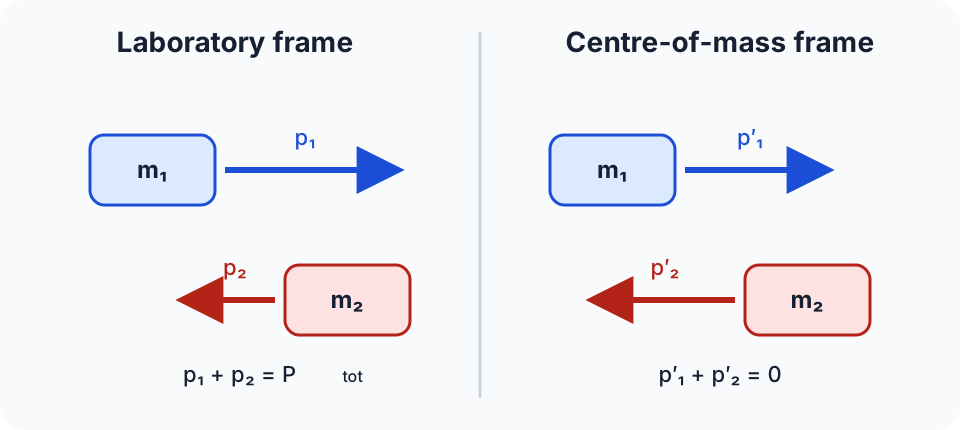
The centre of mass (COM) frame (also called the zero-momentum frame) is an inertial frame where the total linear momentum of the system is zero. It’s a powerful tool for simplifying 1D collision questions in H3.
1. Definitions (Must Know)
- Centre of mass (COM): The point that moves as if all the system’s mass were concentrated there for translational motion.
- COM velocity, vector V_cm (m s⁻¹):
vector V_cm = (∑ mᵢ vector vᵢ)/(∑ mᵢ)
- Total momentum, vector Pₜₒₜ (kg m s⁻¹): vector Pₜₒₜ = ∑ mᵢ vector vᵢ.
- Centre of mass frame / zero-momentum frame: The inertial frame moving at velocity vector V_cm relative to the lab frame, so that vector Pₜₒₜ' = 0.
- Velocity in COM frame: vector vᵢ' = vector vᵢ- vector V_cm (Galilean transformation).
- Symbols used in this lesson: m mass (kg), vector v velocity (m s⁻¹), vector V_cm COM velocity (m s⁻¹), vector P momentum (kg m s⁻¹).
2. Key Ideas (What Earns Marks)
- The COM frame is defined by a single condition: total momentum is zero in that frame.
- vector Pₜₒₜ = M vector V_cm where M = ∑ mᵢ (total mass). This lets you find vector V_cm quickly.
- For a two-body system in 1D, the COM-frame momenta are equal and opposite: m₁v₁' = -m₂v₂'. The objects therefore move in opposite directions, with the heavier object moving more slowly in magnitude.
- Collision problems often become symmetric in the COM frame, then you transform back to the lab frame.
Quick comparison:
| Quantity/idea | Lab frame | COM frame |
|---|---|---|
| Total momentum | Pₜₒₜ can be non-zero | Pₜₒₜ' = 0 by definition |
| Typical pattern (2-body, 1D) | Asymmetric speeds | Opposite directions, mass-weighted speeds |
| Why it helps | Direct algebra in unknowns | Use symmetry/constraints, then transform back |
3. Detailed Explanations
A. Why the COM frame has zero total momentum
Start with: vector V_cm = (∑ mᵢ vector vᵢ)/(∑ mᵢ) Let M = ∑ mᵢ. Then: ∑ mᵢ vector vᵢ = M vector V_cm That is: vector Pₜₒₜ = M vector V_cm
Now move to a frame travelling at vector V_cm (Galilean transformation): vector vᵢ' = vector vᵢ- vector V_cm So the total momentum in the COM frame is:
B. Two-body intuition (1D)
In the COM frame for two objects: m₁ v₁' + m₂ v₂' = 0 So they must move in opposite directions, with the heavier object moving more slowly in magnitude.
4. Common Mistakes
- Using COM position formulas when the question is about the COM frame (momentum/velocity).
- Forgetting that vector V_cm is a vector (sign matters in 1D).
- Computing vector V_cm using speeds instead of signed velocities.
- Transforming one velocity but forgetting to transform the others with the same vector V_cm.
5. Exam Tips
- Write the workflow explicitly:
- Choose + direction, list mᵢ and vᵢ (with signs).
- Compute V_cm = (∑ mᵢ vᵢ)/(∑ mᵢ).
- Convert to COM frame using vᵢ' = vᵢ - V_cm.
- Use the simplification in COM frame, then convert back.
- Always include units: V_cm in m s⁻¹, momentum in kg m s⁻¹.
- Quick check: after transforming, verify ∑ mᵢ vᵢ' = 0 (in 1D) to catch sign errors.
6. Worked Examples
Modelled example 1
Finding the COM velocity and COM-frame velocities (1D)
Problem
Study the worked solution
Find total momentum and mass
Method
Pₜₒₜ = 5.0 kg m s⁻¹ and M = 3.0 kg.Reason
Momentum components retain their direction signs.Working
Pₜₒₜ = (2.0)(3.0) + (1.0)(-1.0) = 5.0Find COM velocity
Method
V_cm = 1.67 m s⁻¹.Reason
The COM velocity is total momentum divided by total mass.Working
V_cm = 5.0/3.0 = 1.67 m s⁻¹Transform both velocities
Method
v'₁ = 1.33 m s⁻¹ and v'₂ = -2.67 m s⁻¹.Reason
Subtract the same frame velocity from each lab velocity.Working
v'₁ = 3.0-1.67 = 1.33, v'₂ = -1.0-1.67 = -2.67 m s⁻¹Check zero momentum
Method
The COM-frame momenta cancel.Reason
The defining property of the COM frame is zero total momentum.Working
(2.0)(1.33) + (1.0)(-2.67) ≈ 0
Guided practice 2
Recognising the COM frame from momentum
Problem
Try this before viewing the solution
Hints
Hint 1: use the system quantities
Hint 2: form the ratio
View solution step by step
Use the system relation
Method
V_cm = Pₜₒₜ/M.Reason
Total momentum equals total mass times COM velocity.Working
Pₜₒₜ = MV_cmEvaluate
Method
V_cm = 4.0 m s⁻¹.Reason
The positive momentum sets the positive direction.Working
V_cm = 12/3.0 = 4.0 m s⁻¹
Common misconception 3
COM velocity for three objects (1D)
Learner claim
Try this before viewing the solution
View solution step by step
Sum signed momentum
Method
Pₜₒₜ = 3.0 kg m s⁻¹.Reason
The second cart’s negative velocity gives negative momentum.Working
Pₜₒₜ = (1.0)(4.0) + (2.0)(-2.0) + (3.0)(1.0) = 3.0Sum mass
Method
M = 6.0 kg.Reason
Mass is scalar and all masses add positively.Working
M = 1.0 + 2.0 + 3.0 = 6.0 kgCalculate COM velocity
Method
V_cm = +0.50 m s⁻¹.Reason
Divide signed total momentum by total mass.Working
V_cm = 3.0/6.0 = 0.50 m s⁻¹
Examiner practice 4
Transforming into the COM frame (and checking P'ₜₒₜ = 0)
Examination question
Try this before viewing the solution
View solution step by step
Transform cart 1
1 markMethod
v'₁ = 3.50 m s⁻¹.Reason
Subtract V_cm from the lab velocity.Working
v'₁ = 4.0-0.50 = 3.50Transform cart 2
1 markMethod
v'₂ = -2.50 m s⁻¹.Reason
The negative lab velocity becomes more negative after subtracting + 0.50.Working
v'₂ = -2.0-0.50 = -2.50Transform cart 3
1 markMethod
v'₃ = 0.50 m s⁻¹.Reason
Apply the same boost.Working
v'₃ = 1.0-0.50 = 0.50Verify momentum
2 marksMethod
P'ₜₒₜ = 0.Reason
The transformed mass-weighted velocities cancel.Working
P'ₜₒₜ = (1.0)(3.50) + (2.0)(-2.50) + (3.0)(0.50) = 0
Self-mark with the mark scheme
Compare your response with each mark point. Select a point only when your response contains that evidence.
Self-mark the three velocities and the substituted zero-momentum verification.
Challenge 5
Converting COM-frame velocities back to the lab
Independent transfer
Try this before viewing the solution
Hints
Hint 1: invert the boost
View solution step by step
Invert the transform
Method
vᵢ = v'ᵢ + V_cm.Reason
Returning to the lab adds the COM frame velocity.Working
vᵢ = v'ᵢ + V_cmRecover both velocities
Method
v₁ = +3.0 m s⁻¹ and v₂ = -3.0 m s⁻¹.Reason
Add + 1.0 m s⁻¹ to each COM-frame velocity.Working
v₁ = 2.0 + 1.0 = 3.0, v₂ = -4.0 + 1.0 = -3.0 m s⁻¹
7. Mind Stretchers
Mind stretcher 1: When is the lab frame already the COM frame?Extension
Give a condition on the initial velocities for a two-body system (1D) so that the lab frame is the COM frame.
Answer
The lab frame is the COM frame when Pₜₒₜ = 0, i.e. m₁v₁ + m₂v₂ = 0.
Mind stretcher 2: How does V_cm change when you change frames?Extension
An observer changes from lab frame S to another inertial frame S' moving at speed u along + x relative to S. How does the COM velocity transform?
Answer
Velocities transform as vᵢ' = vᵢ - u. Then: V_cm' = (∑ mᵢ vᵢ')/(∑ mᵢ) = (∑ mᵢ(vᵢ-u))/(∑ mᵢ) = (∑ mᵢ vᵢ)/(∑ mᵢ)-u = V_cm-u
8. Optional/Enrichment: Beyond 1D
Everything here generalises to 2D/3D by using vectors: vector V_cm = (∑ mᵢ vector vᵢ)/(∑ mᵢ) and transforming each velocity by vector vᵢ' = vector vᵢ- vector V_cm.
Next step
Return to the Frames of Reference hub, or apply this zero-momentum condition in Collision Problems in the COM Frame.
Continue with the next resource in this course.
Course and syllabus information
- Course
- GCE A-Level H3 Physics
- Edition
- GCE A-Level H3 Physics 2027