Galilean Transformation Equation
Key idea: Learn Galilean transformations for position and velocity, identify what stays invariant between inertial frames, and practise exam-style frame-conversion questions.
Continue where you stopped
The core idea
On this page
Learning objectives
- recall and apply the Galilean transformation equations to solve problems relating observations in different inertial frames of reference
Galilean transformations relate how positions, times, and velocities are described in two inertial frames moving at constant relative speed. This is the mathematical backbone of “no preferred inertial frame” in Newtonian mechanics.
1. Definitions (Must Know)
- Inertial frames: Frames moving at constant velocity relative to each other (no relative acceleration).
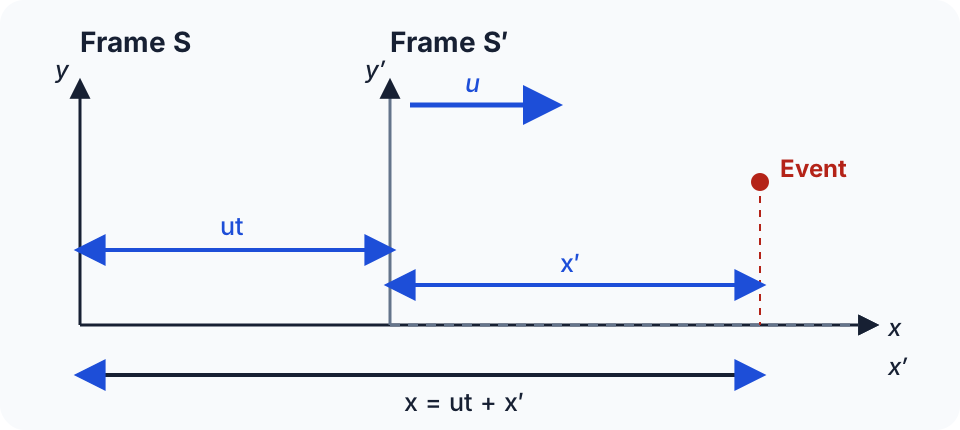
- Standard setup: Frame S' moves at constant speed u relative to S along the + x direction.
- Galilean transformation (1D):
x' = x - ut; t' = t
- 3D extension: y' = y, z' = z (if relative motion is along x only).
- Validity: Classical regime u ≪ c and speeds in the problem ≪ c.
- Symbols used in this lesson: u relative speed (m s⁻¹), v velocity (m s⁻¹), a acceleration (m s⁻²), c speed of light (≈ 3.00 × 10⁸ m s⁻¹).
Summary table (1D, S' moves at + u relative to S):
| Quantity | Transformation | What to remember |
|---|---|---|
| Position | x' = x - ut | Same event, different origin |
| Time | t' = t | “Absolute time” (classical) |
| Velocity | vₓ' = vₓ - u | Be consistent with signs |
| Acceleration | aₓ' = aₓ | Key reason Newton’s laws match |
2. Key Ideas (What Earns Marks)
- A Galilean transformation is just a shift of origin moving at constant speed: same time, different x coordinate.
- Between inertial frames: acceleration is invariant (a' = a), so Newton’s second law keeps its form.
- Velocities add/subtract linearly: vₓ = v'ₓ + u (watch the sign convention).
3. Detailed Explanations
A. Deriving the coordinate transformation
At t = 0, let the origins coincide. After time t, the origin of S' has moved a distance ut in S.
So if an event has coordinate x in S, then relative to the moving origin: x' = x - ut Galilean relativity assumes the same time coordinate: t' = t
B. Transforming velocity and acceleration (why Newton’s laws match)
Differentiate x' = x - ut with respect to t:
So a' = a. If the net real force is the same physical interaction in both frames, then: ∑ F = ma ⇒ ∑ F = ma'
C. The (Galilean) velocity addition rule
Rearrange v'ₓ = vₓ - u: vₓ = v'ₓ + u Interpretation: “velocity in S = velocity relative to S' + velocity of S' relative to S”.
4. Common Mistakes
- Mixing up which frame is moving: define clearly whether S' moves at + u relative to S or vice versa.
- Sign errors: if S' moves in + x, then x' = x - ut (not x + ut).
- Forgetting that Galilean transformations assume absolute time (t' = t).
- Using Galilean velocity addition for light or other relativistic situations (use the H3 special relativity results instead).
5. Exam Tips
- Start by writing your frame statement: “Let S' move at speed u along + x relative to S.”
- Quote the transformation before doing any algebra:
x' = x - ut, t' = t
- For data/word problems, draw a quick axis and label + x to keep the sign consistent.
6. Worked Examples
Modelled example 1
Transforming an event coordinate
Problem
Study the worked solution
Fix the frame convention
Method
S' moves in the positive direction relative to S.Reason
With coincident origins at t = 0, its origin is at x = ut in S.Working
x' = x-utTransform the coordinate
Method
x' = 5.0 m.Reason
Subtract the displacement of the moving origin from the S coordinate.Working
x' = 20-(5.0)(3.0) = 5.0 m
Guided practice 2
Velocity seen in a second inertial frame
Problem
Try this before viewing the solution
Hints
Hint 1: interpret both motions
Hint 2: choose the sign
View solution step by step
Select the inverse transform
Method
vₓ = v'ₓ + u.Reason
Both stated velocities point along + x.Working
vₓ = v'ₓ + uEvaluate
Method
vₓ = 7.0 m s⁻¹.Reason
Add the cart’s velocity relative to S' to the frame velocity.Working
vₓ = 2.0 + 5.0 = 7.0 m s⁻¹
Common misconception 3
Acceleration is invariant (quick check)
Learner claim
Try this before viewing the solution
View solution step by step
Transform velocity
Method
v'ₓ = 2.0-2.0t m s⁻¹.Reason
The moving-frame velocity is v'ₓ = vₓ-u.Working
v'ₓ = (5.0-2.0t)-3.0 = 2.0-2.0tDifferentiate
Method
a'ₓ = -2.0 m s⁻².Reason
The derivative of the constant frame speed is zero.Working
a'ₓ = dv'ₓ/dt = -2.0 m s⁻²Correct the claim
Method
Velocity is frame-dependent, while acceleration is invariant between these inertial frames.Reason
A Galilean boost subtracts a constant velocity.Working
v'ₓ ≠ vₓ, a'ₓ = aₓ
Examiner practice 4
Transforming an equation of motion
Examination question
Try this before viewing the solution
View solution step by step
State the transformation
1 markMethod
x' = x-ut.Reason
The origins coincide at t = 0 and S' moves along + x.Working
x' = x-utSubstitute the motion
1 markMethod
Insert both x(t) and u.Reason
The transform applies at the same Newtonian time t' = t.Working
x' = (2.0 + 4.0t-t²)-(3.0)tSimplify
1 markMethod
x' = 2.0 + 1.0t-t².Reason
Only the coefficient of the linear term changes.Working
x' = 2.0 + 1.0t-t²
Self-mark with the mark scheme
Compare your response with each mark point. Select a point only when your response contains that evidence.
Self-mark the transform, substitution and simplified expression.
Challenge 5
Choosing a frame where an object is at rest
Independent transfer
Try this before viewing the solution
Hints
Hint 1: translate at rest
View solution step by step
Set the target condition
Method
v'ₓ = 0.Reason
The cart must have no velocity in its rest frame.Working
0 = vₓ-uSolve for frame motion
Method
u = +10.0 m s⁻¹.Reason
The frame must move alongside the cart with the same velocity.Working
u = vₓ = +10.0 m s⁻¹
7. Mind Stretchers
Mind stretcher 1: Two different “straight-line” paths can both be correctExtension
In S', a ball is thrown straight up and lands back in the thrower’s hand. Explain (without new forces) why an observer in S can see a parabolic path and still agree with Newton’s laws.
One way to phrase it
The vertical motion is identical in both frames because the vertical forces are the same. The horizontal motion differs because the ball has an extra constant horizontal velocity u in S, so combining “constant horizontal velocity” with “constant vertical acceleration” produces a parabola.
Mind stretcher 2: Why kinetic energy is frame-dependent (but physics is consistent)Extension
Two inertial observers measure different speeds for the same object, so they compute different kinetic energies. Does this mean energy conservation “depends on the frame”?
What to say in an exam
Kinetic energy depends on the frame because it depends on speed, and speeds change under v' = v-u. However, energy conservation is still consistent when you include the full system and apply the work–energy idea correctly within each frame (and account for which parts are doing work in that frame). Different frames can assign different numerical kinetic energies while still agreeing on the underlying dynamics.
8. Optional/Enrichment: Why Galilean Transformations Fail for Light
Galilean velocity addition would predict that a light pulse has speed c ± u in different inertial frames, but the H3 syllabus requires that the measured speed in vacuum is c for all inertial observers. This motivates special relativity:
Next step
Return to the Frames of Reference hub, or continue in sequence to the Centre of Mass Frame, where the same velocity transformation selects the zero-momentum frame.
Continue with the next resource in this course.
Course and syllabus information
- Course
- GCE A-Level H3 Physics
- Edition
- GCE A-Level H3 Physics 2027