Michelson-Morley Experiment
Key idea: Understand the Michelson–Morley null result, what it implies about the ether idea, and how it supports the special relativity postulates.
Continue where you stopped
The core idea
On this page
Learning objectives
- discuss qualitatively the results of the Michelson–Morley interferometer experiment and its implications on the ether theory (knowledge of the details of the experiment is not required)
- state the postulates of the special theory of relativity, that in all inertial frames, the laws of physics are the same and the speed of light in free space is the same regardless of the motion of the light source or observer
- appreciate the failure of Galilean transformation equations when applied to a moving source of light
- discuss the concept of simultaneity
- show an understanding of the terms proper time and proper length
- apply the Lorentz transformation equations to solve one-dimensional problems
- Derive the time dilation formula and the length contraction formula, making use of the Lorentz factor.
- apply the time dilation formula and the length contraction formula in related situations (e.g. the lifetime of fast-moving muons) or to solve problems
- use the one-dimensional relativistic velocity addition formula to calculate velocities in different inertial frames or to solve problems
- Apply the relativistic energy–momentum relation E² = (pc)² + (mc²)² to solve problems, including selecting its limiting form.
- Show that E² = (pc)² + (mc²)² reduces to E = pc for massless particles and to E = mc² + ½mv² at low speeds.
The Michelson–Morley experiment matters in H3 because it provides a famous null result that is inconsistent with a simple “ether wind” model and is consistent with Einstein’s special relativity postulates (universal c in inertial frames).
Use this page as the evidence-first entry point, then move immediately into Postulates of Relativity for the formal model.
1. Definitions (Must Know)
- Ether (historical): a proposed medium that fills space and defines an absolute “rest frame” for light.
- Ether wind: the apparent flow of ether past Earth if Earth moves through the ether.
- Interferometer: an instrument that splits light into two paths and recombines them to produce interference fringes.
- Fringe shift: a change in the interference pattern that would indicate a change in relative travel times along the two arms.
- Null result: observing no measurable change where a non-zero change was expected.
2. Key Ideas (What Earns Marks)
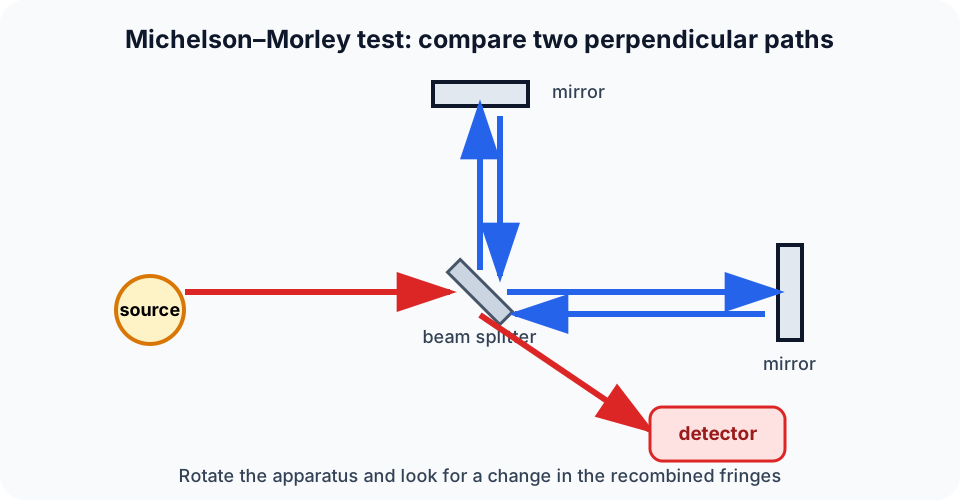
- If an ether rest frame existed, Earth’s motion could make the measured light travel time depend on direction (parallel vs perpendicular to the ether wind).
- Rotating the apparatus should then change the interference pattern (a fringe shift).
- Michelson–Morley saw no fringe shift of the expected size (null result), undermining the simplest ether-wind picture.
Expected vs observed (qualitative):
| If an “ether wind” exists (simple model) | Michelson–Morley observed |
|---|---|
| Light travel times differ by direction | No detectable difference (at expected sensitivity) |
| Rotating the apparatus changes fringes | No expected fringe shift |
3. Detailed Explanations
A. What the experiment tries to do (one sentence)
Compare the light travel times along two perpendicular arms and look for a change when the instrument is rotated relative to Earth’s motion.
B. What the null result implies (H3-safe)
The null result means there is no evidence for an ether wind in the simple model where light speed would differ by direction due to motion through a medium.
C. Link to special relativity (what you should say)
In H3, you connect this to Einstein’s postulates:
4. Common Mistakes
- Saying “Michelson–Morley proved special relativity” (it did not; it supports the postulates by ruling out a simple ether-wind model).
- Forgetting to mention “null result” and what it rules out.
- Writing about “signal delay” rather than the experiment’s aim (direction-dependent travel times).
5. Exam Tips
- Use a 2-line mark-scheme-safe core:
- “They looked for an interference fringe shift when rotating the interferometer.”
- “No expected shift was observed (null result), contradicting a simple ether wind model and motivating Einstein’s postulates.”
- If asked “implication”, say “no detectable ether rest frame / no evidence for ether wind”.
6. Worked Examples
Modelled example 1
State the result and implication (1–2 sentences)
Problem
Study the worked solution
State the observation
Method
No fringe shift of the expected size was detected when the apparatus was rotated.Reason
This is the experiment’s null result.Working
Δ N_observed ≈ 0 at the predicted sensitivityDraw the bounded inference
Method
The result gives no evidence for the direction-dependent travel times predicted by the simple ether-wind model.Reason
A preferred ether rest frame should have made rotation change the relative travel times.Working
null result ⇒ simple ether-wind prediction unsupported
Guided practice 2
What would a fringe shift have meant? (concept)
Problem
Try this before viewing the solution
Hints
Hint 1: trace the optical cause
Hint 2: connect to rotation
View solution step by step
Interpret the fringes
Method
A shift would show that the two beams’ relative travel time changed.Reason
Fringe position depends on their phase difference when they recombine.Working
Δ t changes ⇒ Δφ changesInterpret the rotation
Method
The change would suggest direction-dependent light travel times relative to Earth’s motion.Reason
That is the qualitative prediction of a simple ether wind and preferred frame.Working
t_∥ ≠ t_⊥
Common misconception 3
Is “no fringe shift” the same as “no motion”? (concept)
Learner claim
Try this before viewing the solution
View solution step by step
Identify what was varied
Method
The apparatus orientation changed while Earth continued its motion.Reason
The test looked for direction-dependent optical travel times.Working
rotation → predicted fringe changeState what the null result limits
Method
The expected direction-dependent effect was not detected.Reason
That challenges the simple ether-wind model, not the independent evidence that Earth moves.Working
Δ N ≈ 0not ⇒ v_Earth = 0
Examiner practice 4
Link to the postulates (exam phrasing)
Examination question
Try this before viewing the solution
View solution step by step
State the prediction
1 markMethod
A simple ether wind predicts direction-dependent light travel times.Reason
The apparatus moves relative to the proposed preferred ether frame.Working
t_∥ ≠ t_⊥State the observation
1 markMethod
No expected fringe shift appeared on rotation.Reason
No corresponding travel-time difference was detected.Working
Δ N_observed ≈ 0Link to the postulates
1 markMethod
The result is consistent with invariant vacuum light speed and no detectable preferred inertial frame.Reason
Those ideas remove the predicted ether-wind directional effect.Working
c' = cQualify the conclusion
1 markMethod
The result supports rather than proves the full theory.Reason
One experiment cannot establish every consequence of special relativity.Working
consistent evidence ≠ complete proof
Self-mark with the mark scheme
Compare your response with each mark point. Select a point only when your response contains that evidence.
Self-mark prediction, observation, postulate link and qualification.
Challenge 5
“Consistent with” vs “proves”
Independent transfer
Try this before viewing the solution
Hints
Hint 1: calibrate the verb
View solution step by step
State the general logic
Method
The null result challenges model A and is consistent with model B.Reason
The result discriminates between these predictions without proving every part of B.Working
¬ P_A observed; P_B remains consistentApply it
Method
Michelson–Morley challenges the simple ether-wind model and supports the special relativity postulates.Reason
The expected ether fringe shift was absent, as invariant c and no preferred inertial frame are consistent with.Working
supports ≠ proves
7. Mind Stretchers
Mind stretcher 1: What kind of result would refute “universal c”?Extension
Describe (qualitatively) what kind of measurement would directly contradict the claim “all inertial observers measure c in vacuum.”
Answer
Any reliable experiment in vacuum showing that different inertial observers (or the same observer after changing inertial motion) measure different values of the light speed for the same light beam (after proper corrections) would contradict the postulate.
Mind stretcher 2: Why the result is a “big deal”Extension
Why was the null result so surprising in the 19th-century “waves need a medium” mindset?
Answer
If light were like mechanical waves, you’d expect a medium that defines a rest frame and therefore an “ether wind” effect on measured speed. The absence of the expected effect undermined that assumption and pushed physics toward a new spacetime framework.
8. Optional/Enrichment
Next in the maintained sequence: Postulates of Relativity.
Continue with the next resource in this course.
Course and syllabus information
- Course
- GCE A-Level H3 Physics
- Edition
- GCE A-Level H3 Physics 2027