Lorentz Transformation Equations
Key idea: Use Lorentz transformation equations and the difference form to solve special relativity problems on simultaneity, time dilation, and length contraction.
Continue where you stopped
The core idea
On this page
Learning objectives
- discuss the concept of simultaneity
- show an understanding of the terms proper time and proper length
- apply the Lorentz transformation equations to solve one-dimensional problems
- Derive the time dilation formula and the length contraction formula, making use of the Lorentz factor.
- apply the time dilation formula and the length contraction formula in related situations (e.g. the lifetime of fast-moving muons) or to solve problems
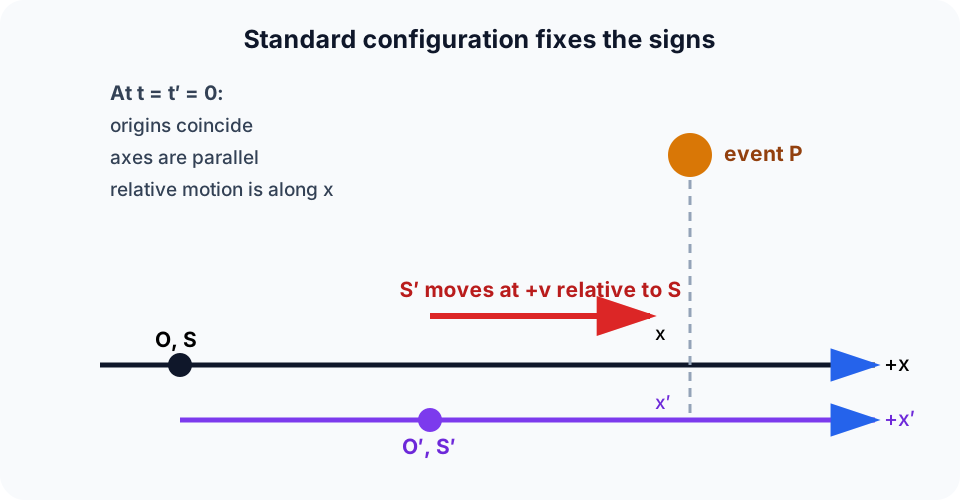
Lorentz transformations are the coordinate-change rules that replace Galilean transformations when the speed of light is invariant. They let you convert (x,t) in one inertial frame into (x',t') in another moving at constant speed v along the x-axis.
Treat this maintained page as the mathematical anchor for the whole cluster; revisit it whenever sign conventions or frame conditions get fuzzy.
1. Definitions (Must Know)
-
Standard configuration: frame S' moves at speed v along + x relative to frame S; axes are parallel; origins coincide at t = t' = 0.
-
Lorentz factor: γ = 1/(square root of (1-v²/c²))
-
Lorentz transformations (1D motion along x): x' = γ(x-vt)
t' = γ(t-vx/c²)
with y' = y, z' = z.
-
Inverse transformations: x = γ(x' + vt')
t = γ(t' + vx'/c²)
-
Symbols used in this lesson: x,x' (m), t,t' (s), v (m s⁻¹), c (m s⁻¹), γ (dimensionless).
2. Key Ideas (What Earns Marks)
- Space and time mix: t' depends on both t and x.
- The transformations reduce to Galilean ones in the low-speed limit: v≪ c ⇒ γ ≈ 1 and t' ≈ t.
- Use the difference form for two events: it’s often cleaner for time dilation, length contraction, and simultaneity.
3. Detailed Explanations
A. The forward and inverse transformations
Forward (from S to S'): x' = γ(x-vt)
t' = γ(t-vx/c²)
Inverse (from S' to S) comes from swapping primes and replacing v → -v: x = γ(x' + vt')
t = γ(t' + vx'/c²)
B. The “difference form” for two events
For two events, define Δ x = x₂-x₁ and similarly for time. Then: Δ x' = γ(Δ x-vΔ t)
Δ t' = γ(Δ t-(vΔ x)/c²)
and inversely: Δ x = γ(Δ x' + vΔ t')
Δ t = γ(Δ t' + (vΔ x')/c²)
These are the forms you’ll use most in H3 problem-solving.
C. Classical limit (sanity check)
If c → ∞, then γ → 1 and vx/c² → 0, so: x' → x-vt, t' → t which matches Galilean transformations.
4. Common Mistakes
- Swapping the sign of v (define clearly whether S' moves at + v relative to S).
- Forgetting the vx/c² term in t' (that term is the source of relativity of simultaneity).
- Mixing coordinates from different frames in the same equation.
- Using degrees for v/c (it’s a pure ratio; no angles involved).
5. Exam Tips
- Start by stating the standard setup: “S' moves at speed v along + x relative to S.”
- Decide whether you should use the direct form (single event) or the difference form (two events).
- Quick plausibility checks:
- if v = 0, then x' = x and t' = t.
- if Δ x = 0 (events at same place in S), the time relation simplifies.
6. Worked Examples
Modelled example 1
Transforming one event
Problem
Study the worked solution
Fix the convention and factor
Method
Use the forward transformation because the given coordinates are in S and the required coordinates are in S'.Reason
S' moves at + v relative to S.Working
γ = 1/(square root of (1-0.60²)) = 1.25Transform position
Method
Substitute consistently in SI units.Reason
c(3.0 × 10⁻⁶) = 900 m, so vt = 540 m.Working
x' = 1.25(600-540) = 75 mTransform time
Method
Retain the space-time mixing term.Reason
vx/c² = (0.60)(600)/c = 1.2 × 10⁻⁶ s.Working
t' = 1.25(3.0-1.2) × 10⁻⁶ = 2.3 × 10⁻⁶ s
Guided practice 2
Relativity of simultaneity via the difference form
Problem
Try this before viewing the solution
Hints
Hint 1: choose the difference form
Hint 2: preserve the sign
View solution step by step
Calculate the factor
Method
Find γ for 0.80c.Reason
The transformation is relativistic.Working
γ = 1/(square root of (1-0.80²)) = 1.67Transform the interval
Method
Apply the simultaneous-in-S condition.Reason
Δ t = 0 removes the first term but not the spatial term.Working
Δ t' = -1.67(0.80c)(300)/c² ≈ -1.3 × 10⁻⁶ sInterpret
Method
The events are not simultaneous in S'.Reason
The negative sign means event 2 has the earlier S' time coordinate under the stated ordering.Working
t'₂ < t'₁
Common misconception 3
Using the inverse transformations
Learner attempt
Try this before viewing the solution
View solution step by step
Choose the direction
Method
Use the inverse transformations.Reason
The known coordinates are primed and the target coordinates are unprimed.Working
x = γ(x' + vt'), t = γ(t' + vx'/c²)Find position
Method
Use γ = 1.25 and vt' = 180 m.Reason
All terms inside the position bracket must have units of metres.Working
x = 1.25(120 + 180) = 375 mFind time
Method
Use vx'/c² = 72/c = 2.40 × 10⁻⁷ s.Reason
The time-mixing term must have seconds.Working
t = 1.25(1.0 × 10⁻⁶ + 2.40 × 10⁻⁷) = 1.6 × 10⁻⁶ s
Examiner practice 4
Time dilation from the difference form
Examination question
Try this before viewing the solution
View solution step by step
Identify the condition
1 markMethod
The events are co-located in S'.Reason
This is the proper-time frame condition.Working
Δ x' = 0Select and simplify
1 markMethod
Use the inverse time-difference transformation.Reason
The known interval is primed.Working
Δ t = γ(Δ t' + (vΔ x')/c²) = γΔ t'Calculate gamma
1 markMethod
Evaluate the Lorentz factor.Reason
v/c = 0.80.Working
γ = 1/(square root of (1-0.80²)) = 1.67Calculate the interval
1 markMethod
Multiply the proper time by γ.Reason
The interval in S is longer.Working
Δ t = (1.67)(4.0) = 6.7 s
Self-mark with the mark scheme
Compare your response with each mark point. Select a point only when your response contains that evidence.
Self-mark the frame condition, equation, Lorentz factor and result.
Challenge 5
Length contraction from the difference form
Independent transfer
Try this before viewing the solution
Hints
Hint 1: start from the spatial difference
View solution step by step
Apply the measurement condition
Method
Set Δ t = 0 because the endpoints are recorded simultaneously in S.Reason
A moving length requires same-frame simultaneous endpoint positions.Working
Δ x' = γΔ xMap the lengths
Method
Identify Δ x' = L₀ and Δ x = L.Reason
The rod is at rest in S', so its primed length is proper.Working
L = L₀/γCalculate
Method
Use γ = 1.25 at 0.60c.Reason
The moving length must be smaller than the proper length.Working
L = 2.0/1.25 = 1.6 m
7. Mind Stretchers
Mind stretcher 1: Why t' depends on xExtension
If t' depended only on t, could c be the same in all inertial frames? Explain briefly.
Answer
No. If time were absolute (t' = t), then the speed of light would follow Galilean velocity addition between frames. The vx/c² mixing term is what allows different frames to relate measurements while keeping c invariant.
Mind stretcher 2: Why the “difference form” is so usefulExtension
Why are Δ x and Δ t often easier to use than x and t directly in exam questions?
Answer
Most questions describe two events and ask about time/space intervals between them. Using differences removes the need to track absolute origins, and you can apply special-case conditions cleanly (e.g. Δ x' = 0 for proper time, Δ t = 0 for length measurement in the lab frame).
8. Optional/Enrichment: Relativity Results as Corollaries
Time dilation, length contraction, and relativity of simultaneity can all be derived cleanly from the difference form of Lorentz transformations:
Forward difference form:
Δ x' = γ(Δ x-vΔ t)
Δ t' = γ(Δ t-(vΔ x)/c²)
For the inverse form, replace v with -v and interchange primed and unprimed quantities.
Next in the maintained sequence: Relativistic Velocity Addition.
Continue with the next resource in this course.
Course and syllabus information
- Course
- GCE A-Level H3 Physics
- Edition
- GCE A-Level H3 Physics 2027