Simultaneity and Relativity of Time
Key idea: Learn why simultaneity is frame-dependent in special relativity, using the train/boxcar thought experiment and exam-style questions.
Continue where you stopped
The core idea
On this page
Learning objectives
- discuss qualitatively the results of the Michelson–Morley interferometer experiment and its implications on the ether theory (knowledge of the details of the experiment is not required)
- state the postulates of the special theory of relativity, that in all inertial frames, the laws of physics are the same and the speed of light in free space is the same regardless of the motion of the light source or observer
- appreciate the failure of Galilean transformation equations when applied to a moving source of light
- discuss the concept of simultaneity
- show an understanding of the terms proper time and proper length
- apply the Lorentz transformation equations to solve one-dimensional problems
- Derive the time dilation formula and the length contraction formula, making use of the Lorentz factor.
- apply the time dilation formula and the length contraction formula in related situations (e.g. the lifetime of fast-moving muons) or to solve problems
- use the one-dimensional relativistic velocity addition formula to calculate velocities in different inertial frames or to solve problems
- Apply the relativistic energy–momentum relation E² = (pc)² + (mc²)² to solve problems, including selecting its limiting form.
- Show that E² = (pc)² + (mc²)² reduces to E = pc for massless particles and to E = mc² + ½mv² at low speeds.
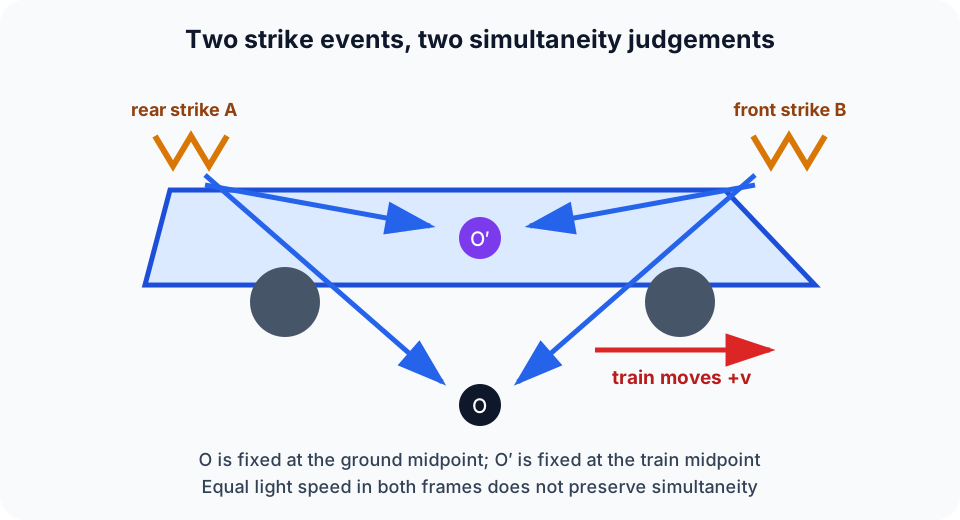
Simultaneity is the key “mind bend” of special relativity: two events can be simultaneous in one inertial frame but not in another.
This maintained page sets up every later derivation, so keep frame labels and simultaneity conditions explicit before moving on.
1. Definitions (Must Know)
- Event: something that happens at a specific place and time, described by (x,t) in a chosen frame.
- Simultaneous (in a given frame): two events have the same time coordinate in that frame (t₁ = t₂).
- Inertial frame: a frame moving at constant velocity where the laws of physics take their standard form.
2. Key Ideas (What Earns Marks)
- “Simultaneous” is not just “I saw them at the same time.” You must account for signal travel time using a procedure consistent with the postulates.
- If all inertial observers measure the same speed of light in vacuum (c), then different inertial frames disagree on what events are simultaneous.
- Relativity of simultaneity is not an “illusion”; it is a consequence of how space and time coordinates relate between frames.
Quick comparison:
| Statement | Correct? | Why |
|---|---|---|
| “I saw them at the same time” | Not sufficient | Light travel time matters |
| “They have the same time coordinate in my frame” | Definition of simultaneous (in that frame) | Depends on synchronization procedure |
| “If simultaneous in one inertial frame, simultaneous in all” | False | Lorentz time mixes t and x |
3. Detailed Explanations
A. Why “seeing” is not the same as “happening”
Light takes time to reach you. If you see two flashes simultaneously, you can only conclude the events were simultaneous in your frame if you also know:
- you are equidistant from the event locations (in your frame), or
- you have a synchronized clock network and have corrected for signal delays.
B. The train/boxcar lightning thought experiment (core idea)
Two lightning bolts strike the two ends of a moving boxcar. Consider two observers:
- O on the ground, midway between the ground strike marks.
- O' on the boxcar, midway between the boxcar ends (in the boxcar’s frame).
In the ground frame, if the light reaches O at the same time and the distances are equal, O concludes the strikes were simultaneous in the ground frame.
But O' is moving toward one flash and away from the other (in the ground frame). Since both observers must measure light moving at speed c, O' concludes the strike at the front end happened first in the boxcar frame.
The conclusion: Events simultaneous in one inertial frame are generally not simultaneous in another inertial frame moving relative to it.
C. Connection to the postulates
This is a direct consequence of:
- Postulate 1: laws of physics same in all inertial frames, and
- Postulate 2: c is the same in all inertial frames.
4. Common Mistakes
- Saying “they saw different times because of signal delay” and stopping there (each observer corrects for signal travel in their own frame).
- Assuming simultaneity is absolute, then trying to force Galilean time (t' = t) onto special relativity.
- Forgetting that “midpoint” depends on frame (lengths and simultaneity are linked).
5. Exam Tips
- When asked “are they simultaneous?”, always include “in which frame?”
- Use the safe phrasing: “Simultaneity is frame-dependent because all inertial observers measure the same light speed.”
- If you use the train thought experiment, state explicitly who is moving toward which flash (this anchors the reasoning).
6. Worked Examples
Modelled example 1
Interpreting “I saw both flashes together”
Problem
Study the worked solution
Name the frame
Method
Make the conclusion only in the ground frame.Reason
Simultaneity is a relation between time coordinates in a specified frame.Working
Δ t_ground ?Compare signal paths
Method
The two light paths have equal ground-frame length.Reason
You are at the midpoint and both pulses travel at c.Working
t_(travel,A) = d/c = t_(travel,B)Infer emission times
Method
The emissions were simultaneous in the ground frame.Reason
Equal arrival times minus equal travel times give equal emission times.Working
Δ t_(emission,ground) = 0
Guided practice 2
Train lightning (concept)
Problem
Try this before viewing the solution
Hints
Hint 1: track the train observer
Hint 2: keep c invariant
View solution step by step
Ground-frame conclusion
Method
The ground midpoint observer receives equal-path pulses together and assigns simultaneous ground-frame emission times.Reason
The observer is equidistant from the ground strike positions.Working
Δ t_ground = 0Train-frame conclusion
Method
The train observer assigns the front strike an earlier train-frame time.Reason
The observer approaches the front pulse and recedes from the rear pulse while measuring both at c.Working
t'_front < t'ᵣₑₐᵣReconcile
Method
Both descriptions are valid in their own inertial frames.Reason
Lorentz transformations assign frame-dependent time coordinates while preserving the laws and c.Working
Δ t = 0, Δ t' ≠ 0
Common misconception 3
Events simultaneous in S, not in S' (numerical)
Learner claim
Try this before viewing the solution
View solution step by step
Select the equation
Method
Use the Lorentz time-difference transformation.Reason
The question compares two spatially separated events across frames.Working
Δ t' = γ(Δ t-(vΔ x)/c²)Apply the condition
Method
Set Δ t = 0 and calculate γ = 1.25.Reason
Simultaneity is given only in S; the spatial term remains.Working
Δ t' = -γ(vΔ x)/c²Calculate and interpret
Method
The events are not simultaneous in S'; event 2 occurs earlier there.Reason
The transformed interval is negative under the stated ordering.Working
Δ t' = -1.25(0.60c)(240)/c² = -6.00 × 10⁻⁷ s
Examiner practice 4
“Saw simultaneously” but not at the midpoint
Examination question
Try this before viewing the solution
View solution step by step
Compare distances
1 markMethod
The pulse from A travels 50 m; the pulse from B travels 150 m.Reason
The observer is not at the midpoint.Working
d_A = 50 m, d_B = 150 mCompare travel times
1 markMethod
The B pulse travels for 100/c longer.Reason
Both propagate at c in the ground frame.Working
t_(B,travel)-t_(A,travel) = 100/cInfer order
1 markMethod
A emitted later than B.Reason
Its shorter travel time compensates for its later start.Working
t_(A,emit)-t_(B,emit) = 100/c > 0State conclusion
1 markMethod
The emissions were not simultaneous in the ground frame.Reason
Equal reception times do not cancel unequal signal delays.Working
Δ tₑₘᵢₜ ≠ 0
Self-mark with the mark scheme
Compare your response with each mark point. Select a point only when your response contains that evidence.
Self-mark distances, travel-time difference, emission order and conclusion.
Challenge 5
What do you need to claim simultaneity in your frame?
Independent transfer
Try this before viewing the solution
Hints
Hint 1: put clocks at the events
View solution step by step
Prepare the frame
Method
Place clocks at both detector locations and synchronize them in the chosen inertial frame.Reason
Distant simultaneity requires a frame-specific synchronization convention.Working
C_A ↔ C_B synchronized in SRecord locally
Method
Record each event’s local clock reading.Reason
Local records avoid confusing event time with later signal arrival at a third location.Working
t_A, t_BCompare
Method
Call the events simultaneous in S exactly when the recorded readings match.Reason
Equal synchronized-clock coordinates are the operational definition.Working
t_A = t_B ⇒ Δ t_S = 0
7. Mind Stretchers
Mind stretcher 1: What becomes impossible without frame-dependent simultaneity?Extension
If simultaneity were absolute (same for all inertial frames), what would that imply about the speed of light measurements in different inertial frames?
Answer
It would force a Galilean-style velocity addition for light (some observers would measure c± u), contradicting the postulate that all inertial observers measure c in vacuum.
Mind stretcher 2: Why simultaneity and length measurement are linkedExtension
Explain briefly why a “length of a moving object” measurement in your frame requires simultaneity in your frame.
Answer
To measure length you need the positions of both ends at the same time in your frame. If you use different times for the two ends, the object has moved in between and you are not measuring a single-frame length; this is why relativity of simultaneity is tied to length contraction.
8. Optional/Enrichment: Lorentz Transformations and a Formula
Using Lorentz transformations, the time difference between two events in different frames depends on both Δ t and Δ x. This is why spatial separation matters for simultaneity.
Next steps:
Next in the maintained sequence: Lorentz Transformations.
Continue with the next resource in this course.
Course and syllabus information
- Course
- GCE A-Level H3 Physics
- Edition
- GCE A-Level H3 Physics 2027