Time Dilation
Key idea: Learn time dilation using Δt = γΔτ, identify proper time, and solve exam-style problems including muons and moving clocks.
Continue where you stopped
The core idea
On this page
Learning objectives
- discuss qualitatively the results of the Michelson–Morley interferometer experiment and its implications on the ether theory (knowledge of the details of the experiment is not required)
- state the postulates of the special theory of relativity, that in all inertial frames, the laws of physics are the same and the speed of light in free space is the same regardless of the motion of the light source or observer
- appreciate the failure of Galilean transformation equations when applied to a moving source of light
- discuss the concept of simultaneity
- show an understanding of the terms proper time and proper length
- apply the Lorentz transformation equations to solve one-dimensional problems
- Derive the time dilation formula and the length contraction formula, making use of the Lorentz factor.
- apply the time dilation formula and the length contraction formula in related situations (e.g. the lifetime of fast-moving muons) or to solve problems
- use the one-dimensional relativistic velocity addition formula to calculate velocities in different inertial frames or to solve problems
- Apply the relativistic energy–momentum relation E² = (pc)² + (mc²)² to solve problems, including selecting its limiting form.
- Show that E² = (pc)² + (mc²)² reduces to E = pc for massless particles and to E = mc² + ½mv² at low speeds.
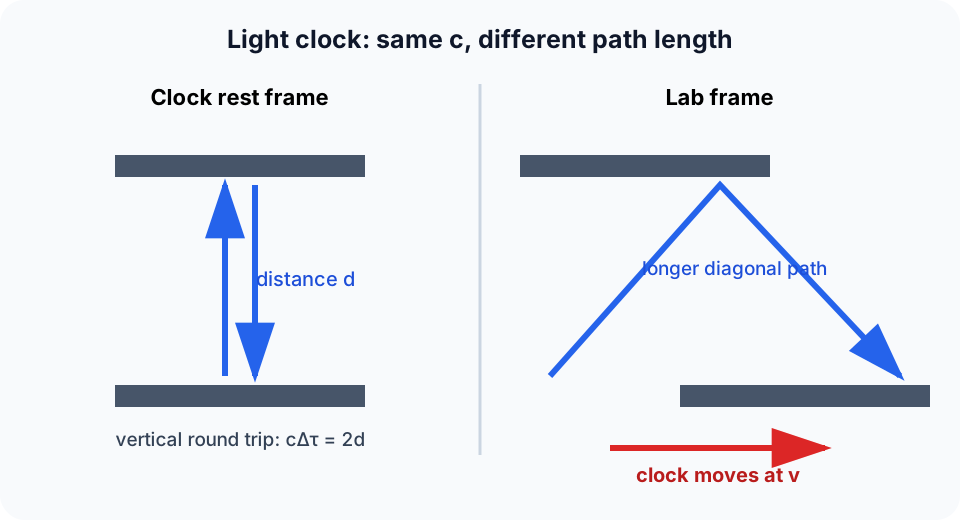
Time dilation is the result that a moving clock ticks more slowly than a clock at rest in your frame. The key H3 formula is: Δ t = γ Δτ where Δτ is the proper time and γ is the Lorentz factor.
In the maintained path, pair this with simultaneity so you can justify why proper-time conditions are frame-specific.
1. Definitions (Must Know)
- Lorentz factor: γ = 1/(square root of (1-v²/c²))
- Proper time, Δτ: the time interval between two events measured in the frame where the two events occur at the same position (one clock can record both).
- Dilated time, Δ t: the time interval measured in a frame where the same two events occur at different positions (the clock is moving relative to that frame).
- Time dilation formula: Δ t = γ Δτ
- Symbols used in this lesson: v relative speed (m s⁻¹), c speed of light (≈ 3.00 × 10⁸ m s⁻¹), γ (dimensionless), Δτ,Δ t (s).
Lorentz factor γ vs speed
The Lorentz factor γ increases slowly at low speeds but rises sharply as v approaches c.
Scroll across the graph to read all labels.
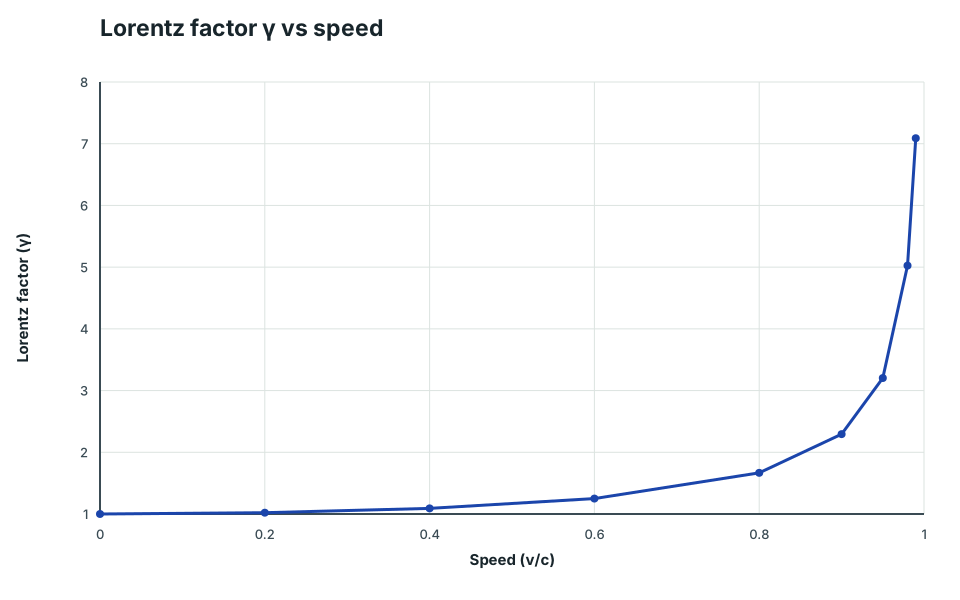
View figure data
| Speed (v/c) | γ |
|---|---|
| 0 | 1 |
| 0.2 | 1.021 |
| 0.4 | 1.091 |
| 0.6 | 1.25 |
| 0.8 | 1.667 |
| 0.9 | 2.294 |
| 0.95 | 3.203 |
| 0.98 | 5.025 |
| 0.99 | 7.089 |
2. Key Ideas (What Earns Marks)
- “Moving clocks run slow” means: for the same pair of events, Δ t ≥ Δτ with equality only when v = 0.
- Proper time is measured in the clock’s rest frame (events at same place).
- Time dilation is a consequence of the two postulates and the relativity of simultaneity.
Quick comparison:
| Quantity | Meaning | How to identify |
|---|---|---|
| Proper time Δτ | One clock measures both events | Events occur at same position in that frame (Δ x' = 0) |
| Dilated time Δ t | Other inertial frame’s interval | Same events occur at different positions in that frame |
3. Detailed Explanations
A. The light clock thought experiment (derivation)
In the clock’s rest frame, a light pulse travels up and down between two mirrors separated by distance d. One “tick” has proper time: Δτ = 2d/c
In a frame where the clock moves at speed v, the light travels a longer diagonal path, but still at speed c. For half a tick, geometry gives: ((cΔ t)/2)² = d² + ((vΔ t)/2)² Rearrange: Δ t = 2d/(c square root of (1-v²/c²))
Using Δτ = 2d/c gives
Δ t = γΔτ
B. What “proper” means (how to identify it)
If a single clock can stay at one place and record both events, that frame measures Δτ.
Example: “ticks of a wristwatch” are measured at the watch’s location in its own rest frame, so the watch measures its proper time.
4. Common Mistakes
- Swapping Δ t and Δτ: proper time is the smaller interval.
- Using time dilation for two events that occur at the same place in your frame (then your frame measures Δτ, not Δ t).
- Treating γ as square root of (1-v²/c²) (it is the reciprocal).
5. Exam Tips
- First decide which interval is proper: “Which frame sees both events at the same position?”
- Write the formula in the safe direction: Δ t = γ Δτ where Δ t is the longer (“dilated”) time.
- For v≪ c, you can sanity-check that γ ≈ 1 so the effect is small.
6. Worked Examples
Modelled example 1
Time dilation at 0.80c
Problem
Study the worked solution
Identify proper time
Method
The spacecraft interval is proper.Reason
The process occurs at one place in its own rest frame.Working
Δτ = 1.0 μsCalculate gamma
Method
Use the speed ratio 0.80.Reason
The Lorentz factor must exceed one.Working
γ = 1/(square root of (1-0.80²)) = 1.67Dilate the interval
Method
Multiply the proper time by γ.Reason
Earth sees the process move, so Earth measures the longer interval.Working
Δ t = (1.67)(1.0 μs) = 1.7 μs
Guided practice 2
Finding speed from a time dilation factor
Problem
Try this before viewing the solution
Hints
Hint 1: extract gamma
Hint 2: square after isolating the root
View solution step by step
Identify gamma
Method
The dilation factor equals the Lorentz factor.Reason
Δ t/Δτ = γ.Working
γ = 2Invert
Method
Solve the Lorentz-factor equation.Reason
Squaring the isolated reciprocal root avoids a sign error.Working
1-v²/c² = 1/4Calculate
Method
Select the positive speed magnitude.Reason
v/c is non-negative here.Working
v/c = square root of (3/4) = 0.866
Common misconception 3
Muon lifetime (application)
Learner claim
Try this before viewing the solution
View solution step by step
Locate the events
Method
Creation and decay occur at the same position in the muon’s rest frame.Reason
That frame therefore measures Δτ.Working
Δτ = 2.2 μsCalculate gamma
Method
Evaluate at 0.98c.Reason
The high speed produces a large factor.Working
γ = 1/(square root of (1-0.98²)) = 5.03Find Earth time
Method
Earth measures the dilated interval.Reason
The muon moves between the two events in Earth coordinates.Working
Δ t = (5.03)(2.2 μs) = 11 μs
Examiner practice 4
How far can the muon travel? (Earth frame)
Examination question
Try this before viewing the solution
View solution step by step
Choose frame quantities
1 markMethod
Use speed and time measured in the Earth frame.Reason
Distance d = vΔ t must use same-frame quantities.Working
v = 0.98c, Δ t = 11.1 μsConvert time
1 markMethod
Write microseconds in seconds.Reason
SI consistency is required with c.Working
11.1 μs = 11.1 × 10⁻⁶ sSubstitute
1 markMethod
Apply uniform-motion distance.Reason
The Earth-frame muon speed is given.Working
d = (0.98c)(11.1 × 10⁻⁶)Calculate
1 markMethod
Retain sensible significant figures.Reason
The inputs are approximately two to three significant figures.Working
d ≈ 3.3 × 10³ m
Self-mark with the mark scheme
Compare your response with each mark point. Select a point only when your response contains that evidence.
Self-mark frame consistency, conversion, substitution and result.
Challenge 5
Finding proper time from an observed interval
Independent transfer
Try this before viewing the solution
Hints
Hint 1: reverse the relation
View solution step by step
Identify proper frame
Method
The moving clock’s rest frame measures proper time.Reason
Both ticks occur at the same clock position there.Working
Δτ belongs to the clock frameCalculate gamma
Method
At 0.60c, γ = 1.25.Reason
1/square root of (1-0.60²) = 1/0.80.Working
γ = 1.25Reverse the formula
Method
Divide the observed interval by γ.Reason
The proper interval is the shorter one.Working
Δτ = 10.0/1.25 = 8.0 s
7. Mind Stretchers
Mind stretcher 1: Why time dilation is not “just signal delay”Extension
Two observers correct for signal travel time in their own frames, yet still disagree on the time interval between the same two events. Why?
Answer
Because the disagreement is about the time coordinate assignment in different inertial frames (linked to how clocks are synchronized in each frame and the invariance of c), not about one observer “seeing late”. Even after correcting for light travel, the spacetime interval splits into different Δ t and Δ x in different frames.
Mind stretcher 2: “Each sees the other’s clock run slow” — so who is right?Extension
Two inertial observers move relative to each other. Each says the other’s moving clock runs slow. How can both statements be correct without contradiction?
Answer
Each statement is about how a moving clock’s tick interval relates to the observer’s own synchronized clocks and simultaneity convention in that observer’s inertial frame. There is no single “absolute” time interval for separated events; different frames assign different time coordinates consistently via Lorentz transformations.
8. Optional/Enrichment: The Low-Speed Approximation
For v≪ c, a useful approximation is: γ ≈ 1 + (1/2)v²/c² This shows why time dilation is negligible at everyday speeds.
Next in the maintained sequence: Length Contraction.
Continue with the next resource in this course.
Course and syllabus information
- Course
- GCE A-Level H3 Physics
- Edition
- GCE A-Level H3 Physics 2027