Length Contraction
Key idea: Learn length contraction using L = L0/γ, identify proper length, and solve exam-style problems with clear simultaneity conditions.
Continue where you stopped
The core idea
On this page
Learning objectives
- discuss qualitatively the results of the Michelson–Morley interferometer experiment and its implications on the ether theory (knowledge of the details of the experiment is not required)
- state the postulates of the special theory of relativity, that in all inertial frames, the laws of physics are the same and the speed of light in free space is the same regardless of the motion of the light source or observer
- appreciate the failure of Galilean transformation equations when applied to a moving source of light
- discuss the concept of simultaneity
- show an understanding of the terms proper time and proper length
- apply the Lorentz transformation equations to solve one-dimensional problems
- Derive the time dilation formula and the length contraction formula, making use of the Lorentz factor.
- apply the time dilation formula and the length contraction formula in related situations (e.g. the lifetime of fast-moving muons) or to solve problems
- use the one-dimensional relativistic velocity addition formula to calculate velocities in different inertial frames or to solve problems
- Apply the relativistic energy–momentum relation E² = (pc)² + (mc²)² to solve problems, including selecting its limiting form.
- Show that E² = (pc)² + (mc²)² reduces to E = pc for massless particles and to E = mc² + ½mv² at low speeds.
Length contraction is the result that a moving object is measured to be shorter along the direction of motion. The key H3 formula is: L = L₀/γ where L₀ is the proper length and γ is the Lorentz factor.
Treat this as the sister result of time dilation: both come from the same Lorentz structure with different measurement conditions.
1. Definitions (Must Know)
- Lorentz factor: γ = 1/(square root of (1-v²/c²))
- Proper length, L₀: length measured in the frame where the object is at rest (its rest frame).
- Contracted length, L: length measured in a frame where the object moves at speed v (measured along the direction of motion).
- Length contraction formula: L = L₀/γ
- Symbols used in this lesson: L₀,L (m), v (m s⁻¹), c (≈ 3.00 × 10⁸ m s⁻¹), γ (dimensionless).
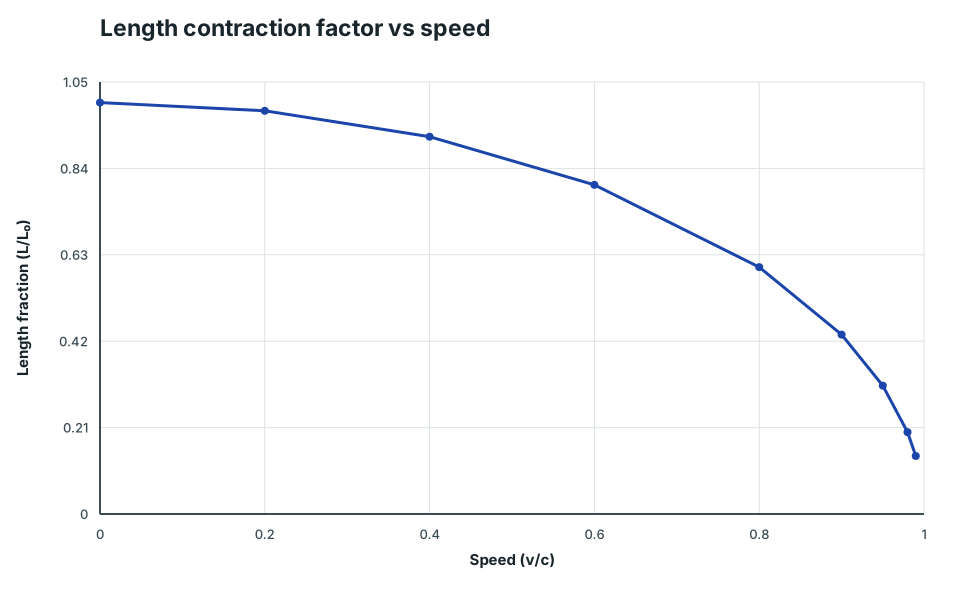
Length contraction factor vs speed
The ratio L/L0 decreases with speed and drops rapidly as v approaches c.
Scroll across the graph to read all labels.
View figure data
| Speed (v/c) | L/L₀ |
|---|---|
| 0 | 1 |
| 0.2 | 0.98 |
| 0.4 | 0.917 |
| 0.6 | 0.8 |
| 0.8 | 0.6 |
| 0.9 | 0.436 |
| 0.95 | 0.312 |
| 0.98 | 0.199 |
| 0.99 | 0.141 |
2. Key Ideas (What Earns Marks)
- Length contraction only applies parallel to the relative motion. Perpendicular dimensions are unchanged in this model.
- Proper length is the largest length: L ≤ L₀.
- Measuring length requires recording the positions of both ends at the same time in your frame (this ties directly to relativity of simultaneity).
Quick comparison:
| Quantity | Meaning | Key condition |
|---|---|---|
| Proper length L₀ | Object’s rest-frame length | Object at rest in that frame |
| Contracted length L | Length measured when object moves | Endpoints measured simultaneously in the measuring frame |
3. Detailed Explanations
A. Why “same time” matters for length
To measure the length of a moving rod in your frame, you need the positions of the front and back ends at the same time in your frame. Because simultaneity is frame-dependent, different frames can disagree on the length.
See: Simultaneity
B. A clean derivation using time dilation (spaceship/stars argument)
Consider two stars at rest in the Earth frame, separated by proper distance L₀ (proper length in the stars/Earth rest frame).
In Earth frame, a spaceship travels at speed v, so the travel time is: Δ t = L₀/v
The spaceship clock measures proper time for the trip (departure and arrival occur at the same place in the spaceship frame), so: Δτ = (Δ t)/γ = L₀/(γ v)
In the spaceship frame, the stars move toward the ship at speed v and the ship measures the distance between stars as L. The trip duration in the ship frame is: Δτ = L/v
Equate: L/v = L₀/(γ v) ⇒ L = L₀/γ
4. Common Mistakes
- Using L = γ L₀ (wrong direction); moving lengths are shorter.
- Forgetting “along the direction of motion”.
- Mixing proper time and proper length: proper length is measured in the object’s rest frame; proper time is measured where the two events occur at the same place.
- Measuring length using endpoints at different times (invalid in a single frame).
5. Exam Tips
- Decide what is proper: “Which frame is the object at rest in?” That frame measures L₀.
- Write the safe chain: L = L₀/γ, γ = 1/(square root of (1-v²/c²))
- Quick check: if v → 0, then γ → 1 and L → L₀.
6. Worked Examples
Modelled example 1
Length at 0.80c
Problem
Study the worked solution
Identify the lengths
Method
The spacecraft rest frame measures L₀; Earth measures L.Reason
The spacecraft moves relative to Earth and its length is measured along the motion.Working
L₀ = 100 m, L < L₀Calculate gamma
Method
Evaluate the Lorentz factor.Reason
v/c = 0.80.Working
γ = 1/(square root of (1-0.80²)) = 1.67Contract
Method
Divide proper length by γ.Reason
The moving length is shorter.Working
L = 100/1.67 = 60 m
Guided practice 2
Find speed from contraction factor
Problem
Try this before viewing the solution
Hints
Hint 1: extract gamma
Hint 2: use the positive magnitude
View solution step by step
Find gamma
Method
Invert the length fraction.Reason
L/L₀ = 1/γ.Working
0.50 = 1/γ ⇒ γ = 2Find speed
Method
Invert and square the Lorentz-factor relation.Reason
This isolates the squared speed ratio.Working
1-v²/c² = 1/4 ⇒ v/c = square root of (3/4) = 0.866
Common misconception 3
Length at 0.60c
Learner claim
Try this before viewing the solution
View solution step by step
Apply the ordering check
Method
The moving length must be smaller than the proper length.Reason
L₀ is measured in the rod rest frame and is the maximum length.Working
L < 5.0 mCalculate gamma
Method
At 0.60c, γ = 1.25.Reason
1/square root of (1-0.60²) = 1.25.Working
γ = 1.25Correct the relation
Method
Divide by γ.Reason
Multiplication would incorrectly lengthen the moving rod.Working
L = 5.0/1.25 = 4.0 m
Examiner practice 4
Contraction to 80% of proper length
Examination question
Try this before viewing the solution
View solution step by step
Relate the fraction
1 markMethod
Use the contraction ratio.Reason
L/L₀ = 1/γ.Working
0.80 = 1/γFind gamma
1 markMethod
Invert the ratio.Reason
The Lorentz factor exceeds one.Working
γ = 1.25Rearrange
1 markMethod
Square the reciprocal relation.Reason
This isolates v²/c².Working
1-v²/c² = 1/1.25² = 0.64Calculate
1 markMethod
Take the positive speed magnitude.Reason
Speed is non-negative.Working
v/c = square root of 0.36 = 0.60
Self-mark with the mark scheme
Compare your response with each mark point. Select a point only when your response contains that evidence.
Self-mark ratio, gamma, rearrangement and speed.
Challenge 5
Which length is “proper”?
Independent transfer
Try this before viewing the solution
Hints
Hint 1: start from rest
View solution step by step
Identify proper length
Method
The pilot’s 100 m is L₀.Reason
The spacecraft is at rest in the pilot frame.Working
L₀ = 100 mIdentify moving length
Method
Your 60 m is L.Reason
The spacecraft moves relative to your frame, and its endpoints are recorded simultaneously in that frame.Working
L = 60 mExplain the relation
Method
The moving length is contracted along the motion.Reason
Lorentz transformations give L = L₀/γ.Working
60 = 100/γ
7. Mind Stretchers
Mind stretcher 1: Why contraction and time dilation are consistentExtension
In the spaceship/stars scenario, Earth says “distance is L₀ and time is Δ t”. The spaceship says “time is smaller (Δτ)”.
What must the spaceship conclude about the distance, and why?
Answer
It must conclude the distance is smaller: L = L₀/γ. Otherwise v = L/Δτ would exceed the relative speed v measured in both frames, creating an inconsistency with Lorentz transformations and the invariance of c.
Mind stretcher 2: The “garage and pole” paradox (qualitative)Extension
A moving pole is length-contracted and can “fit” inside a garage in the garage frame. In the pole’s rest frame, the garage is length-contracted and seems too short. How can both frames be consistent?
Answer
The key is relativity of simultaneity. “Both ends inside at the same time” is frame-dependent. The garage frame’s “door closes when the back end enters” and the pole frame’s “door close events” do not occur simultaneously in both frames, so there is no contradiction.
8. Optional/Enrichment: Low-Speed Approximation
For v≪ c, γ ≈ 1 + (1/2)v²/c², so: L ≈ L₀(1-(1/2)v²/c²) This explains why length contraction is negligible at everyday speeds.
Next in the maintained sequence: Relativistic Velocity Addition.
Continue with the next resource in this course.
Course and syllabus information
- Course
- GCE A-Level H3 Physics
- Edition
- GCE A-Level H3 Physics 2027