Einstein’s Principle of Relativity
Key idea: Learn Einstein’s two postulates of special relativity and how they force Lorentz transformations, replacing Galilean ideas at high speeds.
Continue where you stopped
The core idea
On this page
Learning objectives
- discuss qualitatively the results of the Michelson–Morley interferometer experiment and its implications on the ether theory (knowledge of the details of the experiment is not required)
- state the postulates of the special theory of relativity, that in all inertial frames, the laws of physics are the same and the speed of light in free space is the same regardless of the motion of the light source or observer
- appreciate the failure of Galilean transformation equations when applied to a moving source of light
Einstein’s special theory of relativity starts from two postulates. Together, they explain why Galilean ideas work at low speeds, but break down for light.
In the maintained sequence, treat this as the conceptual checkpoint after Michelson-Morley and before simultaneity/time-mixing derivations.
1. Definitions (Must Know)
- Inertial frame: a frame where Newton’s laws hold in their standard form (no fictitious forces needed).
- Postulate: a foundational statement accepted as a starting point (then tested by its consequences).
- Speed of light in vacuum: c ≈ 3.00 × 10⁸ m s⁻¹.
2. Key Ideas (What Earns Marks)
- Postulate 1 (Principle of Relativity): the laws of physics are the same in all inertial frames.
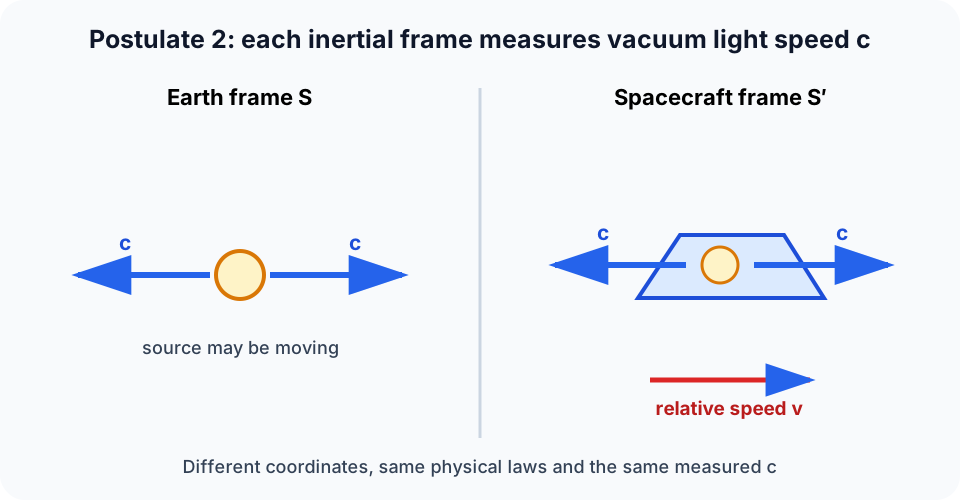
- Postulate 2 (Constancy of light speed): in vacuum, light has the same speed c for all inertial observers, independent of the motion of the source or observer.
- These postulates force you to abandon Galilean velocity addition for light, motivating Lorentz transformations.
Quick comparison:
| Postulate | What you state | What it rules out |
|---|---|---|
| 1. Relativity principle | No preferred inertial frame for physics laws | Absolute rest frame for laws |
| 2. Invariant c | All inertial observers measure c in vacuum | Galilean addition for light (c± u) |
3. Detailed Explanations
A. What Postulate 1 really claims
Postulate 1 is not just about mechanics (Galilean relativity). It says all physical laws (including electromagnetism) take the same form in every inertial frame. There is no preferred inertial frame.
B. Why Postulate 2 is a shock to “common sense”
In Galilean relativity, speeds add: you might expect “observer sees c± u”. Postulate 2 says this is not allowed: all inertial observers must measure c for light in vacuum.
This creates a contradiction with Galilean transformation ideas at high speeds, and the resolution is that time and space coordinates must transform differently (Lorentz transformations).
C. Link to evidence (qualitative)
The Michelson–Morley experiment is historically important because it supports the idea that there is no detectable “ether wind” and is consistent with c being universal in inertial frames:
4. Common Mistakes
- Writing principal instead of principle (it’s the principle of relativity).
- Saying “speed of light is constant in all frames” without stating “in vacuum” and “in inertial frames”.
- Mixing “same laws” with “same measurements”: different inertial observers can measure different times/lengths, but the laws connecting them are the same.
- Treating Galilean velocity addition as valid for light (it is the classical, low-speed limit).
5. Exam Tips
- If asked to “state the postulates”, write them cleanly as two separate bullet points (as in Section 2).
- When asked about “no preferred frame”, use a closed-lab phrasing: “no internal experiment in a uniformly moving lab can detect its uniform motion.”
- Use c ≈ 3.00 × 10⁸ m s⁻¹ (SI units) unless the question specifies otherwise.
6. Worked Examples
Modelled example 1
Galilean prediction vs Einstein postulate (concept)
Problem
Study the worked solution
Apply Galilean addition
Method
Earth would predict c + u.Reason
Galilean kinematics adds source-frame velocity to frame velocity.Working
v_Earth = c + uApply the postulate
Method
Earth measures c in vacuum.Reason
All inertial observers measure the same vacuum light speed, independent of source motion.Working
v_light = c
Guided practice 2
Classify the statement (postulate 1 or 2?)
Problem
Try this before viewing the solution
Hints
Hint 1: separate laws from light speed
View solution step by step
Classify statement 1
Method
Postulate 1.Reason
No inertial frame is preferred by the laws of physics.Working
same law form in inertial framesClassify statement 2
Method
Postulate 2.Reason
It directly states invariance of vacuum light speed.Working
c invariant
Common misconception 3
Why Galilean transformations fail (one sentence)
Learner claim
Try this before viewing the solution
View solution step by step
Follow Galilean consequence
Method
Observers would obtain c± u.Reason
Absolute time plus linear coordinate shifts produce ordinary velocity addition.Working
v' = v-uIdentify contradiction
Method
The measured light speed would depend on observer motion.Reason
This contradicts Postulate 2.Working
c' ≠ cUse the correct framework
Method
Space and time must transform by Lorentz transformations.Reason
They preserve the invariant speed c.Working
t' ≠ t generally
Examiner practice 4
“Same laws” does not mean “same measurements”
Examination question
Try this before viewing the solution
View solution step by step
State the postulate
1 markMethod
Physical laws have the same form in all inertial frames.Reason
No inertial frame is preferred.Working
law form invariantSeparate coordinates
1 markMethod
Event coordinates may differ by frame.Reason
Time and position are frame-dependent.Working
(x,t) ≠ (x',t')Apply to interval
1 markMethod
Different measured intervals are allowed.Reason
The observers use different coordinate assignments.Working
Δ t ≠ Δ t'Conclude consistency
1 markMethod
Both observers can use the same laws and obtain mutually consistent predictions.Reason
Lorentz transformations relate their measurements.Working
same physics, different coordinates
Self-mark with the mark scheme
Compare your response with each mark point. Select a point only when your response contains that evidence.
Self-mark postulate, coordinate distinction, interval application and consistency.
Challenge 5
When do we expect the postulates to apply?
Independent transfer
Try this before viewing the solution
Hints
Hint 1: use the no-acceleration criterion
View solution step by step
Identify the domain
Method
The postulates apply directly to inertial frames.Reason
Such frames have constant relative velocity.Working
a_frame = 0Mark the boundary
Method
Accelerating and rotating frames require additional treatment.Reason
They are non-inertial and introduce frame-acceleration effects.Working
a_frame ≠ 0
7. Mind Stretchers
Mind stretcher 1: What has to “give”?Extension
If both postulates are true, which everyday assumptions must fail at high speeds: (i) absolute time, (ii) absolute length, (iii) simple velocity addition? Explain briefly.
Answer
All three classical assumptions fail in their naive forms: time and length become frame-dependent (time dilation and length contraction), and velocity addition must be replaced by the relativistic formula so that c remains invariant.
Mind stretcher 2: Why “in vacuum” mattersExtension
Postulate 2 says the speed of light is c in vacuum for inertial observers. Why do we include “in vacuum” rather than “in any material”?
Answer
In materials, light’s speed depends on the medium (refractive index) and can be different from c. The postulate is about the fundamental invariant speed in vacuum that appears in the spacetime structure (Lorentz transformations).
8. Optional/Enrichment: Where the Postulates Lead Next
The next steps are the consequences you’ll use in H3:
Next in the maintained sequence: Simultaneity.
Continue with the next resource in this course.
Course and syllabus information
- Course
- GCE A-Level H3 Physics
- Edition
- GCE A-Level H3 Physics 2027