Inertial and non-inertial frames
Key idea: Newton's laws use interaction forces alone in an inertial frame. Accelerating or rotating coordinates need additional inertial-force terms to account for apparent acceleration.
Offline pages
Saved on this device only. Connect at least once every 30 days to confirm Premium. Sign-out or a change of account removes saved copies.
Loading guide controls…
Guided lessons · coming soon
Guided lesson
Guided steps
- Predict where the dropped ball lands inside the train.
- Read what a frame and an event are.
- Read how a force-free particle tests an inertial frame.
- Compare the ball’s path in the two frames.
- Calculate both accelerations and test Newton’s second law.
- Read what changes in an accelerating frame.
- Calculate the puck’s acceleration in each frame.
- Explain why the passenger’s rest does not make the elevator inertial.
- Find the car’s acceleration and classify its frame.
- Compare Earth’s rotational acceleration with gravity.
- Design an experiment to detect acceleration inside the carriage.
On this page
You stopped at:
ContinueNewton’s laws do not hold for every observer. They hold in their usual form only in an inertial frame. In an accelerating or rotating frame, an object with no force on it can appear to speed up or curve. This lesson shows how to tell the two kinds of frame apart.
Check your understanding 1 Predict first
A train moves along a straight track at constant velocity. A passenger holds a ball still above a mark on the floor and lets go. Ignoring air resistance, where does the ball land?
Show answer
On the mark. The ball keeps the train’s horizontal velocity, so it stays above the mark as it falls. No experiment inside the steadily moving train can tell that it is moving.
Frames of reference and events
A frame of reference is an origin, a set of axes and a clock, used to give each event a position and a time. An event is something that happens at one place at one instant, such as a ball hitting the floor, described by (x, y, z, t) in a chosen frame. Two observers in different frames can give the same event different coordinates.
Inertial frames
An inertial frame is one in which a particle with no resultant interaction force stays at rest or moves at constant velocity: Newton’s first law holds, and Newton’s second law applies using only the forces from physical interactions. This is the test for an inertial frame. If a force-free particle accelerates in your frame, the frame is not inertial.
Start with a frame S known to be inertial. A second frame S' is also inertial if it moves at constant velocity relative to S and its axes do not rotate. In Newtonian mechanics both frames use the same time, and their velocity readings differ by the constant frame velocity. Subtracting a constant does not change how fast a velocity changes, so both frames measure the same acceleration, a' = a. With the same mass and the same interaction forces, both observers can use F = ma.
So there is no preferred inertial frame: an experiment done entirely inside a train moving at constant velocity cannot detect that motion. Observers in different inertial frames can disagree about positions, velocities and the shape of a path, but they explain the motion with the same forces.
For the next two examples, assume a train moving uniformly along a straight track, parallel non-rotating axes, negligible air resistance and uniform gravity. Treat the ground as inertial over this short experiment.
Worked example 1
Dropping a ball inside a moving train
Problem
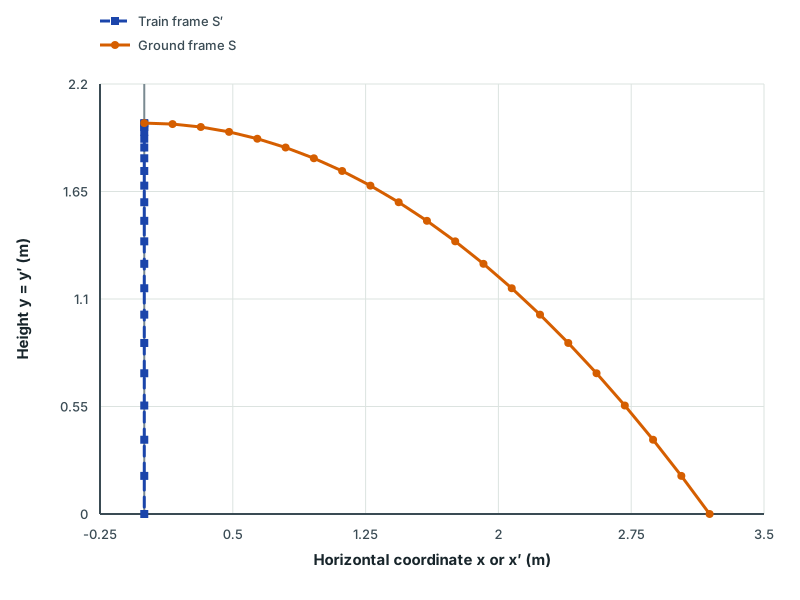
A train moves at constant velocity u > 0 along + x. A passenger drops a ball from rest relative to the train from height h. Choose coincident horizontal origins at the release point when t = 0, and let + y be upwards. Describe the path seen in the train and ground frames.
Show full solution
Classify the frames
Method
The constant-velocity train and ground are treated as inertial frames.
Reason
Their relative velocity is constant, so no fictitious force is needed.
Working
Answer
a_frame = 0Describe the train view
Method
The ball falls vertically with acceleration -g along the upward y-axis.
Reason
It has no horizontal velocity relative to the train when released.
Working
Answer
x' = constant, y = h-(1/2)gt²
Describe the ground view
Method
The ball follows a parabola.Reason
It retains horizontal speed u while accelerating vertically.
Working
Answer
x = ut, y = h-(1/2)gt²
Quick check
The paths differ, but both observers use the same forces and obtain the same vertical acceleration.
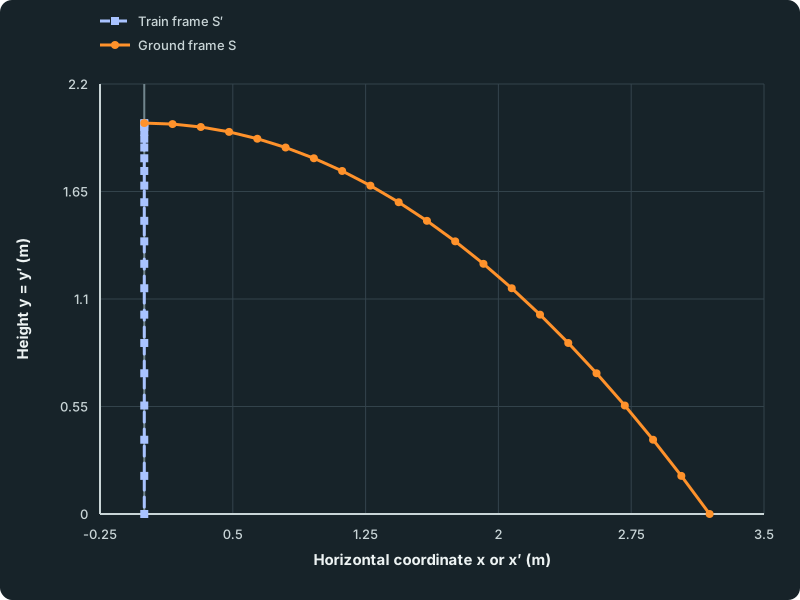
Same falling ball, two inertial frames
A ball is released from height 2.0 metres in a train moving at 5.0 metres per second. The train-frame horizontal coordinate stays zero; the ground-frame horizontal coordinate increases to about 3.19 metres. Both heights fall to zero at the same time.
Scroll across the figure to read all labels.
View figure data
| Series | Horizontal coordinate x or x′ (m) | Height y = y′ (m) |
|---|---|---|
| Train frame S′ | 0.00000 | 2.000 |
| Train frame S′ | 0.00000 | 1.995 |
| Train frame S′ | 0.00000 | 1.980 |
| Train frame S′ | 0.00000 | 1.955 |
| Train frame S′ | 0.00000 | 1.920 |
| Train frame S′ | 0.00000 | 1.875 |
| Train frame S′ | 0.00000 | 1.820 |
| Train frame S′ | 0.00000 | 1.755 |
| Train frame S′ | 0.00000 | 1.680 |
| Train frame S′ | 0.00000 | 1.595 |
| Train frame S′ | 0.00000 | 1.500 |
| Train frame S′ | 0.00000 | 1.395 |
| Train frame S′ | 0.00000 | 1.280 |
| Train frame S′ | 0.00000 | 1.155 |
| Train frame S′ | 0.00000 | 1.020 |
| Train frame S′ | 0.00000 | 0.875 |
| Train frame S′ | 0.00000 | 0.720 |
| Train frame S′ | 0.00000 | 0.555 |
| Train frame S′ | 0.00000 | 0.380 |
| Train frame S′ | 0.00000 | 0.195 |
| Train frame S′ | 0.00000 | 0.000 |
| Ground frame S | 0.00000 | 2.000 |
| Ground frame S | 0.15964 | 1.995 |
| Ground frame S | 0.31928 | 1.980 |
| Ground frame S | 0.47891 | 1.955 |
| Ground frame S | 0.63855 | 1.920 |
| Ground frame S | 0.79819 | 1.875 |
| Ground frame S | 0.95783 | 1.820 |
| Ground frame S | 1.11746 | 1.755 |
| Ground frame S | 1.27710 | 1.680 |
| Ground frame S | 1.43674 | 1.595 |
| Ground frame S | 1.59638 | 1.500 |
| Ground frame S | 1.75601 | 1.395 |
| Ground frame S | 1.91565 | 1.280 |
| Ground frame S | 2.07529 | 1.155 |
| Ground frame S | 2.23493 | 1.020 |
| Ground frame S | 2.39457 | 0.875 |
| Ground frame S | 2.55420 | 0.720 |
| Ground frame S | 2.71384 | 0.555 |
| Ground frame S | 2.87348 | 0.380 |
| Ground frame S | 3.03312 | 0.195 |
| Ground frame S | 3.19275 | 0.000 |
The graph uses a release height of 2.0 m and train velocity of 5.0 m s⁻¹. Each trace uses its own frame’s horizontal coordinate. Equal-time points have the same height: both observers agree on the fall time, even though one sees a vertical path and the other a parabola.
Guided practice 2
Do changing velocity readings mean changing laws?
Problem
Frame S is known to be inertial. Both frames have parallel, non-rotating axes, the same classical time, and the same positive x direction. The table gives simultaneous velocity readings for one 2.00 kg particle. Treat the readings as exact for this comparison and assume the velocities vary linearly between them. The net physical interaction force on the particle is +4.00 N along x in both descriptions.
Find the acceleration in each frame. Decide whether S' is inertial during the interval, and test whether both descriptions obey Newton’s second law. Explain why a negative velocity reading does not require a negative force.
| Time / s | Velocity in S / m s⁻¹ | Velocity in S' / m s⁻¹ |
|---|---|---|
| 0.0 | +2.0 | −2.0 |
| 1.0 | +4.0 | 0.0 |
| 2.0 | +6.0 | +2.0 |
Try this before viewing the solution
Show the steps Optional working
Show the steps Optional working
Hints
Hint 1
read the changes rather than the signs
Which feature of velocity–time data gives acceleration?Hint 2
compare the two columns
Find the velocity difference at each time. What would a constant difference mean for the motion of the non-rotating frames?Show solution step by step
Compare velocity changes
Method
Use the same 2.0 s interval in each frame.Reason
Acceleration is the velocity change per unit time, rather than the velocity’s value or sign.Working
Answer
In S, the change is 6.0 − 2.0 = +4.0 m s⁻¹. In S', it is 2.0 − (−2.0) = +4.0 m s⁻¹. Each acceleration is +2.0 m s⁻².Identify the frame motion
Method
The velocity columns differ by a constant +4.0 m s⁻¹.Reason
With common time and non-rotating axes, a constant velocity offset means that S' translates uniformly relative to the known inertial frame.Working
Answer
S' is therefore inertial during the stated interval. The particle accelerates in both frames; this does not mean that either frame accelerates.Test the same physical law
Working
Answer
The force–mass ratio is 4.00 N ÷ 2.00 kg = +2.00 m s⁻², agreeing with both accelerations. In S', the particle initially moves in the negative direction but has positive acceleration: it slows, stops and reverses. Newton’s second law relates force to acceleration, not to velocity.
Quick check
Non-inertial frames
A frame that accelerates, or whose axes rotate, relative to an inertial frame is non-inertial. A bus speeding up, a turning car and a carousel are examples. A force-free object appears to accelerate or curve in such a frame. To keep using F = ma there, you must add frame-dependent terms, often called inertial or fictitious forces. They come from the accelerating coordinates, not from any physical interaction.
| Inertial frame | Non-inertial frame | |
|---|---|---|
| A force-free particle | stays at rest or moves at constant velocity | appears to accelerate or curve |
| Newton’s laws | apply in their usual form | need fictitious terms to keep F = ma |
A position–time curve can bend because the object accelerates or because the observer’s frame accelerates. Identify the physical interaction forces in a known inertial frame before you blame the curve on a new force.
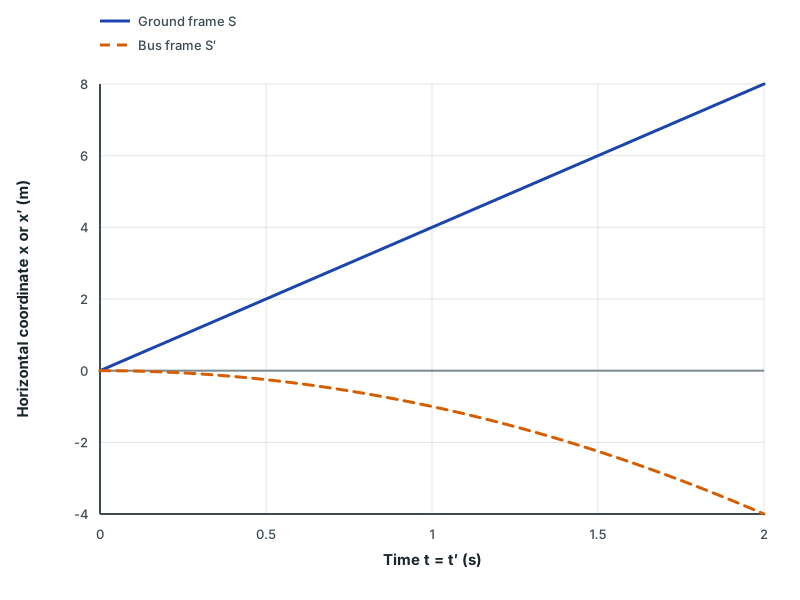
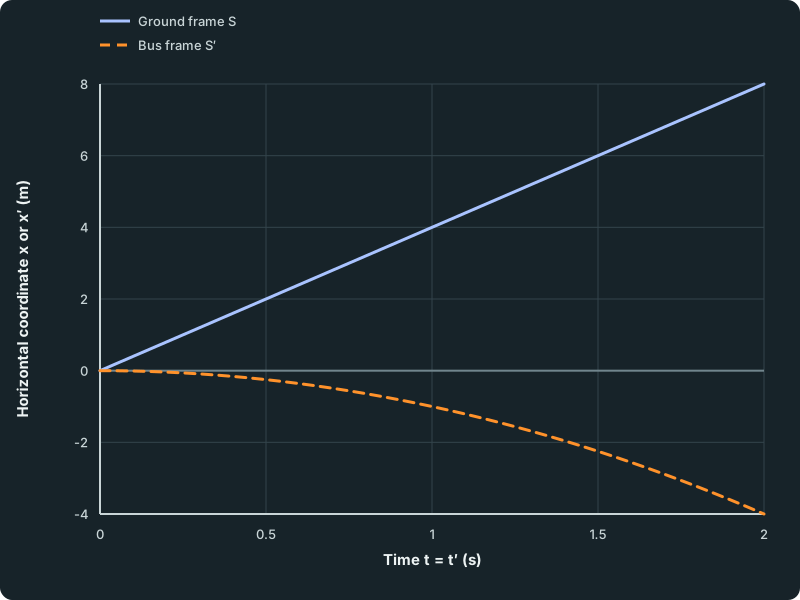
One puck described from the ground and the accelerating bus
The puck coordinate in the ground frame rises linearly from zero to eight metres in two seconds. Its coordinate in the accelerating bus frame decreases on a curve from zero to minus four metres over the same times.
Scroll across the figure to read all labels.
View figure data
| Time t = t′ (s) | Ground frame S | Bus frame S′ |
|---|---|---|
| 0.00 | 0.0 | 0.0000 |
| 0.05 | 0.2 | -0.0025 |
| 0.10 | 0.4 | -0.0100 |
| 0.15 | 0.6 | -0.0225 |
| 0.20 | 0.8 | -0.0400 |
| 0.25 | 1.0 | -0.0625 |
| 0.30 | 1.2 | -0.0900 |
| 0.35 | 1.4 | -0.1225 |
| 0.40 | 1.6 | -0.1600 |
| 0.45 | 1.8 | -0.2025 |
| 0.50 | 2.0 | -0.2500 |
| 0.55 | 2.2 | -0.3025 |
| 0.60 | 2.4 | -0.3600 |
| 0.65 | 2.6 | -0.4225 |
| 0.70 | 2.8 | -0.4900 |
| 0.75 | 3.0 | -0.5625 |
| 0.80 | 3.2 | -0.6400 |
| 0.85 | 3.4 | -0.7225 |
| 0.90 | 3.6 | -0.8100 |
| 0.95 | 3.8 | -0.9025 |
| 1.00 | 4.0 | -1.0000 |
| 1.05 | 4.2 | -1.1025 |
| 1.10 | 4.4 | -1.2100 |
| 1.15 | 4.6 | -1.3225 |
| 1.20 | 4.8 | -1.4400 |
| 1.25 | 5.0 | -1.5625 |
| 1.30 | 5.2 | -1.6900 |
| 1.35 | 5.4 | -1.8225 |
| 1.40 | 5.6 | -1.9600 |
| 1.45 | 5.8 | -2.1025 |
| 1.50 | 6.0 | -2.2500 |
| 1.55 | 6.2 | -2.4025 |
| 1.60 | 6.4 | -2.5600 |
| 1.65 | 6.6 | -2.7225 |
| 1.70 | 6.8 | -2.8900 |
| 1.75 | 7.0 | -3.0625 |
| 1.80 | 7.2 | -3.2400 |
| 1.85 | 7.4 | -3.4225 |
| 1.90 | 7.6 | -3.6100 |
| 1.95 | 7.8 | -3.8025 |
| 2.00 | 8.0 | -4.0000 |
This graph is horizontal position against time, rather than a sketch of the puck’s track. Each curve uses its own frame’s horizontal origin. Both describe one puck at the same times. A constant gradient means constant velocity in that frame; a changing gradient means acceleration in that frame. A negative coordinate says where the puck is relative to an origin, rather than which physical force acts on it.
Spot the mistake 3
A force-free puck in an accelerating bus
Learner claim
For the graph above, the bus and puck initially move at +4.0 m s⁻¹ relative to an approximately inertial ground frame. The bus then accelerates at a₀ = +2.0 m s⁻². Its level floor is frictionless, and its axes do not rotate. The puck has zero net horizontal interaction force throughout the stated interval. A learner says that its curved bus-frame position–time graph proves that a new backwards interaction force acts on it. Give the puck’s horizontal acceleration in each frame, then select the cause of the curved bus-frame graph.
Try this before viewing the solution
Show solution step by step
Use the inertial ground frame
Method
The puck’s horizontal velocity stays constant.Reason
There is no horizontal interaction force on the frictionless puck.
Working
Answer
Its horizontal speed remains +4.0 m s⁻¹, so aₓ = 0. Weight and the normal contact force balance vertically; the force-free test here concerns the horizontal direction.Compare with the bus
Method
The puck appears to accelerate backwards relative to the bus.
Reason
The bus speeds up while the puck retains its ground-frame horizontal velocity.
Working
Answer
With non-rotating bus axes, a'ₓ = aₓ-a₀. The puck’s bus-frame acceleration is −2.0 m s⁻². The bus gains forwards speed while the puck retains its ground-frame speed.
Classify the frame
Method
The accelerating bus frame is non-inertial.Reason
The apparent acceleration of a horizontally force-free puck does not satisfy the inertial-frame test.
Working
Answer
No new backwards interaction is needed in the ground-frame explanation. A frame-dependent inertial term is needed if we want a Newton-like force balance using the bus-frame acceleration; that term accounts for the accelerating coordinates.
Common mistake
The apparent acceleration is evidence that the chosen frame accelerates; it is not evidence of a new interaction with the puck.
Exam-style question 1
At rest inside an accelerating elevator
Examination question
An elevator accelerates upwards relative to an approximately inertial ground frame. A passenger remains at rest relative to the elevator and claims that the elevator must therefore be inertial. Assess the claim using the force-free-particle criterion, then contrast the accelerating elevator with one moving at constant velocity with non-rotating axes. [3 marks]
Try this before viewing the solution
Show solution step by step
Classify the frame
1 markMethod
The elevator frame is non-inertial.Reason
It accelerates relative to the inertial ground frame.
Working
Answer
a₀ ≠ 0Distinguish observer from frame
1 markMethod
The passenger can stay still relative to a non-inertial elevator.
Reason
An observer can be stationary in an accelerating coordinate system.
Working
Answer
In the ground frame, the passenger accelerates upwards, so the net interaction force is non-zero. Contact forces keep the passenger at rest relative to the elevator; that rest does not test how a particle with zero resultant interaction force would move.
Compare a valid case
1 markMethod
A straight-moving elevator at constant velocity, with non-rotating axes, can be treated as inertial relative to the ground approximation.
Reason
There is then no relative frame acceleration or rotation.
Working
Answer
Constant velocity is the relevant condition, not zero velocity.
Self-mark with the mark scheme
Tick each mark point that your answer includes.
Mark your full written answer against these points.
Try it yourself 4
A car turning at constant speed
Problem
A car travels at a constant 15 m s⁻¹ around a circle of radius 50 m. Its driver says that the car frame is inertial because the speed is constant. Find the car’s acceleration and decide whether the driver is right.
Try this before viewing the solution
Hints
Hint 1
compare speed and velocity
Velocity includes direction as well as speed.
Show solution step by step
Identify the change
Method
The car’s velocity direction continually changes.
Reason
Constant speed on a circle is not constant velocity.
Working
Answer
There is an inward centripetal acceleration: a = v²/r = 15²/50 = 4.5 m s⁻².
Classify the car frame
Method
The car frame is non-inertial.Reason
Its origin accelerates and its car-fixed axes turn relative to the ground approximation.
Working
Answer
A uniformly translating, non-rotating frame is the inertial comparison.
Quick check
A passenger at rest relative to the car still follows an accelerated path in the ground frame.
Check your understanding 2 Is a lab on Earth an inertial frame?
Earth rotates once a day, so a lab fixed to it is strictly non-inertial. At the equator (R = 6.37 × 10⁶ m), find the centripetal acceleration due to Earth’s rotation and compare it with g = 9.81 m s⁻². When can you treat the lab as inertial?
Show the steps Optional working
Show the steps Optional working
Show answer
ω = 2π/86 400 = 7.27 × 10⁻⁵ rad s⁻¹, so a = ω²R = 0.0337 m s⁻², about 0.34% of g. Treat the lab as inertial when effects of this size do not matter at the accuracy you need. Short bench experiments usually qualify. A long-running experiment such as a Foucault pendulum shows the rotation clearly, even though the acceleration is small.
Check your understanding 3 A test inside a sealed carriage
You are inside a sealed train carriage with no windows. Propose a simple experiment you could do inside the carriage that can detect whether the carriage is accelerating, but cannot detect whether it is moving at constant velocity.
Show answer
Use a puck on a level, nearly frictionless surface and watch its horizontal motion relative to the carriage. No horizontal interaction force acts on it. If the carriage is accelerating, a free object will appear to accelerate opposite the carriage’s acceleration (straight-line constant-velocity motion fails), revealing a non-inertial frame. If the carriage moves at constant velocity, Newton’s first law still holds and the same internal experiment cannot distinguish it from rest.
Common mistakes
- Writing “inertia frame” instead of inertial frame.
- Thinking an inertial frame must be at rest. Constant velocity with non-rotating axes is enough.
- Taking a person at rest inside a vehicle as proof that the vehicle is inertial. Contact forces can hold a person still in an accelerating frame.
- Thinking a parabolic path in one frame and a straight path in another means different laws. The path depends on the observer’s velocity.
- Treating constant speed on a curve as constant velocity.
- Treating a fictitious force as a real interaction.
Spotted an error? Report a correction
Syllabus and review details
- GCE A-Level H3 Physics 2027 · 2027
9814 additional Subject Content, PDF pages 9–13; the full 9478 profile is inherited separately
Last reviewed: