RLC Circuits Analysis
Key idea: Set up the source-free series RLC differential equation, classify damping regimes using R and Rc, and use standard solution forms with examples.
Continue where you stopped
The core idea
On this page
Learning objectives
- Apply U = ½LI² to the energy stored in an inductor.
- Derive the expression U = ½LI² for the potential energy stored in an inductor by considering the work done on charges.
- solve problems using the formulae for the combined inductance of two or more inductors in series and in parallel
- solve problems involving circuits with resistors, inductors, and sources of constant e.m.f. (includes solving first-order differential equations) [RL series circuits with constant e.m.f. source]
- solve problems involving circuits with inductors and capacitors only (includes solving second-order differential equations) [LC series circuits without e.m.f. source]
- solve problems involving circuits with resistors, inductors and capacitors only (candidates are not expected to solve the general second-order differential equations, though they can be asked to verify and use particular solutions). [RLC series circuits without e.m.f. source]
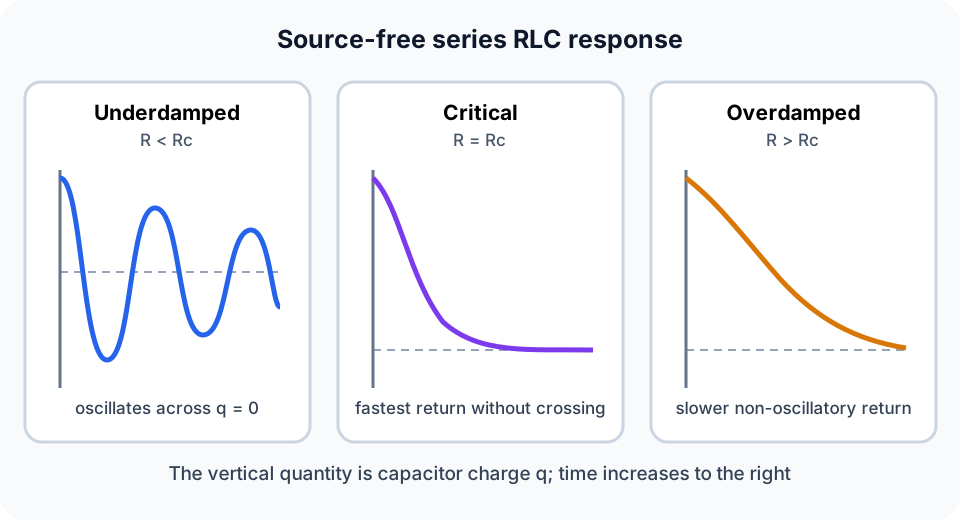
An RLC series circuit with no e.m.f. source is a second-order transient system. Depending on R, it can:
- oscillate with decaying amplitude (underdamped), or
- return to equilibrium without oscillating (critical/overdamped).
In H3, you are not expected to solve the most general second-order differential equation from scratch, but you should be able to set up the equation, identify the regime, and use/verify standard solution forms.
1. Definitions (Must Know)
- State variable (common choice): capacitor charge q(t) (C).
- Current: I(t) = dq/dt
- KVL for source-free series RLC: V_L + V_R + V_C = 0
- Using V_L = LdI/dt = Ld²q/dt², V_R = IR = Rdq/dt, V_C = q/C gives: Ld²q/dt² + Rdq/dt + q/C = 0
- Natural angular frequency (LC): ω₀ = 1/(square root of LC)
- Damping factor: γ = R/2L
- Damped angular frequency (underdamped): ω_d = square root of (ω₀²-γ²)
- Critical resistance: R_c = 2 square root of (L/C)
- Symbols used in this lesson: L (H), R (Ω), R_c critical resistance (Ω), C (F), q (C), I (A), t (s), ω₀,ω_d (rad s⁻¹), γ (s⁻¹).
2. Key Ideas (What Earns Marks)
- The governing equation is: q double dot + R/Lq dot + (1/LC)q = 0 where dots denote time derivatives.
- Determine the behaviour from R relative to R_c:
- Underdamped: R < R_c (oscillatory, decaying)
- Critical: R = R_c (fastest return without oscillation)
- Overdamped: R > R_c (no oscillation, slower return)
- In underdamped case, amplitude decays as e^(-γ t): q(t) = Qe^(-γ t) cos(ω_dt + φ) and I(t) = dq/dt is also sinusoidal with the same envelope.
- The resistor dissipates energy. For weak damping, the energy envelope and cycle-averaged stored energy decay approximately as e^(-2γ t); the instantaneous total stored energy is not a perfect exponential throughout each cycle.
Quick classification table:
| Regime | Condition | What you see |
|---|---|---|
| Underdamped | R < R_c | Oscillations with decaying envelope |
| Critical | R = R_c | Fastest return without oscillation |
| Overdamped | R > R_c | No oscillation, slower return |
3. Detailed Explanations
A. Setting up the ODE (the main H3 skill)
Use KVL and write each element voltage in terms of q:
- V_L = Ld²q/dt²
- V_R = Rdq/dt
- V_C = q/C
So: Lq double dot + Rq dot + q/C = 0
B. How to classify the response quickly
Define: ω₀ = 1/(square root of LC), γ = R/2L
- If γ < ω₀, ω_d is real and you get oscillations (underdamped).
- If γ = ω₀, you are critically damped.
- If γ > ω₀, you are overdamped.
Equivalent resistance test: R_c = 2 square root of (L/C)
C. “Use/verify” a given solution form (what the syllabus allows)
If you are given a proposed form for q(t), you can verify it by:
- differentiating to get q dot and q double dot, and
- substituting into Lq double dot + Rq dot + q/C = 0 to check it holds.
This is often faster than solving from scratch and is explicitly within H3 expectations.
4. Common Mistakes
- Using the wrong variable: mixing q(t) and I(t) without using I = dq/dt consistently.
- Forgetting the capacitor relation V_C = q/C.
- Using ω = 1/square root of LC even when R is not negligible (use ω_d for underdamped).
- Confusing γ = R/2L with τ = L/R (RL time constant).
5. Exam Tips
-
Start from the canonical ODE: Lq double dot + Rq dot + q/C = 0
-
Immediately compute R_c = 2 square root of (L/C) to classify the regime.
-
If the question gives/assumes “underdamped oscillations”, use: γ = R/2L
ω_d = square root of (1/LC-(R/2L)²)
-
Useful decay facts (underdamped):
- amplitude time constant: τₐₘₚ = 1/γ = 2L/R
- energy decays with half the time constant: τ_U = 1/2γ = L/R
6. Worked Examples
Modelled example 1
Classify the response and find ω_d
Problem
Study the worked solution
Find the undamped scale
Method
ω₀ = 500 rad s⁻¹.Reason
ω₀ = 1/square root of LC.Working
ω₀ = 1/square root of ((0.50)(8.0 × 10⁻⁶)) = 500Find damping rate
Method
γ = 10 s⁻¹.Reason
γ = R/(2L).Working
γ = 10/[2(0.50)] = 10Classify and calculate
Method
The response is underdamped and ω_d = 499.9 rad s⁻¹.Reason
γ < ω₀ and ω_d = square root of (ω₀²-γ²).Working
ω_d = square root of (500²-10²) = 499.9
Guided practice 2
Verify a proposed solution form (underdamped)
Problem
Try this before viewing the solution
Hints
Hint 1: group sine and cosine terms
View solution step by step
Differentiate
Method
q dot = Qe^(-γ t)(-γ c-ω_ds).Reason
Use product and chain rules, with c = cos ω_dt and s = sin ω_dt.Working
q double dot = Qe^(-γ t)[(γ²-ω_d²)c + 2γω_ds]Cancel sine terms
Method
2γ = R/L.Reason
The differential equation must hold for all t.Working
γ = R/(2L)Cancel cosine terms
Method
ω_d² = 1/(LC)-γ².Reason
Substituting the damping condition leaves this coefficient relation.Working
γ²-ω_d²-(R/L)γ + 1/(LC) = 0
Common misconception 3
Find the amplitude decay time constant
Learner claim
Try this before viewing the solution
View solution step by step
Read the envelope
Method
The amplitude factor is e^(-Rt/(2L)).Reason
γ = R/(2L).Working
e^(-t/τₐₘₚ) = e^(-Rt/(2L))Find the time constant
Method
τₐₘₚ = 0.080 s.Reason
τₐₘₚ = 2L/R.Working
τₐₘₚ = 2(0.20)/5.0 = 0.080 s
Examiner practice 4
Find the critical resistance
Examination question
Try this before viewing the solution
View solution step by step
State the boundary
1 markMethod
R_c = 2 square root of (L/C).Reason
Critical damping occurs when R/(2L) = 1/square root of LC.Working
R_c = 2 square root of (L/C)Substitute
1 markMethod
R_c = 2 square root of (0.20/(5.0 × 10⁻⁶)).Reason
Convert microfarads to farads.Working
square root of 40000 = 200Report
1 markMethod
R_c = 400 Ω.Reason
Resistance has ohm units.Working
R_c = 2(200) = 400 Ω
Self-mark with the mark scheme
Compare your response with each mark point. Select a point only when your response contains that evidence.
Self-mark boundary relation, substitution and value.
Challenge 5
Decide whether it is overdamped
Independent transfer
Try this before viewing the solution
Hints
Hint 1: compare with the boundary
View solution step by step
Compare resistances
Method
R > R_c.Reason
600 Ω > 400 Ω.Working
R/R_c = 1.5Classify
Method
The response is overdamped and non-oscillatory.Reason
Resistance exceeds the critical boundary.Working
R > R_c ⇒ overdamped
7. Mind Stretchers
Mind stretcher 1: Why R changes the frequencyExtension
In an LC circuit, ω₀ = 1/square root of LC. In an underdamped RLC circuit, the oscillation frequency is ω_d < ω₀.
Why does adding a resistor reduce the oscillation frequency?
Answer
The resistance introduces a term proportional to dq/dt in the differential equation. For an underdamped solution, this changes the oscillatory part of the characteristic response from ω₀ to ω_d = square root of (ω₀²-γ²). Since γ² > 0, ω_d < ω₀. Energy dissipation explains the shrinking amplitude; the differential equation gives the frequency shift.
Mind stretcher 2: How fast does the energy decay?Extension
In a weakly underdamped RLC circuit, the amplitude envelope decays like e^(-γ t), so the energy envelope scales approximately as U ∝ e^(-2γ t).
After time t = 1/γ, by what factor has the energy decreased?
Answer
At t = 1/γ: U/U₀ = e^(-2γ(1/γ)) = e⁻² ≈ 0.135 So the energy drops to about 13.5% of its initial value.
8. Optional/Enrichment: Full Solutions (Not Required)
Full derivations use the characteristic equation of the second-order ODE and produce different functional forms for under/critical/over damping. H3 typically focuses on using the standard forms and verifying them when needed.
Next step
Return to the RLC Circuits hub for mixed revision, then continue to Special Relativity.
Continue with the next resource in this course.
Course and syllabus information
- Course
- GCE A-Level H3 Physics
- Edition
- GCE A-Level H3 Physics 2027