Kinematics of Angular Motion
Key idea: Learn angular displacement, angular velocity, angular acceleration, and the constant-α rotational SUVAT equations, with worked examples and exam tips.
Continue where you stopped
The core idea
On this page
Learning objectives
- show an understanding of and use the terms angular displacement, angular velocity, and angular acceleration of a rigid body with respect to a fixed axis
- solve problems using the equations of motion for uniform angular acceleration that are analogous to the equations of motion for uniform linear acceleration
Kinematics of angular motion describes how a rigid body rotates about a fixed axis. The payoff is that the rotational equations under uniform angular acceleration are direct analogues of SUVAT.
1. Definitions (Must Know)
- Angular displacement, θ (rad): angle turned about a fixed axis.
- Angular velocity, ω (rad s⁻¹): rate of change of angular displacement, ω = dθ/dt.
- Angular acceleration, α (rad s⁻²): rate of change of angular velocity, α = dω/dt = d²θ/dt².
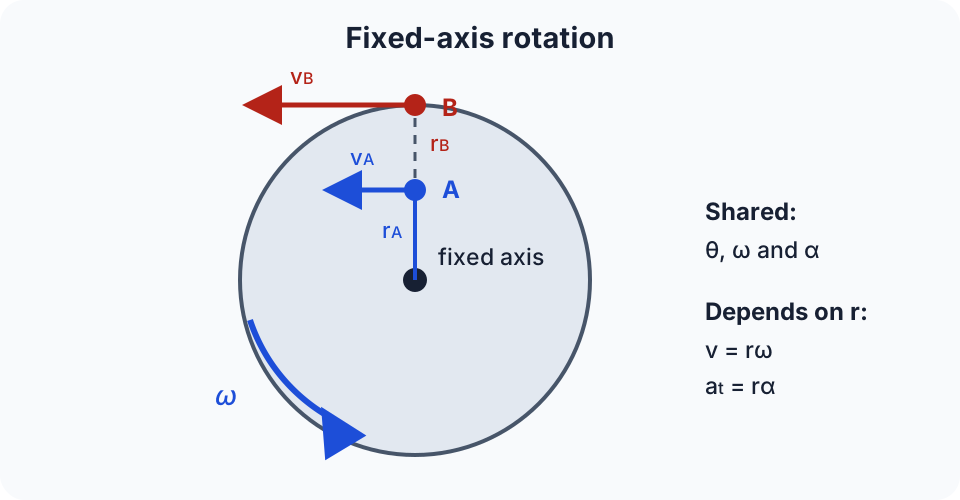
- Fixed axis rotation: every point on the rigid body moves in a circle centred on the axis, with the same θ, ω, α at any instant.
- Radian: θ = s/r where s is arc length and r is radius.
- Symbols used in this lesson: θ,θ₀ angle (rad), ω,ω₀ angular speed (rad s⁻¹), α angular acceleration (rad s⁻²), t time (s), r radius (m), s arc length (m), v tangential speed (m s⁻¹), aₜ tangential acceleration (m s⁻²).
2. Key Ideas (What Earns Marks)
- Rotational kinematics mirrors linear kinematics:
- x ↔ θ, v ↔ ω, a ↔ α.
- For a point at distance r from the axis: s = rθ, v = rω, aₜ = rα
- Under uniform angular acceleration (α constant), use the rotational “SUVAT” set:
ω = ω₀ + α t; θ = θ₀ + ω₀ t + (1/2)α t²; ω² = ω₀² + 2α(θ-θ₀)
Quick map (use a table when asked to compare):
| Linear (translation) | Rotation (fixed axis) | Units |
|---|---|---|
| displacement s | angle θ | m, rad |
| velocity v | angular speed ω | m s⁻¹, rad s⁻¹ |
| acceleration a | angular acceleration α | m s⁻², rad s⁻² |
3. Detailed Explanations
A. Linear–rotational links for a point on a rotating rigid body
If a point is at radius r from the axis:
- The arc length travelled is s = rθ.
- Differentiating gives tangential speed: v = ds/dt = rdθ/dt = rω
- Differentiating again gives tangential acceleration: aₜ = dv/dt = rdω/dt = rα
These are especially useful when a question gives a linear speed/acceleration and asks for ω or α (or vice versa).
B. Deriving the constant-α equations (one clean route)
If α is constant: α = dω/dt ⇒ ω = ω₀ + α t
Also ω = dθ/dt, so (use a dummy variable τ):
To eliminate t, use α = dω/dt = (dω/dθ)dθ/dt = ωdω/dθ:
4. Common Mistakes
- Using degrees in calculations without converting to radians (units of ω and α require radians).
- Confusing tangential acceleration aₜ = rα with centripetal acceleration aᵣ = rω² (different directions, different causes).
- Forgetting that r can differ for different points on the same rigid body (so different points have different v and aₜ, even though ω and α are shared).
- Substituting into the constant-α equations when α is not constant (the question must justify “uniform angular acceleration”).
5. Exam Tips
- Write a one-line map before you start: “use θ–ω–α as the rotational analogues of s–v–a.”
- Keep a clear sign convention (clockwise vs anticlockwise) and stick to it.
- Use radians by default; only convert to degrees at the end if the question asks for it.
- If a question mixes linear and rotational quantities, immediately write v = rω and aₜ = rα for the point of interest.
6. Worked Examples
Modelled example 1
Using constant angular acceleration (direct)
Problem
Study the worked solution
Set the initial condition
Method
ω₀ = 0.Reason
The wheel starts from rest.Working
ω₀ = 0Find angular speed
Method
ω = 10 rad s⁻¹.Reason
Use the constant-α velocity relation.Working
ω = 0 + (2.0)(5.0) = 10Find displacement
Method
Δθ = 25 rad.Reason
Use Δθ = ω₀t + (1/2)α t².Working
Δθ = (1/2)(2.0)(5.0)² = 25 rad
Guided practice 2
Converting between linear speed and angular speed
Problem
Try this before viewing the solution
Hints
Hint 1: link rim distance to angle
View solution step by step
Rearrange
Method
ω = v/r.Reason
Tangential speed increases with distance from the axis.Working
v = rωEvaluate
Method
ω = 15 rad s⁻¹.Reason
Divide the tangential speed by radius.Working
ω = 3.0/0.20 = 15 rad s⁻¹
Common misconception 3
Eliminating time (the ω² equation)
Learner claim
Try this before viewing the solution
View solution step by step
Use the angular relation
Method
ω² = ω₀² + 2αΔθ.Reason
Time is absent and all variables are angular.Working
Δθ = (ω²-ω₀²)/(2α)Evaluate
Method
Δθ = 100 rad.Reason
Substitute angular speed and acceleration consistently.Working
(150²-50²)/[2(100)] = 100 rad
Examiner practice 4
Tangential acceleration of a point on the rim
Examination question
Try this before viewing the solution
View solution step by step
State relation
1 markMethod
aₜ = rα.Reason
Angular acceleration maps to tangential acceleration through radius.Working
aₜ = rαSubstitute
1 markMethod
aₜ = (0.30)(4.0).Reason
Use SI quantities.Working
aₜ = 1.2Report
1 markMethod
aₜ = 1.2 m s⁻².Reason
Tangential acceleration is linear.Working
1.2 m s⁻²
Self-mark with the mark scheme
Compare your response with each mark point. Select a point only when your response contains that evidence.
Self-mark relation, substitution and result.
Challenge 5
Stopping time (sign convention matters)
Independent transfer
Try this before viewing the solution
Hints
Hint 1: set the final state
View solution step by step
Apply the velocity relation
Method
0 = 12 + 3.0α.Reason
Use the initial rotation direction as positive.Working
ω = ω₀ + α tSolve and interpret
Method
α = -4.0 rad s⁻².Reason
The negative direction opposes the positive initial angular velocity.Working
α = (0-12)/3.0 = -4.0 rad s⁻²
7. Mind Stretchers
Mind stretcher 1: Same ω, different vExtension
Two points A and B are on the same rigid body rotating about a fixed axis, with r_A = 0.10 m and r_B = 0.30 m.
If the body has angular speed ω, compare v_A and v_B.
Answer
Using v = rω: v_B/v_A = r_B/r_A = 0.30/0.10 = 3 So v_B = 3v_A even though both points share the same ω.
Mind stretcher 2: Tangential vs centripetal accelerationExtension
A wheel spins at constant angular speed ω (so α = 0). Does a point on the rim have zero acceleration? Explain.
Answer
No. If ω is constant, the tangential acceleration is zero (aₜ = rα = 0), but the point still has centripetal (radial) acceleration: aᵣ = rω² directed toward the centre, because the velocity direction is continuously changing.
8. Optional/Enrichment: Variable Angular Acceleration (Calculus Form)
If α is not constant, the constant-α equations do not apply. The safe starting points are: ω = dθ/dt, α = dω/dt and you integrate/differentiate according to what the question gives.
Next step
Return to the Rotational Motion hub, or continue in sequence to Moment of Inertia.
Continue with the next resource in this course.
Course and syllabus information
- Course
- GCE A-Level H3 Physics
- Edition
- GCE A-Level H3 Physics 2027