Moment of Inertia
Key idea: Learn how to compute moment of inertia using calculus and the parallel-axis theorem, with common results and worked examples.
Continue where you stopped
The core idea
On this page
Learning objectives
- show an understanding of and use the terms angular displacement, angular velocity, and angular acceleration of a rigid body with respect to a fixed axis
- solve problems using the equations of motion for uniform angular acceleration that are analogous to the equations of motion for uniform linear acceleration
- show an understanding of and use the terms angular momentum and moment of inertia of a rotating rigid body
- calculate the moment of inertia about an axis for simple bodies by using calculus, the parallel-axis theorem or otherwise (knowledge of the perpendicular-axis theorem and mathematical derivation of the moment of inertia for spheres are not required)
- show an understanding of torque produced by a force relative to a reference point, and apply the principle that torque is related to the rate of change of angular momentum to solve problems, such as those involving point masses, rigid bodies, or bodies with a variable moment of inertia e.g. an ice-skater
- Apply Eₖ,rot = ½Iω² to the rotational kinetic energy of a rigid body.
- Derive Eₖ,rot = ½Iω² for a rigid body from the equations of motion.
- recall and apply the result that the motion of a rigid body can be regarded as translational motion of its centre of mass with rotational motion about an axis through the centre of mass to solve problems, including the use of F ⩽ µN for solid surfaces in no-slip contact (no distinction is made between the coefficient of static and kinetic friction)
The moment of inertia describes how a body’s mass is distributed relative to a chosen rotation axis. For fixed-axis rotation with constant I, it appears in: ∑τₑₓₜ = Iα
1. Definitions (Must Know)
- Moment of inertia, I (kg m²): for point masses about a fixed axis, I = ∑ mᵢrᵢ² where rᵢ is the perpendicular distance from the axis.
- Continuous body form: I = ∫ r² dm
- Axis matters: the same object has different I about different axes.
- Parallel-axis theorem: I = I_cm + Md² where I_cm is about a parallel axis through the centre of mass, M is total mass, and d is the perpendicular separation between axes.
- Symbols used in this lesson: I moment of inertia (kg m²), m mass (kg), M total mass (kg), r distance from axis (m), x coordinate (m), L length (m), R radius (m), d axis separation (m), λ linear mass density (kg m⁻¹).
2. Key Ideas (What Earns Marks)
- I is a geometry + mass distribution quantity, not a new force law.
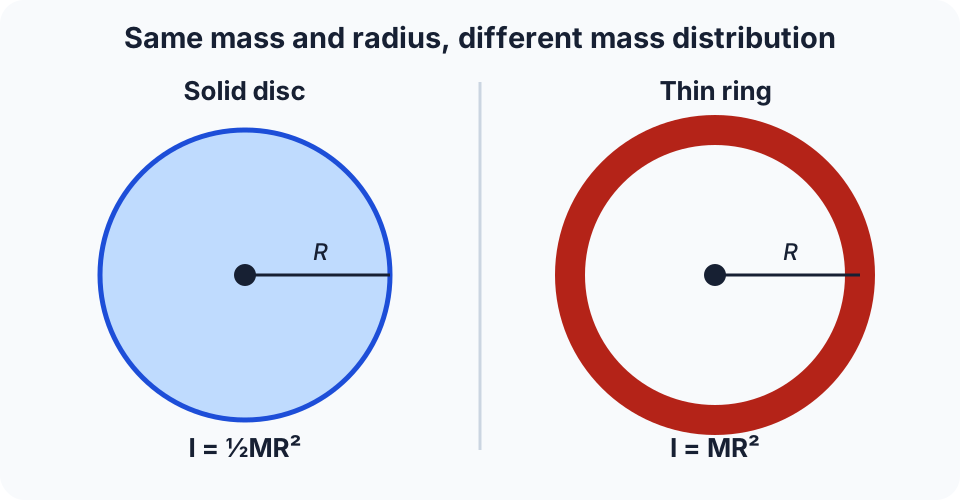
- The r² weighting means mass far from the axis increases I strongly.
- For “simple bodies”, you can compute I by:
- direct calculus with I = ∫ r² dm, or
- using a known result + the parallel-axis theorem.
3. Detailed Explanations
A. The calculus method: I = ∫ r² dm
General steps:
- Choose the axis and define a coordinate (e.g. x along a rod).
- Express r (distance to axis) in terms of the coordinate.
- Express dm using a density (e.g. dm = λ dx for a uniform rod).
- Integrate over the full object.
B. Example derivation: uniform thin rod about its centre
Rod of length L and mass M, axis through the centre and perpendicular to the rod.
Uniform linear density: λ = M/L, so dm = λ dx. Distance to axis is r = |x|.
C. Parallel-axis theorem in action (rod about its end)
For the same rod, an axis through one end is a distance d = L/2 from the centre axis:
D. Common “simple body” results (memorise + use carefully)
| Object (uniform) | Axis | Result |
|---|---|---|
| Thin ring/hoop | Central axis | I = MR² |
| Solid disc/cylinder | Central axis | I = 1/2 MR² |
| Thin rod | Through centre, perpendicular to rod | I = (1/12)ML² |
| Thin rod | Through end, perpendicular to rod | I = (1/3)ML² |
4. Common Mistakes
- Using the wrong r: it must be the perpendicular distance to the axis, not just a coordinate distance.
- Forgetting that changing the axis changes I (even for the same object).
- Forgetting units: I must be in kg m².
- Misusing the parallel-axis theorem:
- d is the separation of axes (not “radius” unless the geometry matches),
- M is the total mass of the object (not a part of it).
5. Exam Tips
- Start by writing: “Axis: …” then draw a tiny sketch; it prevents wrong-r errors.
- If you’re asked for I about a non-centre axis, look for a route: “known I_cm + parallel-axis theorem”.
- Quick plausibility check: moving the axis away from the mass should make I larger.
6. Worked Examples
Modelled example 1
Disc vs ring (same M and R)
Problem
Study the worked solution
State both results
Method
I_ring = MR² and I_disc = (1/2)MR².Reason
The ring places all mass at radius R, while the disc distributes mass from zero to R.Working
I = ∫ r²dmCompare
Method
The ring has twice the disc’s inertia.Reason
The common MR² factors cancel in the ratio.Working
I_ring/I_disc = 2
Guided practice 2
Using parallel-axis theorem (disc about a tangent axis)
Problem
Try this before viewing the solution
Hints
Hint 1: identify the centre axis result
View solution step by step
Set the reference
Method
I_cm = (1/2)MR² and d = R.Reason
The tangent axis is parallel to and one radius from the central axis.Working
I = I_cm + Md²Combine
Method
I = (3/2)MR².Reason
Add the parallel-axis shift MR².Working
I = (1/2)MR² + MR² = (3/2)MR²
Common misconception 3
From I to angular acceleration
Learner claim
Try this before viewing the solution
View solution step by step
Use rotational dynamics
Method
α = τₙₑₜ/I.Reason
τₙₑₜ = Iα.Working
α = τ/IEvaluate
Method
α = 3.0 rad s⁻².Reason
2.4/0.80 = 3.0.Working
3.0 rad s⁻²
Examiner practice 4
Point masses about an axis
Examination question
Try this before viewing the solution
View solution step by step
State definition
1 markMethod
I = ∑ mᵢrᵢ².Reason
Each point mass contributes its mass times squared perpendicular distance.Working
I = ∑ mr²Substitute
1 markMethod
Use all three squared radii.Reason
Distances are measured from the stated axis.Working
(0.50)(0.20²) + (0.30)(0.40²) + (0.20)(0.10²)Add contributions
1 markMethod
0.020 + 0.048 + 0.002 kg m².Reason
All contributions are non-negative.Working
0.070 kg m²Report
1 markMethod
I = 0.070 kg m².Reason
Moment of inertia has mass-times-length-squared units.Working
0.070 kg m²
Self-mark with the mark scheme
Compare your response with each mark point. Select a point only when your response contains that evidence.
Self-mark definition, substitution, sum and units.
Challenge 5
Radius of gyration
Independent transfer
Try this before viewing the solution
Hints
Hint 1: isolate squared radius
View solution step by step
Calculate
Method
k = 0.300 m.Reason
Take the positive square root of I/M.Working
k = square root of (0.36/4.0) = 0.300 mInterpret
Method
The body has the same inertia as if all 4.0 kg were concentrated 0.300 m from the axis.Reason
I = Mk² defines the equivalent mass radius.Working
I = M(0.300)²
7. Mind Stretchers
Mind stretcher 1: Why “hollow” objects spin up slower (same mass)Extension
Two wheels have the same mass and radius. Wheel A has most of its mass near the rim; Wheel B has more mass near the centre. The same torque is applied to both.
Which wheel has the larger angular acceleration, and why?
Answer
Wheel B. Concentrating mass nearer the axis reduces the average r², so I is smaller. Since α = τₙₑₜ/I, smaller I gives larger α for the same torque.
Mind stretcher 2: Which parallel axis gives the smallest I?Extension
For a given rigid body and a set of axes all parallel to each other, which one gives the smallest moment of inertia: the axis through the centre of mass, or an axis offset from it?
Answer
The axis through the centre of mass gives the smallest I. By the parallel-axis theorem, any parallel axis a distance d away has: I = I_cm + Md² and since Md² ≥ 0, moving the axis away can only increase I.
8. Optional/Enrichment
A. Perpendicular-axis theorem (not required)
Some courses use I_z = Iₓ + I_y for thin laminae. The H3 syllabus does not require this theorem; use it only if a question explicitly guides you.
B. Spheres (derivations not required)
Deriving I for spheres is not required at H3. If a sphere’s result is needed, the question will usually provide it or the setup will be simplified.
Next step
Return to the Rotational Motion hub, or use this axis-dependent inertia in Dynamics of Angular Motion.
Continue with the next resource in this course.
Course and syllabus information
- Course
- GCE A-Level H3 Physics
- Edition
- GCE A-Level H3 Physics 2027