Charged particles in a uniform electric field
Key idea: A uniform electric field gives constant acceleration qE/m. A charge entering perpendicular to it follows a parabola in the field, then travels straight after leaving if no other force acts.
Loading guide controls…
Guided lessons · coming soon
Guided lesson
How Guide me works
Work through examples, try questions and get help when you need it. You stay in this lesson throughout.
- Read the short instruction beside the current activity.
- Try the question using its usual answer controls, or work on paper.
- Compare your answer, revisit an explanation if needed, and return to the same question.
A preview uses the public lesson and no guided start. Guided sessions are unscored. Free accounts get 2 starts a day; Premium includes unlimited starts in covered courses. You confirm before a new session starts.
Steps in this guide
These links open parts of the lesson. Use the guide’s actions to continue your session.
More
Offline pages
Saved on this device only. Connect at least once every 30 days to confirm Premium. Sign-out or a change of account removes saved copies.
Guided steps
- Use charge sign to find the constant acceleration’s direction.
- Relate potential-energy loss to kinetic-energy gain, including initial motion.
- Find electron speed from the accelerating potential difference.
- Compare energy gains, then calculate the proton’s speed.
- Include the electron’s initial energy in its final speed.
- Separate horizontal velocity from transverse acceleration.
- Find transit time, deflection and the required plate clearance.
- Find time, acceleration, deflection magnitude and direction.
- Derive the parabola and explain the straight tangent after exit.
- Find deflection at doubled entry speed and describe the exit path.
On this page
You stopped at:
ContinueRevision Mode is on. Worked examples are hidden.
An old television tube, an electron microscope and a particle accelerator all steer charged particles with electric fields. In a uniform field the force on a particle is constant, so its motion is the same kind of motion as a ball thrown in the Earth’s gravitational field: straight-line acceleration or a parabola.
Constant force, constant acceleration
In a uniform field E, a particle of charge q and mass m feels a constant force qE and so has a constant acceleration
provided the electric force greatly exceeds its weight and its speed remains well below the speed of light. The equations of uniformly accelerated motion then apply while the particle is in the field.
Accelerating along the field
A particle that starts from rest, or moves parallel to the field, speeds up or slows down in a straight line. To find its speed, energy is quicker than force and acceleration. With Δ V = V final -V initial, the field does work -qΔ V, which becomes kinetic energy:
For a particle accelerated from rest through a p.d. of magnitude V, this becomes (1/2)mv² = |q|V. An electron gains energy moving to higher potential; a positive charge gains energy moving to lower potential.
This needs only the p.d., not the field strength or the distance, and it works even if the field is not uniform.
Worked example 1
Speed after an accelerating p.d.
Problem
An electron starts from rest and is accelerated through a p.d. of 2.0 kV. Find its final speed. The mass of an electron is 9.11 × 10⁻³¹ kg.
Show full solution
Energy equation
Method
Equate the kinetic energy gained to the work done by the field.Reason
Only the electric force does work, and the electron starts from rest.Working
Answer
(1/2)mv² = eV, so v = square root of (2eV/m)
Speed
Working
Answer
v = square root of ((2(1.60 × 10⁻¹⁹)(2.0 × 10³))/(9.11 × 10⁻³¹)) = 2.7 × 10⁷ m s⁻¹
Quick check
This is about 9% of the speed of light, so ignoring relativity still gives a fair answer.
Spot the mistake 1
Same p.d., different particle
Learner claim
A proton and an electron are each accelerated from rest through 500 V. A student says they reach the same speed, because their charges have the same size. What is wrong, and what is the proton’s speed? The mass of a proton is 1.67 × 10⁻²⁷ kg.
Try this before viewing the solution
Show the steps Optional working
Show solution step by step
Same energy
Method
Compare the kinetic energies first.Reason
Both particles have charge of size e and cross the same p.d., so the field does the same work on each.Working
Answer
Each gains eV = (1.60 × 10⁻¹⁹)(500) = 8.0 × 10⁻¹⁷ J.
Proton's speed
Working
Answer
v = square root of ((2(8.0 × 10⁻¹⁷))/(1.67 × 10⁻²⁷)) = 3.1 × 10⁵ m s⁻¹
Common mistake
Equal kinetic energy does not mean equal speed. The proton is about 1840 times as massive, so it ends up about 43 times slower.
Try it yourself 1
An electron that is already moving
Problem
An electron moving at 1.0 × 10⁶ m s⁻¹ passes from a point at 0 V to a point at + 20 V. Only the electric force acts on it. Find its final speed.
Find the final speed
Show the steps Optional working
Hints
Hint 1
starting energy
What energy does the electron already have, and does the potential change increase or decrease it?
Show solution step by step
Energy equation
Reason
The electron moves to a higher potential, so it loses potential energy e × 20 V and gains that much kinetic energy.Working
Answer
(1/2)mv² = (1/2)mu² + e(20)
Final speed
Working
Answer
v = square root of (u² + 2e(20)/m) = square root of ((1.0 × 10⁶)² + 7.0 × 10¹²) = 2.8 × 10⁶ m s⁻¹
Quick check
Check with energies: the electron starts with 4.6 × 10⁻¹⁹ J and gains 20 eV = 3.2 × 10⁻¹⁸ J. A kinetic energy of 3.7 × 10⁻¹⁸ J gives 2.8 × 10⁶ m s⁻¹.
Entering at right angles to the field
A particle that enters the field moving at right angles to it behaves like a ball thrown horizontally. Take x along its original direction and y along the field.
- There is no force along x, so the x-component of velocity stays uₓ. The time in the field is set by the length of the plates: t = L/uₓ.
- Along y the particle starts from rest with acceleration a = qE/m, so its deflection is y = (1/2)at².
Eliminating t gives y = (a/2uₓ²)x²: the path in the field is a parabola. A positive particle is deflected along the field, a negative one against it. Once the particle leaves the field there is no force on it, and it travels in a straight line along the direction it had at the exit.
Worked example 2
Deflection of a proton
Problem
A proton enters a uniform field at right angles to it, with speed 2.0 × 10⁶ m s⁻¹. The field strength is 1.0 × 10⁴ V m⁻¹ and the field region is 0.050 m long. Find the sideways deflection of the proton when it leaves the field. The mass of a proton is 1.67 × 10⁻²⁷ kg.
Show full solution
Time in the field
Method
Divide the length of the field region by the entry speed.Reason
There is no force along the original direction, so that velocity component stays constant.Working
Answer
t = 0.050/(2.0 × 10⁶) = 2.5 × 10⁻⁸ s
Acceleration
Reason
The constant electric force acts along the field only.Working
Answer
a = eE/m = ((1.60 × 10⁻¹⁹)(1.0 × 10⁴))/(1.67 × 10⁻²⁷) = 9.58 × 10¹¹ m s⁻²
Deflection
Working
Answer
y = (1/2)at² = (1/2)(9.58 × 10¹¹)(2.5 × 10⁻⁸)² = 3.0 × 10⁻⁴ m, along the field
Quick check
If the proton enters midway between the plates, its 0.30 mm deflection requires a gap greater than 0.60 mm to leave without hitting a plate. The calculated trajectory applies only while it remains in the field.
Proton deflection inside a uniform field
Calculated parabolic vertical deflection versus horizontal travel inside the uniform field; it starts with a horizontal tangent.
Scroll across the figure to read all labels.
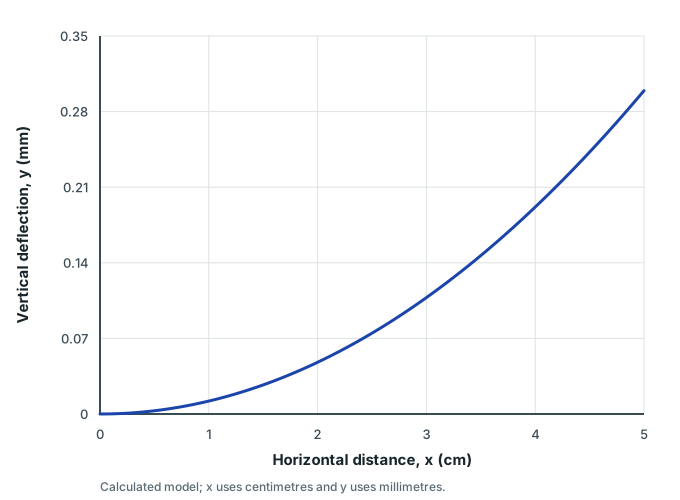
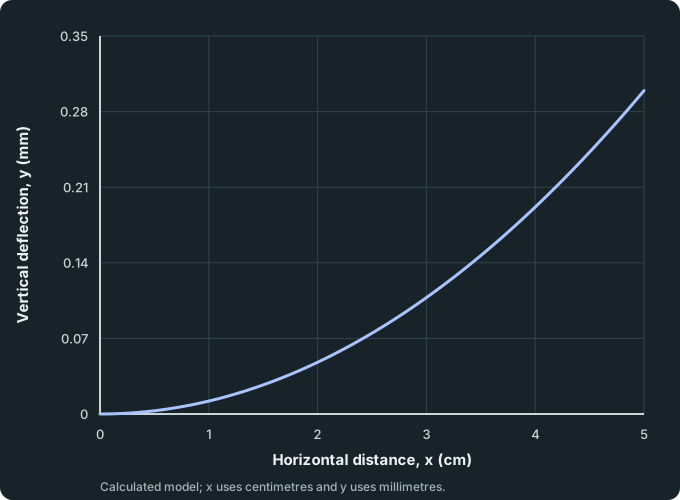
View figure data
| Horizontal distance, x (cm) | Proton: y = aᵧ(x/uₓ)²/2 |
|---|---|
| 0.00 | 0.00000000 |
| 0.05 | 0.00002994 |
| 0.10 | 0.00011976 |
| 0.15 | 0.00026946 |
| 0.20 | 0.00047904 |
| 0.25 | 0.00074850 |
| 0.30 | 0.00107784 |
| 0.35 | 0.00146707 |
| 0.40 | 0.00191617 |
| 0.45 | 0.00242515 |
| 0.50 | 0.00299401 |
| 0.55 | 0.00362275 |
| 0.60 | 0.00431138 |
| 0.65 | 0.00505988 |
| 0.70 | 0.00586826 |
| 0.75 | 0.00673653 |
| 0.80 | 0.00766467 |
| 0.85 | 0.00865269 |
| 0.90 | 0.00970060 |
| 0.95 | 0.01080838 |
| 1.00 | 0.01197605 |
| 1.05 | 0.01320359 |
| 1.10 | 0.01449102 |
| 1.15 | 0.01583832 |
| 1.20 | 0.01724551 |
| 1.25 | 0.01871257 |
| 1.30 | 0.02023952 |
| 1.35 | 0.02182635 |
| 1.40 | 0.02347305 |
| 1.45 | 0.02517964 |
| 1.50 | 0.02694611 |
| 1.55 | 0.02877246 |
| 1.60 | 0.03065868 |
| 1.65 | 0.03260479 |
| 1.70 | 0.03461078 |
| 1.75 | 0.03667665 |
| 1.80 | 0.03880240 |
| 1.85 | 0.04098802 |
| 1.90 | 0.04323353 |
| 1.95 | 0.04553892 |
| 2.00 | 0.04790419 |
| 2.05 | 0.05032934 |
| 2.10 | 0.05281437 |
| 2.15 | 0.05535928 |
| 2.20 | 0.05796407 |
| 2.25 | 0.06062874 |
| 2.30 | 0.06335329 |
| 2.35 | 0.06613772 |
| 2.40 | 0.06898204 |
| 2.45 | 0.07188623 |
| 2.50 | 0.07485030 |
| 2.55 | 0.07787425 |
| 2.60 | 0.08095808 |
| 2.65 | 0.08410180 |
| 2.70 | 0.08730539 |
| 2.75 | 0.09056886 |
| 2.80 | 0.09389222 |
| 2.85 | 0.09727545 |
| 2.90 | 0.10071856 |
| 2.95 | 0.10422156 |
| 3.00 | 0.10778443 |
| 3.05 | 0.11140719 |
| 3.10 | 0.11508982 |
| 3.15 | 0.11883234 |
| 3.20 | 0.12263473 |
| 3.25 | 0.12649701 |
| 3.30 | 0.13041916 |
| 3.35 | 0.13440120 |
| 3.40 | 0.13844311 |
| 3.45 | 0.14254491 |
| 3.50 | 0.14670659 |
| 3.55 | 0.15092814 |
| 3.60 | 0.15520958 |
| 3.65 | 0.15955090 |
| 3.70 | 0.16395210 |
| 3.75 | 0.16841317 |
| 3.80 | 0.17293413 |
| 3.85 | 0.17751497 |
| 3.90 | 0.18215569 |
| 3.95 | 0.18685629 |
| 4.00 | 0.19161677 |
| 4.05 | 0.19643713 |
| 4.10 | 0.20131737 |
| 4.15 | 0.20625749 |
| 4.20 | 0.21125749 |
| 4.25 | 0.21631737 |
| 4.30 | 0.22143713 |
| 4.35 | 0.22661677 |
| 4.40 | 0.23185629 |
| 4.45 | 0.23715569 |
| 4.50 | 0.24251497 |
| 4.55 | 0.24793413 |
| 4.60 | 0.25341317 |
| 4.65 | 0.25895210 |
| 4.70 | 0.26455090 |
| 4.75 | 0.27020958 |
| 4.80 | 0.27592814 |
| 4.85 | 0.28170659 |
| 4.90 | 0.28754491 |
| 4.95 | 0.29344311 |
| 5.00 | 0.29940120 |
Guided practice 1
Deflection of an electron beam
Problem
An electron enters the field between two plates at right angles to the field, with speed 3.0 × 10⁷ m s⁻¹. The plates are 0.060 m long and the field between them is 5.0 × 10³ V m⁻¹. The gap is wide enough for the electron to leave without hitting a plate. Find its time between the plates and its deflection magnitude and direction. Use mₑ = 9.11 × 10⁻³¹ kg and e = 1.60 × 10⁻¹⁹ C.
Find the time and the deflection
Show the steps Optional working
Hints
Hint 1
order
Which velocity component stays constant, and how does that determine the time in the field?
Show solution step by step
Time between the plates
Reason
No force acts along the plates, so the horizontal speed stays constant.Working
Answer
t = 0.060/(3.0 × 10⁷) = 2.0 × 10⁻⁹ sTransverse acceleration
Method
Divide the electric force by the electron’s mass.Reason
The constant force eE acts across the plates, towards the positive plate for a negative charge.Working
Answer
a = eE/mₑ = ((1.60 × 10⁻¹⁹)(5.0 × 10³))/(9.11 × 10⁻³¹) = 8.8 × 10¹⁴ m s⁻²Deflection
Method
Use y = (1/2)at².Reason
The electron starts with no velocity across the plates.Working
Answer
y = (1/2)(8.8 × 10¹⁴)(2.0 × 10⁻⁹)² = 1.8 × 10⁻³ m, towards the positive plate
Quick check
The two motions are independent. The field changes only the vertical velocity, so the time between the plates depends on the horizontal speed alone.
Check your understanding 1
For a particle entering perpendicular to a uniform field, take x along entry velocity and + y along the field. Derive its path equation and explain the shape inside and after the field. Work on paper and record the equations and your conclusion.
Show answer
No force acts along x, so x = uₓ t. Along y, ay = qE/m and y = (1/2)ay t². Eliminating time gives y = qE x²/(2muₓ²): a parabola, with negative y for an electron. After leaving an ideal field that ends at the plate edge, both velocity components are constant, so the path follows a straight tangent to the exit trajectory.
Check your understanding 2 Twice the entry speed
A proton enters the same field as in the proton example, but at twice the speed. Find its deflection when it leaves the field, and describe its path after it leaves.
Show answer
The acceleration is the same, but the proton spends half as long in the field, so the deflection is a quarter as large: 0.075 mm. After leaving the field there is no force on it, so it moves in a straight line in the direction it had at the exit.
Common mistakes
- Finding the time in the field from the deflection instead of from the length of the plates and the entry speed.
- Giving the particle an acceleration along its original direction; the force is only along the field.
- Drawing the path after the plates as a continuing curve instead of a straight line.
- Using (1/2)mv² = qV for a particle that did not start from rest.
- Deflecting an electron along the field instead of towards the positive plate.
Keep track of this lesson
Mark the lesson done when you have worked through it.
Lesson progress is optional and kept on this device.
Your lesson mark records your own study. Checks are kept separately in My Learning.
Spotted an error? Report a correction