Blackbody Radiation
Key idea: Interpret blackbody spectra and apply Stefan–Boltzmann and Wien laws while distinguishing emitted power, spectral intensity, temperature, and emissivity.
Continue where you stopped
The core idea
On this page
Learning objectives
- Connect blackbody evidence, Planck quantisation, photon momentum, and Compton scattering.
A blackbody is an ideal surface that absorbs all incident electromagnetic radiation and, in thermal equilibrium, emits the maximum possible spectral radiance at each wavelength for its temperature. A cavity with a small hole provides a close experimental approximation.
1. Definitions and quantities
-
Absolute temperature, T (K), sets the shape and scale of the spectrum.
-
Spectral intensity describes how emission is distributed over wavelength or frequency. Always identify which variable is on the horizontal axis.
-
Emissivity, e, is the ratio of a real surface’s total emissive power to that of a blackbody at the same temperature; 0 ≤ e ≤ 1.
-
Stefan–Boltzmann law:
P = eσ AT⁴
where σ = 5.67 × 10⁻⁸ W m⁻²K⁻⁴.
-
Wien displacement law:
λₘₐₓT = b
where b = 2.90 × 10⁻³ m K for a wavelength spectrum.
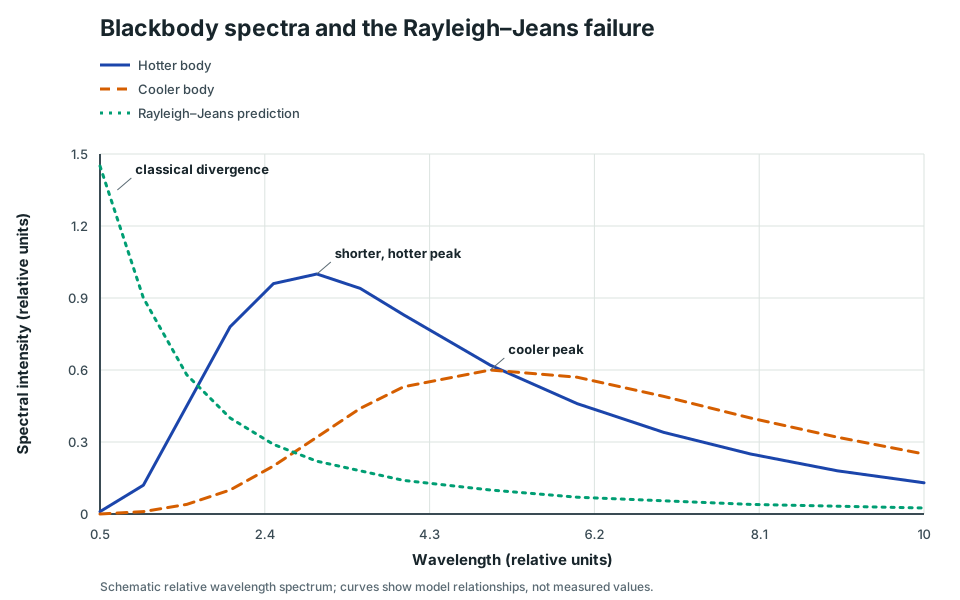
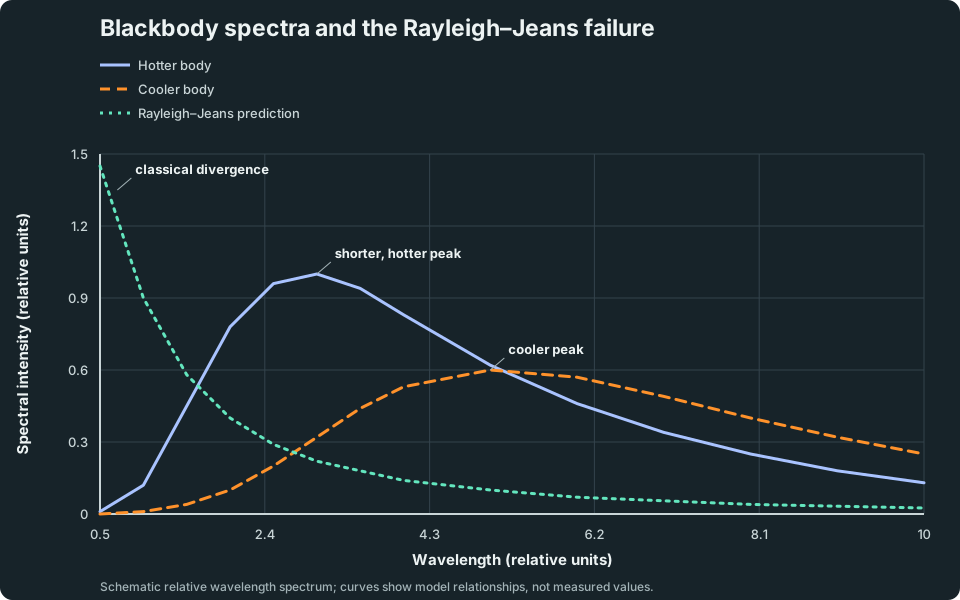
Blackbody spectra and the Rayleigh–Jeans failure
Hotter and cooler blackbody spectra each rise to a peak and fall at short wavelength. The hotter peak is at shorter wavelength and has greater area. A dashed Rayleigh–Jeans curve diverges toward zero wavelength.
Scroll across the graph to read all labels.
View figure data
| Series | Wavelength (relative units) | Wavelength uncertainty | Spectral intensity (relative units) | Spectral intensity uncertainty |
|---|---|---|---|---|
| Hotter body | 0.5 | 0.01 | ||
| Hotter body | 1 | 0.12 | ||
| Hotter body | 1.5 | 0.45 | ||
| Hotter body | 2 | 0.78 | ||
| Hotter body | 2.5 | 0.96 | ||
| Hotter body | 3 | 1 | ||
| Hotter body | 3.5 | 0.94 | ||
| Hotter body | 4 | 0.83 | ||
| Hotter body | 5 | 0.62 | ||
| Hotter body | 6 | 0.46 | ||
| Hotter body | 7 | 0.34 | ||
| Hotter body | 8 | 0.25 | ||
| Hotter body | 9 | 0.18 | ||
| Hotter body | 10 | 0.13 | ||
| Cooler body | 0.5 | 0 | ||
| Cooler body | 1 | 0.01 | ||
| Cooler body | 1.5 | 0.04 | ||
| Cooler body | 2 | 0.1 | ||
| Cooler body | 2.5 | 0.2 | ||
| Cooler body | 3 | 0.32 | ||
| Cooler body | 3.5 | 0.44 | ||
| Cooler body | 4 | 0.53 | ||
| Cooler body | 5 | 0.6 | ||
| Cooler body | 6 | 0.57 | ||
| Cooler body | 7 | 0.49 | ||
| Cooler body | 8 | 0.4 | ||
| Cooler body | 9 | 0.32 | ||
| Cooler body | 10 | 0.25 | ||
| Rayleigh–Jeans prediction | 0.5 | 1.45 | ||
| Rayleigh–Jeans prediction | 1 | 0.9 | ||
| Rayleigh–Jeans prediction | 1.5 | 0.58 | ||
| Rayleigh–Jeans prediction | 2 | 0.4 | ||
| Rayleigh–Jeans prediction | 2.5 | 0.29 | ||
| Rayleigh–Jeans prediction | 3 | 0.22 | ||
| Rayleigh–Jeans prediction | 4 | 0.14 | ||
| Rayleigh–Jeans prediction | 5 | 0.1 | ||
| Rayleigh–Jeans prediction | 6 | 0.07 | ||
| Rayleigh–Jeans prediction | 8 | 0.04 | ||
| Rayleigh–Jeans prediction | 10 | 0.025 |
2. Reading a spectrum
For a wavelength spectrum:
- the area under the curve is proportional to total emitted power per unit area;
- the hotter curve lies higher overall and has a larger area because total power varies as T⁴;
- the hotter curve peaks at smaller λ because λₘₐₓ ∝ 1/T;
- the intensity tends to zero at both very long and very short wavelength.
Do not convert a wavelength peak to a frequency peak using f = c/λₘₐₓ. Spectral density is defined per unit interval, and the change of variable introduces a Jacobian; the two peak locations are not simple reciprocals.
3. Physical model and assumptions
A cavity’s walls absorb and emit radiation until the radiation field reaches thermal equilibrium. The small hole samples that field while disturbing it minimally. The ideal laws assume uniform temperature and negligible external irradiation when discussing emitted power.
For a real body exchanging radiation with surroundings at temperature Tₛ, the net radiative power is
Pₙₑₜ = eσ A(T⁴-Tₛ⁴)
not simply eσ AT⁴.
4. Common mistakes
- Saying a blackbody emits no radiation because it appears black. Absorption and emission are different processes; a hot blackbody is a strong emitter.
- Using degrees Celsius in fourth-power or displacement laws. Use kelvin.
- Treating the peak height as total power. Total power corresponds to area under the spectrum.
- Applying Wien’s wavelength constant to a frequency-spectrum peak.
- Forgetting emissivity or surrounding radiation for a real surface when the question supplies them.
6. Worked Examples
Modelled example 1
Peak wavelength of a hot surface
Problem
Study the worked solution
Apply Wien's law
Method
λₘₐₓ = 5.0 × 10⁻⁷ m = 500 nm.Reason
Peak wavelength is inversely proportional to absolute temperature.Working
λₘₐₓ = (2.90 × 10⁻³)/5800 = 5.0 × 10⁻⁷ m
Guided practice 2
Power change with temperature
Problem
Try this before viewing the solution
Hints
Hint 1: cancel unchanged factors
View solution step by step
Form the fourth-power ratio
Method
P₂/P₁ = 16.Reason
Stefan–Boltzmann power scales as T⁴ for the same surface.Working
P₂/P₁ = (600/300)⁴ = 16
Challenge 3
Net radiative loss
Independent transfer
Try this before viewing the solution
Hints
Hint 1: subtract both radiation streams
View solution step by step
Use net emission
Method
Pₙₑₜ = 4.0 × 10² W.Reason
The surface emits and also absorbs radiation from its surroundings.Working
Pₙₑₜ = eσ A(T⁴-Tₛ⁴) = (0.80)(5.67 × 10⁻⁸)(0.50)(400⁴-300⁴) = 4.0 × 10² W
7. Model check
Mind stretcher 1: Temperature scaling checkExtension
If T doubles, λₘₐₓ halves while total power per unit area rises by a factor of 16. Those simultaneous trends are a useful check on any spectrum sketch.
Next: Failure of Classical Theory.
Continue with the next resource in this course.
Course and syllabus information
- Course
- Advanced Physics
- Edition
- Advanced Physics