Failure of Classical Theory
Key idea: Explain where the Rayleigh–Jeans blackbody model succeeds, why it diverges at short wavelength, and how experiment motivates energy quantisation.
Continue where you stopped
The core idea
On this page
Learning objectives
- Connect blackbody evidence, Planck quantisation, photon momentum, and Compton scattering.
The Rayleigh–Jeans model correctly describes the long-wavelength part of a blackbody spectrum, but it predicts unbounded energy at short wavelength. The failure is not merely a poor fitted constant: it exposes a wrong classical assumption about how thermal energy is shared among electromagnetic modes.
1. Classical prediction
For spectral energy density per unit wavelength, the Rayleigh–Jeans law is
u_λ(λ,T) = (8π kT)/λ⁴
where u_λ dλ is energy per unit volume in the wavelength interval [λ,λ + dλ].
At fixed T,
u_λ ∝ λ⁻⁴
so the prediction diverges as λ → 0.
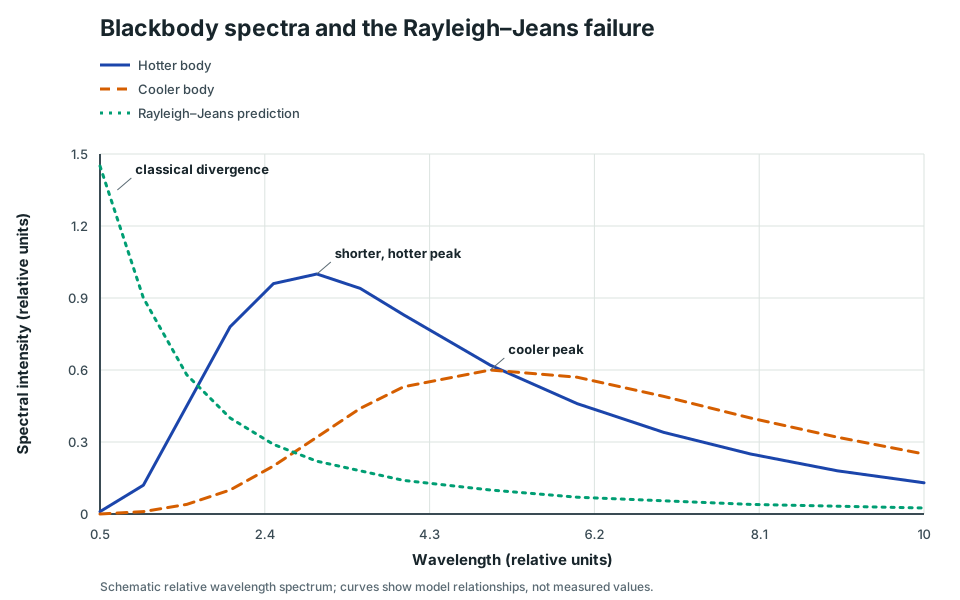
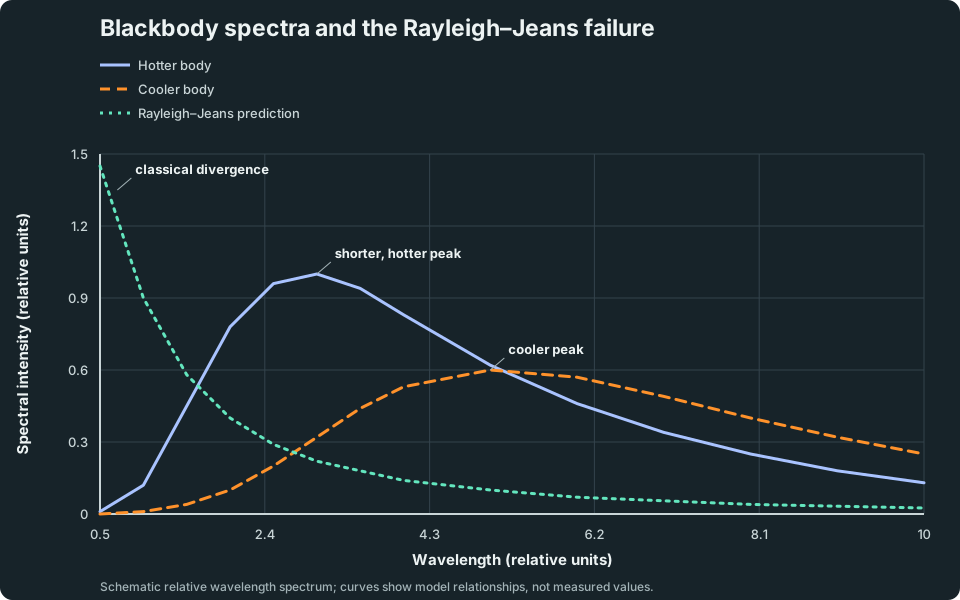
Blackbody spectra and the Rayleigh–Jeans failure
Hotter and cooler blackbody spectra each rise to a peak and fall at short wavelength. The hotter peak is at shorter wavelength and has greater area. A dashed Rayleigh–Jeans curve diverges toward zero wavelength.
Scroll across the graph to read all labels.
View figure data
| Series | Wavelength (relative units) | Wavelength uncertainty | Spectral intensity (relative units) | Spectral intensity uncertainty |
|---|---|---|---|---|
| Hotter body | 0.5 | 0.01 | ||
| Hotter body | 1 | 0.12 | ||
| Hotter body | 1.5 | 0.45 | ||
| Hotter body | 2 | 0.78 | ||
| Hotter body | 2.5 | 0.96 | ||
| Hotter body | 3 | 1 | ||
| Hotter body | 3.5 | 0.94 | ||
| Hotter body | 4 | 0.83 | ||
| Hotter body | 5 | 0.62 | ||
| Hotter body | 6 | 0.46 | ||
| Hotter body | 7 | 0.34 | ||
| Hotter body | 8 | 0.25 | ||
| Hotter body | 9 | 0.18 | ||
| Hotter body | 10 | 0.13 | ||
| Cooler body | 0.5 | 0 | ||
| Cooler body | 1 | 0.01 | ||
| Cooler body | 1.5 | 0.04 | ||
| Cooler body | 2 | 0.1 | ||
| Cooler body | 2.5 | 0.2 | ||
| Cooler body | 3 | 0.32 | ||
| Cooler body | 3.5 | 0.44 | ||
| Cooler body | 4 | 0.53 | ||
| Cooler body | 5 | 0.6 | ||
| Cooler body | 6 | 0.57 | ||
| Cooler body | 7 | 0.49 | ||
| Cooler body | 8 | 0.4 | ||
| Cooler body | 9 | 0.32 | ||
| Cooler body | 10 | 0.25 | ||
| Rayleigh–Jeans prediction | 0.5 | 1.45 | ||
| Rayleigh–Jeans prediction | 1 | 0.9 | ||
| Rayleigh–Jeans prediction | 1.5 | 0.58 | ||
| Rayleigh–Jeans prediction | 2 | 0.4 | ||
| Rayleigh–Jeans prediction | 2.5 | 0.29 | ||
| Rayleigh–Jeans prediction | 3 | 0.22 | ||
| Rayleigh–Jeans prediction | 4 | 0.14 | ||
| Rayleigh–Jeans prediction | 5 | 0.1 | ||
| Rayleigh–Jeans prediction | 6 | 0.07 | ||
| Rayleigh–Jeans prediction | 8 | 0.04 | ||
| Rayleigh–Jeans prediction | 10 | 0.025 |
2. Why the divergence occurs
Classical equipartition assigns an average energy of order kT to every allowed electromagnetic standing-wave mode in the cavity. The number of modes per unit frequency interval grows as ν². With no upper limit on frequency, infinitely many high-frequency modes each receive finite average energy.
The total predicted energy therefore diverges:
U ∝ ∫₀^∞ ν² kT dν → ∞
This unphysical prediction is the ultraviolet catastrophe.
3. Comparison with experiment
Measured spectra have a finite peak and fall toward zero at high frequency or short wavelength. The Rayleigh–Jeans result remains useful when hν≪ kT, which is the low-frequency, long-wavelength limit. A strong answer therefore says both where the model works and where it fails.
Planck’s resolution changes the energy-exchange assumption. An oscillator of frequency f can exchange energy only in quanta hf. When hf≫ kT, thermal excitation of that mode becomes exponentially unlikely, suppressing the high-frequency contribution.
4. Common mistakes
- Saying classical physics predicts infinite intensity at every wavelength. The divergence occurs in the short-wavelength limit.
- Treating the catastrophe as an experimental divergence. Experiment shows the opposite: intensity falls.
- Claiming quantisation removes high-frequency modes. The modes remain; their average thermal occupation is suppressed.
- Mixing wavelength and frequency densities without changing variables correctly.
6. Worked Examples
Modelled example 1
Shortening wavelength in the classical model
Problem
Study the worked solution
Apply the wavelength dependence
Method
The ratio is 16.Reason
u_λ ∝ λ⁻⁴ in the classical model.Working
(u_λ(λ/2))/u_λ(λ) = (λ/(λ/2))⁴ = 16Interpret repeated halving
Method
The predicted density grows without bound.Reason
Every halving multiplies the result by another factor of 16.Working
λ → 0 ⇒ u_λ → ∞
Common misconception 2
Comparing quantum and thermal energy scales
Learner claim
Try this before viewing the solution
View solution step by step
Calculate both scales
Method
hf = 6.63 × 10⁻¹⁹ J and kT = 4.14 × 10⁻²⁰ J.Reason
These are the quantum spacing and available thermal scale.Working
hf = (6.63 × 10⁻³⁴)(10¹⁵), kT = (1.38 × 10⁻²³)(3000)Compare
Method
hf/(kT) = 16.0.Reason
The quantum is far larger than the thermal energy scale.Working
hf/(kT) = 16.0Repair the claim
Method
Classical equipartition is inappropriate; occupation is strongly suppressed.Reason
Planck’s model prevents the ultraviolet divergence when hf≫ kT.Working
hf≫ kT
7. Limiting-case check
Mind stretcher 1: Required limiting casesExtension
Any replacement law must recover Rayleigh–Jeans when hf/(kT) → 0 and must suppress the spectrum when hf/(kT)≫1. Planck’s distribution satisfies both limits.
Next: Planck’s Hypothesis.
Continue with the next resource in this course.
Course and syllabus information
- Course
- Advanced Physics
- Edition
- Advanced Physics