Derivation of the Compton Shift Equation
Key idea: Derive the Compton wavelength shift from two-dimensional momentum conservation, relativistic energy conservation, and photon momentum.
Continue where you stopped
The core idea
On this page
Learning objectives
- Connect blackbody evidence, Planck quantisation, photon momentum, and Compton scattering.
This derivation treats the target electron as free and initially at rest. The incident photon has momentum magnitude p, the scattered photon has magnitude p', and the electron recoils with momentum magnitude P.
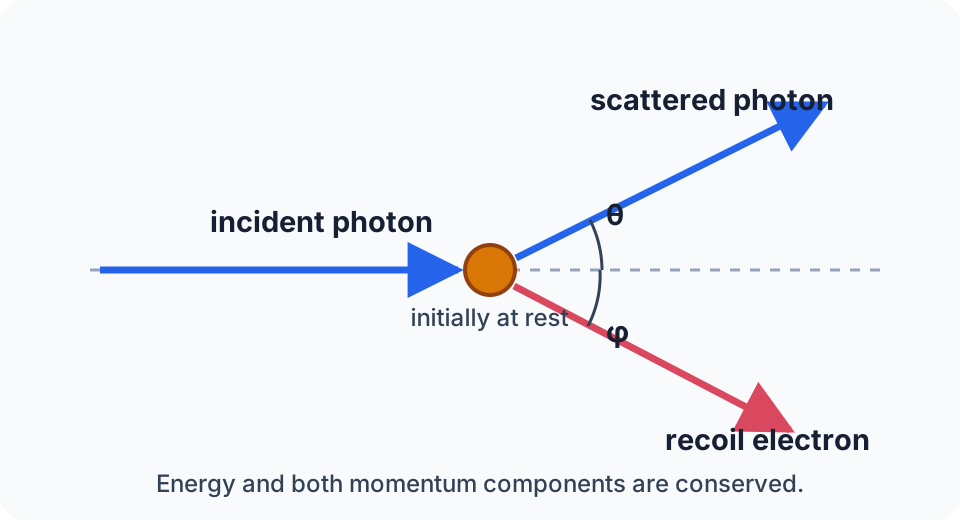
1. Governing relations
For each photon,
E = pc, p = h/λ
For the electron of rest mass mₑ and total energy Eₑ,
Eₑ² = P²c² + mₑ²c⁴
Both momentum components and total energy are conserved.
2. Momentum conservation
Along the initial photon direction,
p = p' cos θ + P cos φ
Perpendicular to it,
0 = p' sin θ-P sin φ
Hence
P cos φ = p-p' cos θ
and
P sin φ = p' sin θ
Squaring and adding eliminates φ:
P² = (p-p' cos θ)² + (p' sin θ)²
Therefore
P² = p² + p'²-2pp' cos θ
3. Energy conservation
Initially, the electron contributes only its rest energy:
pc + mₑc² = p'c + Eₑ
Thus
Eₑ = (p-p')c + mₑc²
Insert this into the electron energy–momentum relation and divide by c²:
(p-p' + mₑc)² = P² + mₑ²c²
Expanding and cancelling mₑ²c² gives
P² = (p-p')² + 2mₑc(p-p')
4. Eliminate the electron momentum
Equate equations (1) and (2):
p² + p'²-2pp' cos θ = (p-p')² + 2mₑc(p-p')
Since (p-p')² = p² + p'²-2pp', cancellation leaves
pp'(1- cos θ) = mₑc(p-p')
Divide by pp':
1- cos θ = mₑc(1/p'-1/p)
Using p = h/λ and p' = h/λ',
1- cos θ = (mₑc/h)(λ'-λ)
Therefore
λ'-λ = (h/mₑc)(1- cos θ)
5. Checks and interpretation
- Dimensions: h/(mₑc) has units of length.
- Forward limit: θ = 0 gives λ' = λ.
- Back-scattering: θ = 180° gives the maximum shift 2h/(mₑc).
- Energy direction: 1- cos θ ≥ 0, so λ' ≥ λ; the photon never gains energy from an electron initially at rest.
The electron recoil angle disappears from the result because its momentum and energy are eliminated using the conservation laws.
Mind stretcher 1: Check the derived equation independentlyExtension
Use Δλ = h(1- cos θ)/(mₑc) to state the forward-scattering shift, the maximum shift and the direction of photon-energy transfer.
Answer
At 0°, the shift is zero. At 180°, it is 2h/(mₑc). Since 1- cos θ ≥ 0, the outgoing wavelength cannot be shorter, so the photon cannot gain energy from an electron initially at rest.
5. Common mistakes
- Conserving photon energy by itself. Energy transfers to the electron.
- Using P²/(2mₑ) for electron kinetic energy inside an otherwise relativistic derivation.
- Losing the rest-energy term mₑc².
- Squaring momentum components and forgetting the cross term -2pp' cos θ.
- Substituting p = h/λ with the primed wavelength paired to the wrong momentum.
6. Worked Examples
Modelled example 1
Recovering the maximum shift
Problem
Study the worked solution
Maximise the angular factor
Method
1- cos θ = 2 at 180°.Reason
Back-scattering gives the smallest possible cosine.Working
Δλₘₐₓ = 2h/(mₑc)Evaluate
Method
Δλₘₐₓ = 4.85 × 10⁻¹² m = 4.85 pm.Reason
Substitute the electron mass into the derived relation.Working
Δλₘₐₓ = (2(6.63 × 10⁻³⁴))/((9.11 × 10⁻³¹)(3.00 × 10⁸)) = 4.85 × 10⁻¹² m
Next: return to Compton Shift or the Quantum Theory of Light Hub.
Continue with the next resource in this course.
Course and syllabus information
- Course
- Advanced Physics
- Edition
- Advanced Physics