Compton Shift
Key idea: Apply the Compton wavelength-shift equation, interpret scattering spectra, and connect photon energy–momentum transfer with recoil electrons.
Continue where you stopped
The core idea
On this page
Learning objectives
- Connect blackbody evidence, Planck quantisation, photon momentum, and Compton scattering.
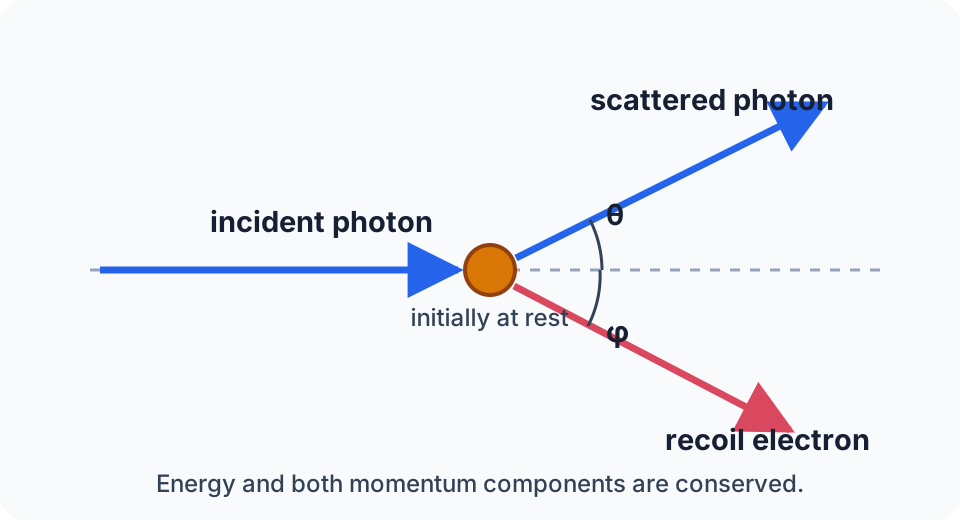
In Compton scattering, a photon transfers energy and momentum to an electron. The scattered photon has lower energy, lower frequency, and greater wavelength. The angle-dependent wavelength shift provides direct evidence for particle-like photon momentum.
1. Model and equation
Assume an electron is initially free and at rest. If the photon is scattered through angle θ relative to its initial direction,
Δλ = λ'-λ = (h/mₑc)(1- cos θ)
The constant
λ_C = h/mₑc = 2.43 × 10⁻¹² m
is the electron Compton wavelength, so Δλ = λ_C(1- cos θ).
2. Angle dependence and limits
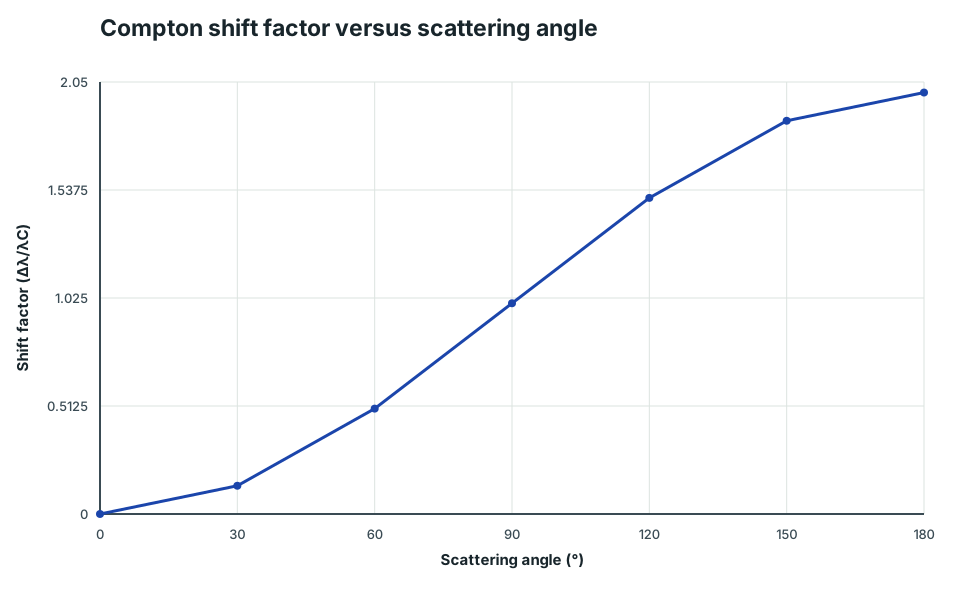
Compton shift factor versus scattering angle
The wavelength shift divided by the electron Compton wavelength follows one minus cosine theta.
Scroll across the graph to read all labels.
View figure data
| Scattering angle (°) | 1 − cos θ |
|---|---|
| 0 | 0 |
| 30 | 0.134 |
| 60 | 0.5 |
| 90 | 1 |
| 120 | 1.5 |
| 150 | 1.866 |
| 180 | 2 |
- At θ = 0°, Δλ = 0.
- At θ = 90°, Δλ = λ_C.
- At θ = 180°, Δλ = 2λ_C = 4.86 pm.
The shift for a free electron depends on angle and electron rest mass, not on incident intensity. The fractional energy loss does depend on the incident wavelength because E = hc/λ.
3. Interpreting observed spectra
A scattering target may produce both shifted and nearly unshifted components. Scattering by weakly bound or effectively free electrons gives the electron Compton shift. Interaction with a tightly bound electron can transfer momentum to the much heavier atom, making h/(Mc) and the resulting shift too small to resolve.
Do not say the unshifted component means “no interaction” in every case; it can reflect coherent or whole-atom scattering with negligible recoil energy.
4. Common mistakes
- Using the recoil-electron angle φ in the Compton shift equation instead of photon angle θ.
- Reporting Δλ as the outgoing wavelength. Use λ' = λ + Δλ.
- Saying a larger wavelength means the scattered photon gained energy. Photon energy is inversely proportional to wavelength.
- Treating intensity as photon energy. Greater intensity mainly means more photons per unit time.
- Using a non-relativistic electron energy relation in the derivation without checking recoil energy.
6. Worked Examples
Modelled example 1
Scattering through 90 degrees
Problem
Study the worked solution
Find the shift
Method
Δλ = 2.43 pm.Reason
1- cos 90° = 1.Working
Δλ = (2.43 pm)(1- cos 90°) = 2.43 pmAdd to the incident wavelength
Method
λ' = 73.4 pm = 0.0734 nm.Reason
Compton shift is defined as λ'-λ.Working
λ' = 71.0 + 2.43 = 73.4 pm
Guided practice 2
Maximum wavelength shift
Problem
Try this before viewing the solution
Hints
Hint 1: maximise the angular factor
View solution step by step
Choose back-scattering
Method
θ = 180°.Reason
This makes 1- cos θ = 2, its maximum.Working
Δλₘₐₓ = 2λ_CEvaluate
Method
Δλₘₐₓ = 4.86 pm.Reason
The electron Compton wavelength is 2.43 pm.Working
2(2.43 pm) = 4.86 pm
Challenge 3
Energy transferred to the electron
Independent transfer
Try this before viewing the solution
Hints
Hint 1: use photon energy loss
View solution step by step
Form the energy difference
Method
K = hc(1/λ-1/λ').Reason
Energy conservation gives the electron the photon’s lost energy.Working
K = E-E'Evaluate
Method
K ≈ 0.57 keV.Reason
The wavelength increase lowers the photon energy.Working
K = (1.240)(1/0.0710-1/0.0734) = 0.57 keV
7. Evidence statement
Mind stretcher 1: Connect the shift to the evidenceExtension
The wavelength change follows from treating light as particles with E = hf and p = h/λ colliding with electrons while conserving energy and momentum. A wave-only classical model does not produce this angle-dependent transfer relation.
Continue with the next resource in this course.
Course and syllabus information
- Course
- Advanced Physics
- Edition
- Advanced Physics