Crystal Structure
Key idea: H3 Solid State Physics: Crystal Structure — key ideas and exam-focused notes on bonding, crystal structures, conduction models, and band ideas.
Continue where you stopped
The core idea
On this page
Learning objectives
- Use advanced reference material to reinforce mathematical, optical, material, and modern-physics models.
Atoms, ions or molecules in a crystal occupy positions with long-range periodic order. A lattice describes that repeating translational pattern; a basis identifies the particle or group attached to each lattice point. A unit cell is a repeating three-dimensional region that generates the crystal structure by translation.
Common structure descriptions include:
- simple cubic (SC),
- body-centred cubic (BCC),
- face-centred cubic (FCC), and
- hexagonal close-packed (HCP).
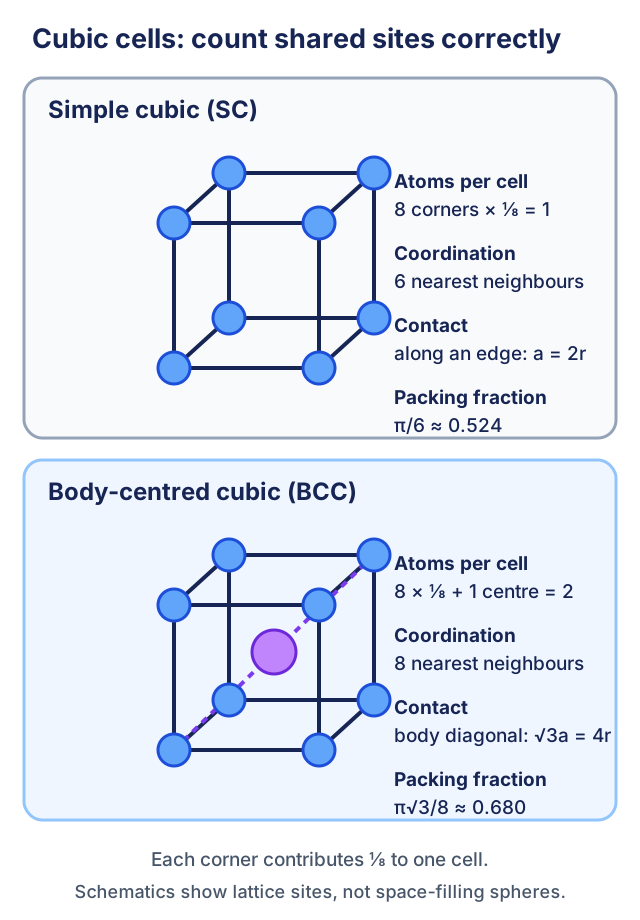
Simple cubic
The conventional simple-cubic cell has lattice sites at its eight corners. Each corner is shared by eight cells, so it contributes 1/8 of an atom to one cell: 8 × (1/8) = 1 atom per cell.
- Coordination number: 6.
- Nearest neighbours touch along a cube edge, so a = 2r.
- Packing fraction: π/6 ≈ 0.524, or about 52.4%.
Naturally occurring alpha-polonium is the standard elemental example of simple-cubic packing.
Body-centred cubic
A BCC cell has the same eight shared corner sites plus one whole lattice point at the body centre, giving 8 × (1/8) + 1 = 2 atoms per cell.
- Coordination number: 8.
- Nearest neighbours touch along a body diagonal, so square root of 3 a = 4r.
- Packing fraction: π square root of 3/8 ≈ 0.680, or about 68.0%.
Alpha-iron at room temperature is a familiar BCC metal. A crystal with one species at the corners and a different species at the centre, such as CsCl, is not a BCC Bravais lattice: translating by half a body diagonal exchanges unlike species. It is described by a simple-cubic Bravais lattice with a two-particle basis.
Continue with the next resource in this course.
Course and syllabus information
- Course
- Advanced Physics
- Edition
- Advanced Physics