Close-packed structures
Key idea: H3 Solid State Physics: Close-packed structures — key ideas and exam-focused notes on bonding, crystal structures, conduction models, and band ideas.
Continue where you stopped
The core idea
On this page
Learning objectives
- Use advanced reference material to reinforce mathematical, optical, material, and modern-physics models.
The densest regular packing of identical spheres occurs in the face-centred cubic (FCC, also called cubic close-packed or CCP) and hexagonal close-packed (HCP) structures. Both are built from close-packed hexagonal layers and have packing fraction about 0.74.
- Both are based upon stacking layers of atoms, where the atoms are arranged in a close-packed hexagonal manner within the individual layer.
- The atoms of the next layer of the structure will sit in some of the hollows in the first layer - this provides the closest approach of atoms in the two layers and hence, maximizes the cohesive interaction. The position of the next layer of atoms determines if the structure is face-centred or hexagonal close-packed.
- Each atom has 12 nearest neighbours, so the coordination number is 12.
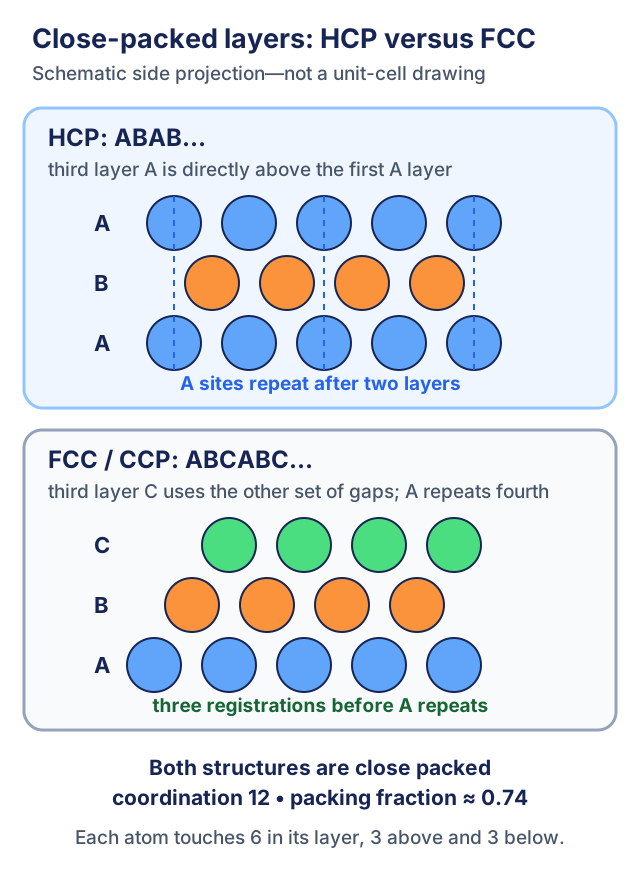
Face-Centred Cubic
The atoms of the third layer are laterally offset from those in both the first and second layers. The sequence first repeats at the fourth layer, giving ABCABC… stacking. FCC is equivalent to a simple cubic cell with an additional lattice point at the centre of each face; its close-packed planes are the {111} family, perpendicular to body diagonals.
Ionic interactions are non-directional. In the rock-salt structure, the chloride ions form an FCC sublattice and sodium ions occupy all the octahedral sites, producing two interpenetrating FCC sublattices.
Continue with the next resource in this course.
Course and syllabus information
- Course
- Advanced Physics
- Edition
- Advanced Physics