Circular Polarisation
Key idea: H3 Photonics: Circular Polarisation — key ideas and exam-focused notes on reflection, refraction, polarisation, fibres, and attenuation.
Continue where you stopped
The core idea
On this page
Learning objectives
- Use advanced reference material to reinforce mathematical, optical, material, and modern-physics models.
Circular polarisation
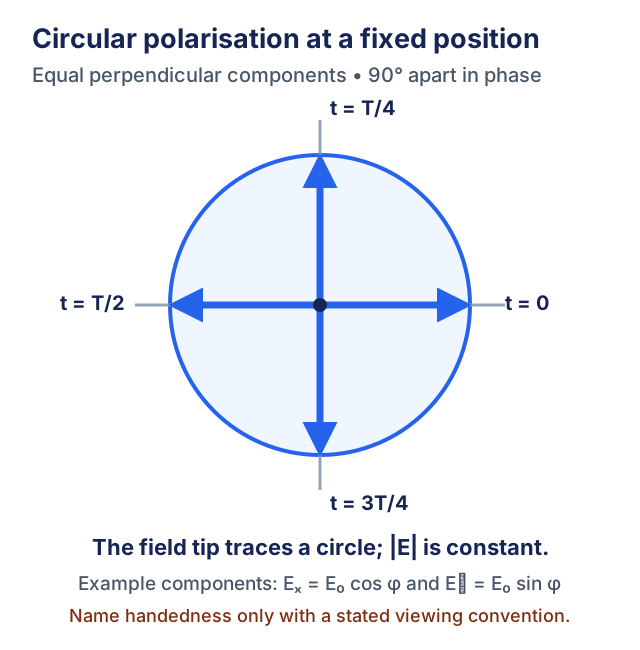
- At a fixed position, the electric-field vector rotates while its magnitude remains constant.
- Circular polarisation is the superposition of two perpendicular components with the same frequency, equal amplitudes and a phase difference of ± 90° (±π/2).
- The sign of the phase difference sets the sense of rotation. Because handedness names vary with viewing/sign convention, state the convention before calling a state left- or right-circularly polarised.
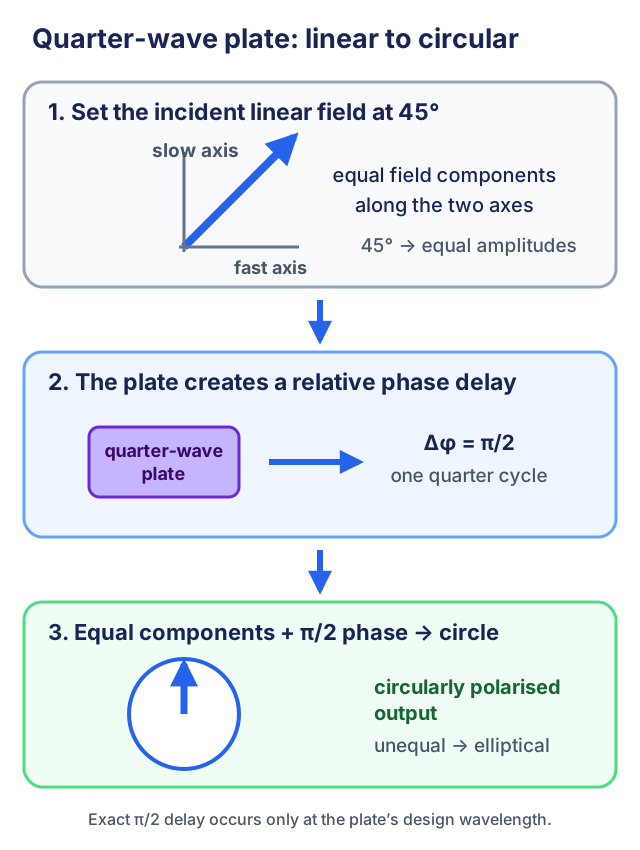
Circular polarisation using a quarter-wave plate
-
A quarter-wave plate is birefringent: the two perpendicular field components acquire different phases as they travel along its fast and slow axes.
-
At the plate’s design wavelength (or specified order), the relative phase delay is π/2.
-
Incident linear polarisation at 45° to the axes gives equal component amplitudes. Equal perpendicular components in quadrature produce circular polarisation; unequal components produce elliptical polarisation.
Continue with the next resource in this course.
Course and syllabus information
- Course
- Advanced Physics
- Edition
- Advanced Physics