Boltzmann Distribution Function
Key idea: Archived extension note on Boltzmann population ratios, degeneracy, and the thermal suppression of higher energy levels.
Continue where you stopped
The core idea
On this page
Learning objectives
- Use advanced reference material to reinforce mathematical, optical, material, and modern-physics models.
For two non-degenerate energy levels in thermal equilibrium, the population ratio is
Nₓ/N₀ = e^(-(Eₓ-E₀)/(kT))
where k = 1.38 × 10⁻²³ J K⁻¹ and T is in kelvin. If the levels have degeneracies gₓ and g₀, include the statistical weights:
Nₓ/N₀ = (gₓ/g₀)e^(-(Eₓ-E₀)/(kT))
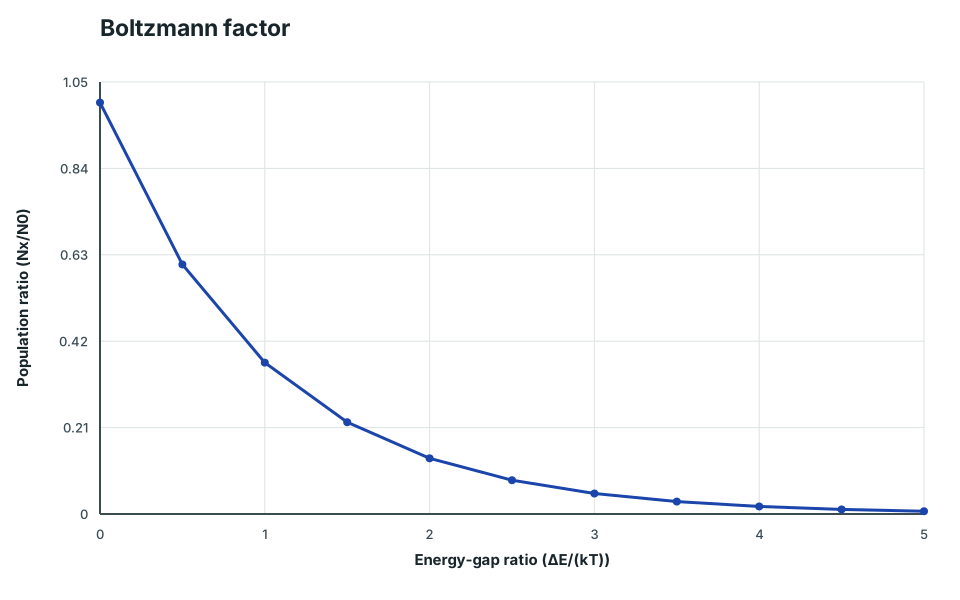
At fixed degeneracy, increasing the energy gap suppresses the upper-level population, while increasing the temperature makes the populations more nearly equal. The relation assumes thermal equilibrium; it is a population model, not a rule for the energy emitted in an individual transition.
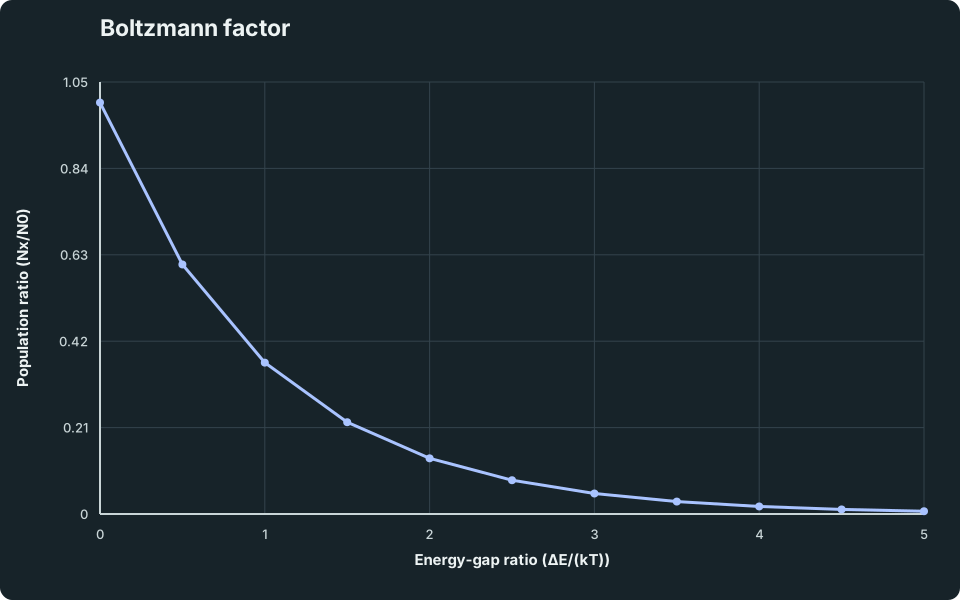
Boltzmann factor
Population ratio for equal degeneracies as the energy gap grows relative to thermal energy.
Scroll across the graph to read all labels.
View figure data
| Energy-gap ratio (ΔE/(kT)) | e^(−x) |
|---|---|
| 0 | 1 |
| 0.5 | 0.6065 |
| 1 | 0.3679 |
| 1.5 | 0.2231 |
| 2 | 0.1353 |
| 2.5 | 0.0821 |
| 3 | 0.0498 |
| 3.5 | 0.0302 |
| 4 | 0.0183 |
| 4.5 | 0.0111 |
| 5 | 0.0067 |
This factor helps explain why high-energy oscillator states are weakly populated in Planck’s model. Return to Planck’s Hypothesis for the maintained derivation path.
Continue with the next resource in this course.
Course and syllabus information
- Course
- Advanced Physics
- Edition
- Advanced Physics