What plants need to grow
Explain the roles of air, light, water, mineral nutrients and pH, and judge plant-growth evidence from a fair test.
On this page
Sources of Food · about 25–35 min
What you need to understand
Find the missing or limiting requirement before choosing a treatment.
Definitions
- photosynthesis
the process by which green plants use light to make food from carbon dioxide and water
For example: Light and air cannot be replaced by fertiliser.- limiting factor
a condition that restricts growth under the conditions being considered
For example: More fertiliser will not help when light is the limiting factor.
Key idea
- LookIdentical seedlings receive water and nutrients, but one group is kept in darkness and becomes pale.
- ThinkFind the missing or limiting requirement before choosing a treatment.
- DoIdentify a missing or limiting requirement without claiming that fertiliser replaces light, air or water.
Review the full sources of food topic picture
Explanation
Green plants make food by photosynthesis. They use light energy to make sugars from carbon dioxide and water. The sugars provide material for growth and can be used to release energy in the plant’s cells. Fertiliser is not ready-made food for the plant.
| Requirement | Why it matters |
|---|---|
| Air | Carbon dioxide from air is a starting material for photosynthesis. Plants also use oxygen for respiration, which releases energy in their cells. |
| Light | Light supplies the energy for photosynthesis. Water and fertiliser cannot replace this energy source. |
| Water | Water is used in photosynthesis and helps keep cells firm. Roots absorb it from the growing medium. |
| Mineral nutrients | Minerals support healthy growth. Roots take them up dissolved in water; they do not replace the carbon dioxide used to make sugars. |
| Suitable pH | The growing medium’s acidity or alkalinity affects roots and the availability of mineral nutrients. Different plants can have different suitable pH ranges. |
A limiting factor is the condition restricting growth in the situation given. A watered plant kept in darkness still lacks light for photosynthesis. A well-lit plant in dry soil still lacks water. Adding more of a requirement that is already sufficient will not remove a different problem.
A seedling can grow for a short time using stored food from its seed. In low light it may become pale and develop long, weak shoots. A taller seedling is therefore not automatically a healthier one. Compare height with leaf number, colour and other evidence of normal growth.
Pause and say it: Find the missing or limiting requirement before choosing a treatment.
Common mistake
Tempting wrong idea: Plants obtain all of their food directly from soil.
Why it fails: Soil supplies water and mineral nutrients, but the plant makes food by photosynthesis using light, carbon dioxide and water. It does not absorb ready-made food from the soil.
Use this instead: Plants make food by photosynthesis; soil can supply water and mineral nutrients but does not replace air or light.
Practical work
What to show: Identify a missing or limiting requirement without claiming that fertiliser replaces light, air or water.
Before you finish: Change one factor at a time before attributing the result to it.
Practical: Plant-growth fair test
How does daily light duration affect seedling growth over seven days?
Safety: Wash hands after handling soil; do not taste plant material or use unknown agricultural chemicals.
- Change
- daily light duration: 0, 6 or 12 hours from the same light source
- Measure
change in seedling height, with leaf number and colour recorded separately
- Keep the same
species, starting size, containers, soil amount and pH, water and mineral supply, temperature, light intensity when illuminated, and the seven-day observation period
View the apparatus, method and sample results
Apparatus
same-species seedlings, identical containers and growth medium, ruler, water, labels, controlled light source.
Method
Select healthy seedlings of similar initial height and assign them randomly to groups.
Set the three daily light durations. Use the same light intensity when the light is on; do not change both its intensity and duration.
Keep all other stated conditions equal.
Measure initial height and height after seven days from the same reference points. Record leaf number and colour as well.
For each seedling, subtract its initial height from its final height. Calculate the group mean height change, then compare the other observations.
| Light / h per day | Mean start / cm | Mean final / cm | Mean change / cm |
|---|---|---|---|
| 0 | 3.0 | 3.4 | 0.4 |
| 6 | 3.1 | 6.8 | 3.7 |
| 12 | 3.0 | 8.2 | 5.2 |
Limitation: Starting seedlings and local light intensity may differ. Height alone may also miss pale, weak growth.
Improvement: Increase sample size, randomise positions and measure actual light intensity.
6. Worked Examples
Modelled example 1
Yellow seedlings
Problem
Matched seedlings receive water and mineral nutrients. Their other conditions are kept the same, but one group is kept in darkness and becomes pale. Explain the missing requirement and why extra fertiliser would not replace it.
Study the worked solution
Reason from the evidence
Method
Hold the shared conditions constant and identify the one growth requirement that differs.
Reason
Find the missing or limiting requirement before choosing a treatment.
Working
- Only light was deliberately changed.
- The dark group cannot photosynthesise normally.
- Nutrients do not replace light as an energy source.
State the conclusion
Working
The evidence supports light as a requirement for normal food production and growth.
Common misconception 2
Does soil provide all of a plant’s food?
Learner response
“A plant gets its food from soil, so light and carbon dioxide are optional.” Correct the first error.
Separate food production from mineral uptake
View solution step by step
Identify what soil supplies
Method
State that soil can supply water and mineral nutrients.
Reason
These materials support growth but are not ready-made food for the plant.
Working
Plants use light energy to make food from carbon dioxide and water by photosynthesis.
Challenge 3
Find the limiting requirement from results
Problem
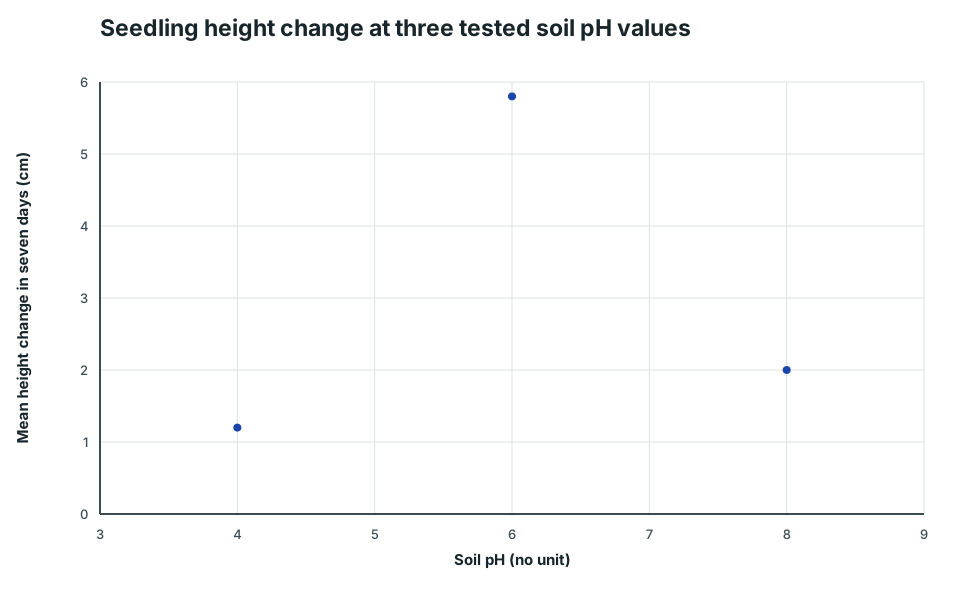
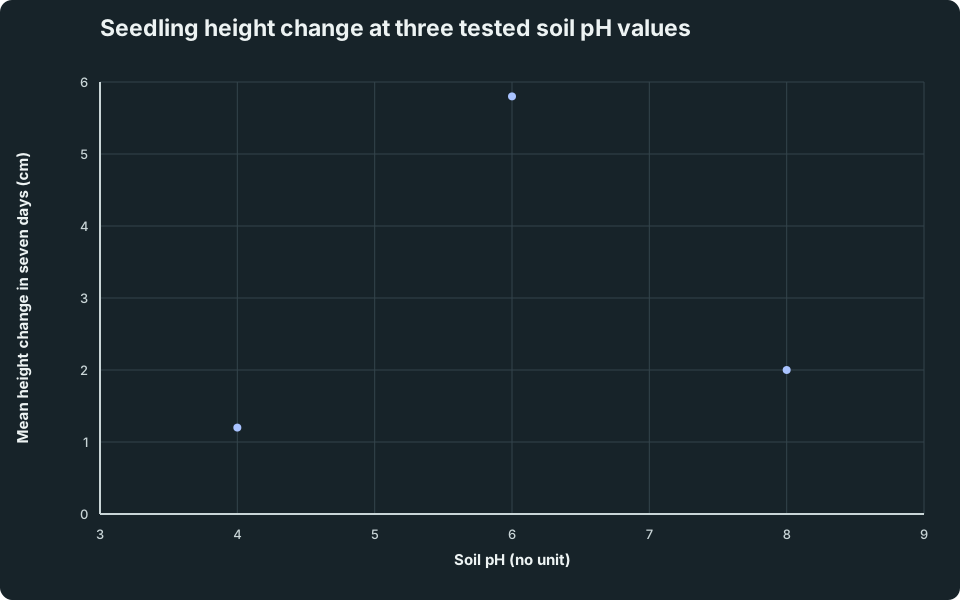
Three matched groups of several seedlings receive the same light, water and nutrients over the same seven-day observation period. Their soil pH values are 4, 6 and 8. The graph shows their mean height changes. State the supported conclusion and one reason this is a fairer comparison than using one plant per pH.
Seedling height change at three tested soil pH values
Soil pH runs horizontally from 3 to 9. Mean height change over seven days in centimetres runs vertically from 0 to 6. Points are pH 4, 1.2 cm; pH 6, 5.8 cm; and pH 8, 2.0 cm.
Scroll across the graph to read all labels.
View figure data
| Soil pH (no unit) | Mean height change in seven days / cm |
|---|---|
| 4 | 1.2 |
| 6 | 5.8 |
| 8 | 2 |
Interpret the trend and method
Hints
Hint 1: compare the growth
Find the pH with greatest mean growth.
Hint 2: consider variation
Several plants reduce the influence of one unusual seedling.
View solution step by step
Use only the tested evidence
Method
State that pH 6 supported the greatest mean growth among these tested values.
Reason
The other named requirements were controlled, so pH is the intended difference.
Working
The data support a more suitable pH near 6 for these seedlings under these conditions.
Evaluate the repeats
Method
Explain that several seedlings reveal biological variation and allow a mean.
Reason
One unusual plant is then less likely to decide the result.
Working
Replicates strengthen the comparison but do not prove every plant species has the same best pH.
Guided practice
Try it with support
Identical seedlings receive water and minerals, but one group is kept in darkness. Predict the difference and explain it.
Identify the one missing requirement.
Do not claim fertiliser replaces it.
Check the guided answer
Answer: The dark group cannot make new food by photosynthesis. Seedlings may initially use stored food, but can become pale with long, weak shoots. Water and minerals cannot replace light, and greater height alone would not establish healthier growth.
Check: A fair conclusion depends on the groups differing only in light exposure.
Practise and continue
Practise this
A well-lit plant has enough water but grows poorly in very acidic soil. Name the likely limiting requirement and one fair-test control.
Need a hint?
Use the complete plant-needs list.
Check your answer
Answer: An unsuitable pH may be limiting growth. A fair comparison could keep plant species, starting size, light, water, soil amount and duration the same.
Check: Change one factor at a time before attributing the result to it.
Think like a scientist
Why are several seedlings needed at each light level?
Check the reasoning
Several seedlings reveal natural variation and allow a mean, making it less likely that one unusual plant decides the conclusion.
Remember: More samples strengthen evidence but do not correct an unfair method.
One-minute check
Name the five requirements for normal plant growth and explain the role of light.
Why might extra fertiliser fail to help a well-watered plant growing in darkness?
Correct this common mistake: “Plants obtain all of their food directly from soil.”
Syllabus and review details
- SEC G1 Science 2027 · 2027
Content structure and syllabus content, PDF pages 8–17
Last reviewed: