Density of solids and liquids
Key idea: Density is mass divided by volume. A larger piece of the same uniform material has more mass and volume, but the same density.
Offline pages
Saved on this device only. Connect at least once every 30 days to confirm Premium. Sign-out or a change of account removes saved copies.
Loading guide controls…
Guided lessons · coming soon
Guided lesson
Guided steps
- Compare equal volumes and explain why cutting leaves density unchanged.
- Convert densities using both mass and cubed volume units.
- Find mass from density and volume.
- Compare mass-to-volume ratios and the graph’s gradient.
- Choose a volume method that suits the sample.
- Divide mass by volume with matching units.
- Find the block’s volume, density and converted density.
- Subtract cylinder readings and consider their precision.
- Subtract the container mass before calculating liquid density.
- Compare the medal with gold and consider other possible materials.
- Find block volume and density, then choose the best match.
- Find both liquid masses and densities before comparing them.
- Calculate recorded density, then predict the effect of bubbles.
On this page
You stopped at:
ContinueA steel nail sinks in water while a huge wooden log floats. The log has far more mass, but the steel packs more mass into each cubic centimetre: it is denser. Density links mass and volume, and a measured density is good evidence of what an object is made of.
Density: mass per unit volume
Take a 1 cm³ cube of water, one of aluminium and one of iron. They are the same size, but their masses are about 1.0 g, 2.7 g and 7.9 g. The iron packs the most mass into each cubic centimetre.
Density, ρ (the Greek letter rho), is the mass per unit volume of a substance.
The same relationship rearranges to m = ρ V to find a mass, and V = m ÷ ρ to find a volume.
For a uniform material at a fixed temperature and pressure, density does not depend on the size of the sample. Cut a uniform block of wood in half: each half has half the mass and half the volume, so the ratio m ÷ V, the density, is unchanged.
Density uses mass, not weight. A rock taken to the Moon keeps the same mass and the same volume, so its density does not change, even though its weight does.
Units: g/cm³ and kg/m³
Use grams with cubic centimetres to get g/cm³, or kilograms with cubic metres to get kg/m³. If you divide grams by cubic metres, the result is in g/m³, not kg/m³. That is a valid unit, but convert before comparing it with a value expressed in kg/m³.
To change between the two units, convert the mass and the volume together. Volume conversions are cubed: 1 cm = 10⁻² m, so 1 cm³ = (10⁻²)³ m³ = 10⁻⁶ m³.
- g/cm³ to kg/m³: multiply by 1000.
- kg/m³ to g/cm³: divide by 1000.
Water has a density of about 1.0 g/cm³ under ordinary conditions, which is about 1000 kg/m³. Use it as a check: a density in kg/m³ is always the larger number.
Check your understanding 1
Convert 2.7 g/cm³ and 13.6 g/cm³ to kg/m³, then convert 920 kg/m³ and 1.2 kg/m³ to g/cm³.
Show answer
2.7 × 1000 = 2700 kg/m³ and 13.6 × 1000 = 13 600 kg/m³. 920 ÷ 1000 = 0.92 g/cm³ and 1.2 ÷ 1000 = 0.0012 g/cm³. (1.2 kg/m³ is roughly the density of air.)
Check your understanding 2
Concrete has a density of 2400 kg/m³. Calculate the mass of 0.50 m³ of concrete.
Show answer
m = ρ V = 2400 × 0.50 = 1200 kg.
More mass does not necessarily mean greater density
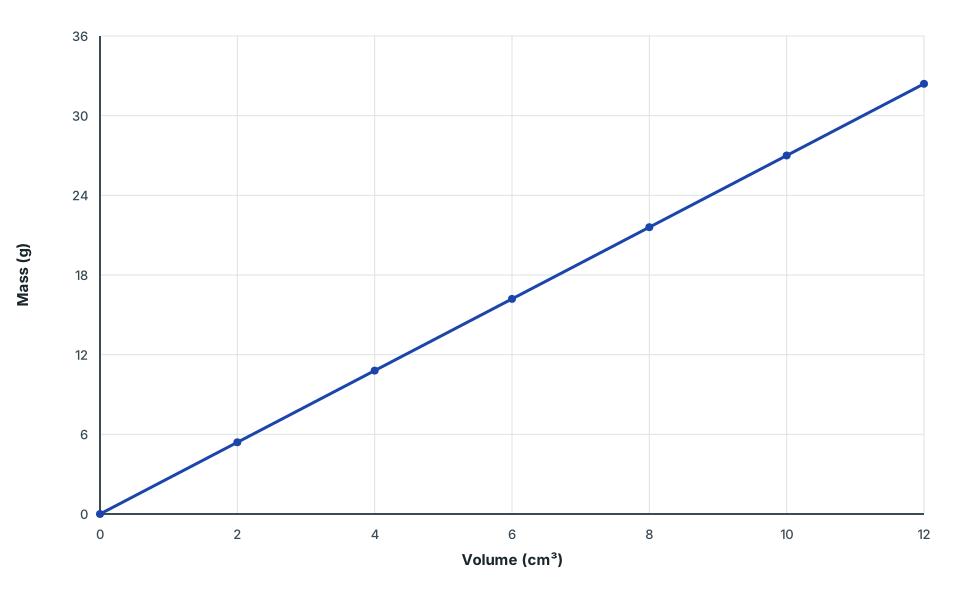
Density is the gradient of a mass–volume graph
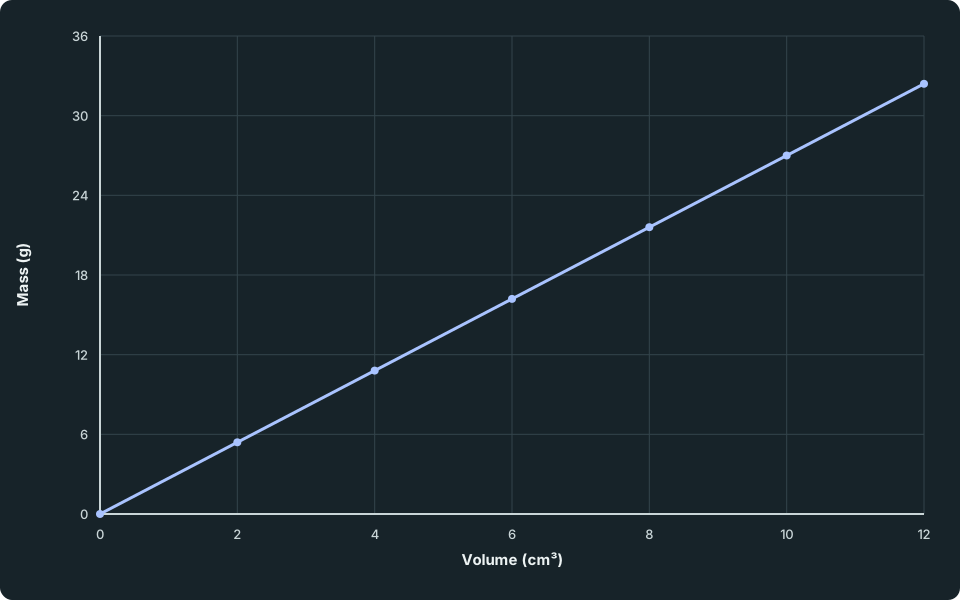
A straight-line graph of mass against volume for a single material. The gradient equals density.
Scroll across the figure to read all labels.
View figure data
| Volume (cm³) | Example material (ρ = 2.7 g cm⁻³) |
|---|---|
| 0 | 0.0 |
| 2 | 5.4 |
| 4 | 10.8 |
| 6 | 16.2 |
| 8 | 21.6 |
| 10 | 27.0 |
| 12 | 32.4 |
The points are for samples of one uniform material. A 4 cm³ sample has mass 10.8 g, while an 8 cm³ sample has mass 21.6 g. Doubling the volume doubles the mass: both ratios are 2.7 g/cm³. The larger sample has more mass, but the same density.
Read mass divided by volume, rather than mass alone. On this graph the ratio is also the gradient of the line:
Finding the volume, then the density
Mass is measured with a balance. How you find the volume depends on what you are measuring.
- A regular solid, such as a cuboid: measure its length, width and height with a rule, then V = l × w × h.
- An irregular solid that sinks, such as a stone: read the water level in a measuring cylinder, lower the solid in until it is completely under water, and read the level again. The volume of the solid is the rise in level, V = V₂ - V₁, not the final reading. The method needs a solid that sinks and does not absorb or dissolve in water.
- A liquid: read its volume in a measuring cylinder. Its mass is the mass of the cylinder with the liquid minus the mass of the empty cylinder.
Worked example 1
Density from mass and volume
Problem
A metal block has a mass of 540 g and a volume of 200 cm³. Find its density.
Show full solution
Check the units
Method
Look at the units of mass and volume.Reason
g and cm³ already give g/cm³, so no conversion is needed.Working
Answer
g and cm³
Find the density
Working
Answer
ρ = m ÷ V = 540 ÷ 200 = 2.7 g/cm³
Worked example 2
A regular block
Problem
A wooden block measures 5.0 cm by 4.0 cm by 2.0 cm and has a mass of 24 g. Find its density in g/cm³ and in kg/m³.
Show full solution
Find the volume
Method
Multiply the three dimensions.Reason
A regular block’s volume is length × width × height.Working
Answer
V = 5.0 × 4.0 × 2.0 = 40 cm³
Find the density
Method
Divide mass by volume.Reason
Density is mass per unit volume.Working
Answer
ρ = 24 ÷ 40 = 0.60 g/cm³
Convert
Method
Multiply by 1000.Reason
1 g/cm³ is 1000 kg/m³.Working
Answer
0.60 × 1000 = 600 kg/m³
Check
Working
Answer
The wood is less dense than water (1.0 g/cm³), which fits wood that floats.
Worked example 3
An irregular solid by displacement
Problem
A brass key has a mass of 42 g. When it is lowered into a measuring cylinder, the water level rises from 30 cm³ to 35 cm³. Find the density of the key.
Show full solution
Find the volume
Method
Subtract the first reading from the second.Reason
The key’s volume is the rise in level, not the final reading.Working
Answer
V = 35 - 30 = 5 cm³
Find the density
Method
Divide mass by volume.Reason
Density is mass per unit volume.Working
Answer
ρ = 42 ÷ 5 = 8.4 g/cm³
Check
Working
Answer
Brass has a density of about 8.5 g/cm³, so the answer is reasonable. A 5 cm³ rise is small, so a narrower cylinder with finer divisions would give a more precise volume.
Worked example 4
A liquid
Problem
An empty measuring cylinder has a mass of 84 g. With 50 cm³ of cooking oil in it, the mass is 130 g. Find the density of the oil in g/cm³ and in kg/m³.
Show full solution
Find the mass of oil
Method
Subtract the empty cylinder’s mass.Reason
The cylinder’s own mass must not be counted.Working
Answer
130 - 84 = 46 g
Find the density
Method
Divide mass by volume.Reason
Density is mass per unit volume.Working
Answer
ρ = 46 ÷ 50 = 0.92 g/cm³
Convert
Method
Multiply by 1000.Reason
1 g/cm³ is 1000 kg/m³.Working
Answer
0.92 × 1000 = 920 kg/m³
Check
Working
Answer
The oil is less dense than water, which fits oil floating on water.
Identifying a material from its density
Compare a measured density with reference values for possible materials under similar conditions. Different materials can have similar densities. Cavities and mixed materials also change an object’s average density, so use other evidence to distinguish a close match.
| Material | Density / g/cm³ | Density / kg/m³ |
|---|---|---|
| ethanol | 0.79 | 790 |
| ice | 0.92 | 920 |
| water | 1.0 | 1000 |
| aluminium | 2.7 | 2700 |
| iron | 7.9 | 7900 |
| copper | 8.9 | 8900 |
| lead | 11.3 | 11 300 |
| gold | 19.3 | 19 300 |
The table gives approximate reference densities. Temperature and, especially for gases, pressure affect density.
Worked example 5
Is the medal solid gold?
Problem
A gold-coloured medal has a mass of 180 g. Lowered into a measuring cylinder, it raises the water level from 50.0 cm³ to 70.0 cm³. Is it made of solid gold?
Show full solution
Find the volume
Method
Subtract the readings.Reason
The medal’s volume is the rise in level.Working
Answer
V = 70.0 - 50.0 = 20.0 cm³
Find the density
Method
Divide mass by volume.Reason
Mass per unit volume lets you compare the medal with the listed materials.Working
Answer
ρ = 180 ÷ 20.0 = 9.0 g/cm³
Compare with gold
Method
Look up gold in the table.Reason
A solid gold medal would have gold’s density.Working
Answer
Gold is 19.3 g/cm³, more than twice as dense. A solid gold medal of this volume would have a mass of 19.3 × 20.0 = 386 g.
Conclude, with limits
Working
Answer
The measured 9.0 g/cm³ is close to copper’s 8.9 g/cm³. The measurements are inconsistent with a medal made entirely of solid gold, assuming the measured volume contains no cavities. Copper is a possible match; an alloy or a hollow object could give a similar density.
Check your understanding 3
A metal block measures 4.0 cm by 3.0 cm by 2.5 cm and has a mass of 339 g. Assume it is a solid, uniform sample of one of the metals listed in the table. Use its density to identify the best match. Start with the volume.
Show the steps Optional working
Show the steps Optional working
Show answer
V = 4.0 × 3.0 × 2.5 = 30 cm³. ρ = 339 ÷ 30 = 11.3 g/cm³. Among the listed metals, lead is the best match.
Check your understanding 4 Compare samples without counting the container
An empty container has mass 10.0 g. With a 4.0 cm³ sample of a liquid its total mass is 20.8 g; with an 8.0 cm³ sample its total mass is 31.6 g. Find the liquid density from each sample. A learner says the larger reading means the second sample is denser. Choose whether the second sample is denser.
Show the steps Optional working
Show the steps Optional working
Show answer
The liquid masses are 20.8 − 10.0 = 10.8 g and 31.6 − 10.0 = 21.6 g. Their densities are 10.8 ÷ 4.0 = 2.7 g/cm³ and 21.6 ÷ 8.0 = 2.7 g/cm³. Twice the liquid volume has twice the liquid mass, with unchanged density. Total mass includes the fixed container contribution: the incorrect ratios 20.8 ÷ 4.0 = 5.2 and 31.6 ÷ 8.0 = 3.95 g/cm³ do not describe the liquid.
Check your understanding 5 Review a displacement method before trusting it
A non-absorbent stone has mass 36 g. Water rises from 40 to 52 cm³ when it is fully submerged. Find its density. The learner notices air bubbles trapped against the stone but ignores them. Choose how the bubbles affect the calculated density.
Show the steps Optional working
Show answer
The recorded volume is 52 − 40 = 12 cm³, so the calculated density is 36 ÷ 12 = 3.0 g/cm³. Bubbles add displaced volume without adding to the stone’s measured mass: an overestimated volume makes the calculated density too low. Remove attached bubbles, fully submerge the non-dissolving, non-absorbent stone and read the meniscus at eye level before repeating. Record what was changed and retain the original readings.
Common mistakes
- Saying a bigger object has a greater density. A bigger piece of the same material has more mass and more volume, so its density is the same.
- Saying a log is denser than a nail because it is heavier. It has more mass but far more volume; wood is much less dense than iron.
- Taking the final water level as the volume of a solid. The volume is the rise in level, V₂ - V₁.
- Writing 1 m³ = 100 cm³. Volume conversions are cubed: 1 m³ = 100³ cm³ = 1 000 000 cm³.
- Dividing weight by volume. Density uses mass, in g or kg.
- Taking the balance reading as the mass of a liquid. Subtract the mass of the empty container.
Spotted an error? Report a correction
Syllabus and review details
- SEC G2 Science Physics component 2027 · 2027
Physics section, PDF pages 8–23
Last reviewed: