Density
Key idea: Learn density (ρ=m/V): units and conversions (g/cm³ ↔ kg/m³), practical measurement ideas, common mistakes, and worked examples for O Level Physics.
Continue where you stopped
The core idea
On this page
Learning objectives
- Define pressure as force per unit area
- Apply pressure = force ÷ area
- Explain pressure transmission in a hydraulic press
- Apply density = mass ÷ volume
- Apply liquid-column pressure = height × density × gravitational field strength
- Explain how liquid-column height measures atmospheric pressure
- Explain how a manometer measures pressure difference
1. Definition
A. Density
Density, ρ, is the mass per unit volume of a substance.
ρ = m/V
- ρ = density (kg m⁻³)
- m = mass (kg)
- V = volume (m³)
- Density is a scalar quantity.
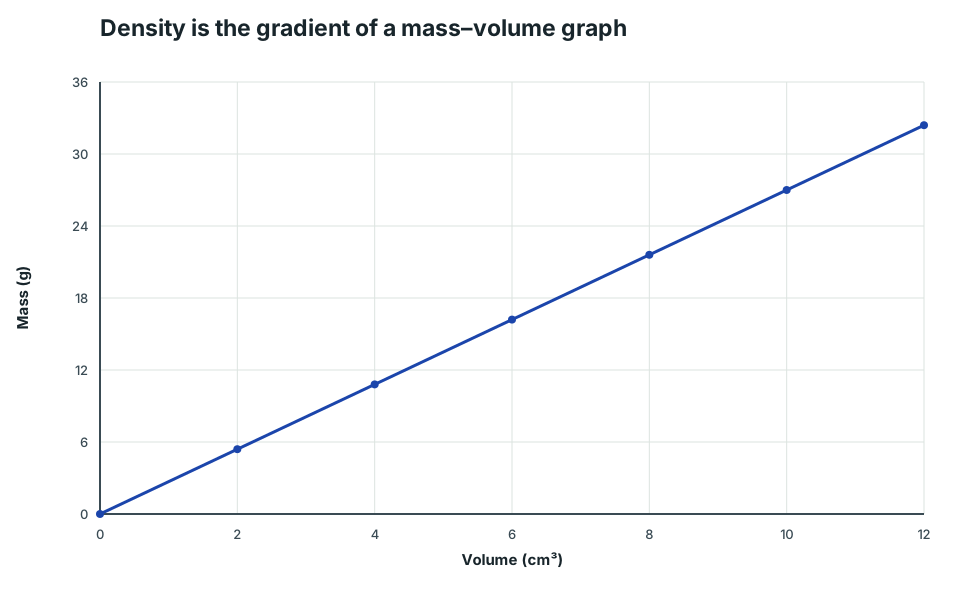
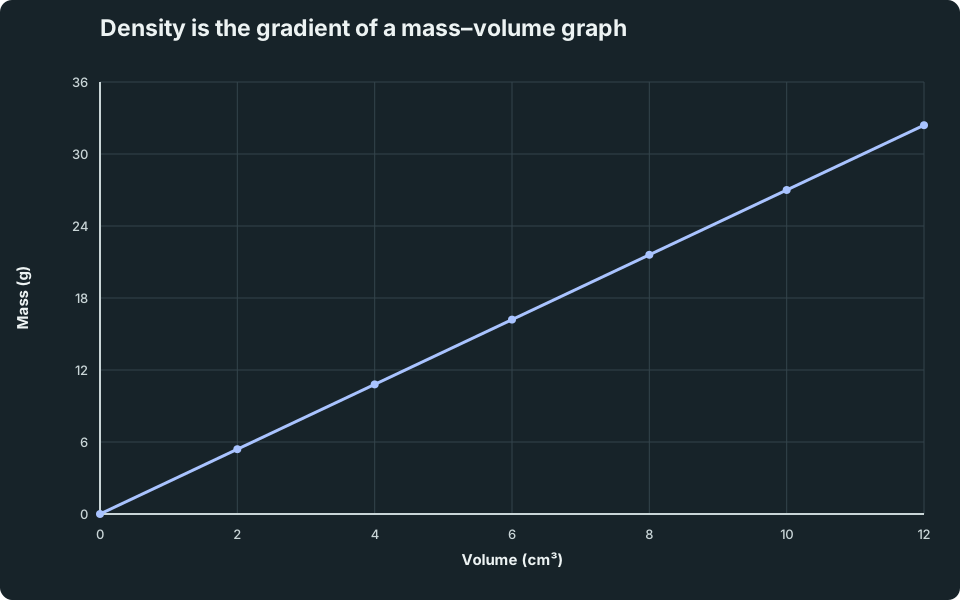
Density is the gradient of a mass–volume graph
A straight-line graph of mass against volume for a single material. The gradient equals density.
Scroll across the graph to read all labels.
View figure data
| Volume (cm³) | Example material (ρ = 2.7 g cm⁻³) |
|---|---|
| 0 | 0 |
| 2 | 5.4 |
| 4 | 10.8 |
| 6 | 16.2 |
| 8 | 21.6 |
| 10 | 27 |
| 12 | 32.4 |
2. Key Ideas
- Rearrangements:
- m = ρ V
- V = m/ρ
- Use consistent units:
- kg with m³ → kg m⁻³
- g with cm³ → g cm⁻³
- Useful conversions:
- 1 g = 1 × 10⁻³ kg
- 1 cm³ = 1 × 10⁻⁶ m³
- 1 g cm⁻³ = 1000 kg m⁻³
- Density of the same material is the same anywhere at the same temperature, because mass and volume do not depend on gravitational field strength.
3. Detailed Explanations
A. What density tells you
Density compares how “packed” the matter is:
- higher density → more mass in the same volume
- lower density → less mass in the same volume
B. Volume (how you measure it)
Volume, V, is the amount of space occupied by a three-dimensional object.
- SI unit of volume is m³.
- Other common units: cm³ and mL (where 1 cm³ = 1 mL).
How volume is found in exams:
- regular solid: use dimensions (e.g. V = lwh)
- irregular solid: use water displacement
- liquid: read the volume in a measuring cylinder
For step-by-step practical methods (measuring cylinder, displacement, calipers), see: O Level Physics Practical Skills.
C. Using the density equation (and rearranging)
Density is given by:
ρ = m/V
Rearranging gives:
- m = ρ V (use this when density and volume are known)
- V = m/ρ (use this when density and mass are known)
Density uses mass (kg), not weight (N). Weight is a force: W = mg.
D. Unit conversions you should memorise
- Converting between cm³ and m³:
- Converting between g cm⁻³ and kg m⁻³:
1 g cm⁻³ = (10⁻³ kg)/(10⁻⁶ m³) = 10³ kg m⁻³
E. Densities of common substances (typical values)
| Solids | Density (g/cm³) |
|---|---|
| aluminium | 2.7 |
| copper | 8.9 |
| iron | 7.9 |
| gold | 19.3 |
| glass | 2.5 |
| wood (teak) | 0.80 |
| ice | 0.92 |
| Liquids | Density (g/cm³) |
|---|---|
| paraffin | 0.80 |
| petrol | 0.80 |
| pure water | 1.0 |
| mercury | 13.6 |
| Gases | Density (kg/m³) |
|---|---|
| air | 1.3 |
| hydrogen | 0.09 |
| carbon dioxide | 2.0 |
F. Link to pressure in liquids (next lesson)
Density appears directly in hydrostatic pressure:
p = hρ g
See: Hydrostatic Pressure.
4. Common Mistakes
- Using weight (N) instead of mass (kg) in ρ = m/V.
- Mixing units (e.g. mass in g but volume in m³) without converting.
- Forgetting that volume conversions are cubed:
- 1 cm³ = 10⁻⁶ m³ (not 10⁻²).
- For displacement questions: using the final reading as the volume instead of (final - initial).
5. Exam Tips
- Start with the formula you need (ρ = m/V, m = ρ V, or V = m/ρ).
- Write units beside your values before you calculate.
- State the final density with the correct unit (kg m⁻³ or g cm⁻³).
- In practical-style questions, describe measurements clearly: “measure mass with a balance” and “find volume by displacement”.
6. Worked Examples
Modelled example 1
Mass from density and dimensions (SI units)
Problem
A block of concrete has dimensions 0.40 m × 0.30 m × 0.10 m and density 2500 kg m⁻³. Find its mass.
Study the worked solution
Find the block's volume
Method
Multiply the three perpendicular dimensions.Reason
A rectangular block’s volume is V = lwh, and all dimensions are already in metres.Working
V = (0.40)(0.30)(0.10) = 0.012 m³Choose the density rearrangement
Reason
Density and volume are known, so rearrange ρ = m/V to make mass the subject.Working
m = ρ VCalculate the mass
Reason
The density and volume use compatible SI units, so no conversion is needed.Working
m = (2500)(0.012) = 30 kg
Guided practice 2
Density of an irregular solid (displacement)
Problem
An irregular stone has mass 120 g. Water in a measuring cylinder rises from 50 cm³ to 95 cm³ when the stone is fully immersed. Find the density of the stone in g cm⁻³.
Complete the displacement calculation
Hints
Hint 1: find the displaced volume
Hint 2: choose the density equation
View solution step by step
Find the stone's volume
Method
Use the volume of water displaced by the fully immersed stone.Reason
The stone is irregular, so its volume is the rise in the measuring-cylinder reading.Working
V = 95-50 = 45 cm³Calculate the density
Reason
The mass is in grams and volume in cubic centimetres, so the result is directly in g cm⁻³.Working
ρ = m/V = 120/45 = 2.67 g cm⁻³ ≈ 2.7 g cm⁻³
Common misconception 3
Convert density units
Learner response
Aluminium has density 2.7 g cm⁻³. A student starts converting it to kg m⁻³ by writing:
Because 1 cm = 10⁻² m, use 1 cm³ = 10⁻² m³.
Locate the first error and give the correct density in kg m⁻³.
Diagnose and correct the conversion
View solution step by step
Locate the volume-conversion error
Method
Cube the linear conversion factor.Reason
Volume has three length dimensions, so converting centimetres to metres requires (10⁻²)³.Working
1 cm³ = 10⁻⁶ m³Combine the mass and volume conversions
Reason
One gram contributes 10⁻³ kg while one cubic centimetre contributes 10⁻⁶ m³.Working
1 g cm⁻³ = (10⁻³ kg)/(10⁻⁶ m³) = 10³ kg m⁻³Convert the aluminium density
Working
2.7 g cm⁻³ = 2.7 × 10³ kg m⁻³
Examiner practice 4
Mass and volume from density (copper)
Examination question
Copper has density 9.0 g cm⁻³. Calculate:
- the mass of 5.0 cm³ of copper;
- the volume occupied by 63 g of copper. [4 marks]
Show both rearrangements before viewing the mark scheme
View solution step by step
Choose the mass relationship
1 markMethod
Rearrange density to make mass the subject.Reason
Density and volume are known in compatible g–cm³ units.Working
m = ρ VCalculate the mass
1 markReason
Multiplying g cm⁻³ by cm³ leaves grams.Working
m = (9.0)(5.0) = 45 gChoose the volume relationship
1 markMethod
Rearrange density to make volume the subject.Reason
Mass and density are known for the second sample.Working
V = m/ρCalculate the volume
1 markReason
Dividing grams by g cm⁻³ leaves cubic centimetres.Working
V = 63/9.0 = 7.0 cm³
Self-mark with the mark scheme
Compare your response with each mark point. Select a point only when your response contains that evidence.
Self-mark each rearrangement and answer separately.
Challenge 5
Identify a sheet material from mass and volume
Data transfer
An unlabelled metal sheet has mass 200 g and volume 73 cm³.
- Calculate its density.
- Compare the result with the table in section 3E and identify the most likely material.
- Explain why density is more useful for this identification than the sheet’s mass alone.
Calculate, identify and justify
Hints
Hint 1: calculate the comparison value
Hint 2: compare a property rather than sample size
View solution step by step
Calculate the sheet's density
Method
Divide its mass by its volume.Reason
The quantities are already in grams and cubic centimetres, matching the reference table’s density unit.Working
ρ = 200/73 = 2.74 g cm⁻³Identify the closest reference material
Reason
The calculated value is closest to aluminium’s listed density of 2.7 g cm⁻³.Working
The most likely material is aluminium.Justify using density
Reason
Mass alone depends on how large the sample is, while a uniform material has the same mass-to-volume ratio at the same temperature.Working
A small and a large aluminium sheet can have different masses but the same density.
7. Mind Stretchers
Mind stretcher 1: Does density change when you cut an object?Extension
A cube has density 8.0 g cm⁻³. It is cut into 8 identical smaller cubes. What is the density of each smaller cube? Explain.
Show Answer
Density stays the same.
When you cut the cube, both the mass and the volume of each piece become 1/8 of the original, so the ratio ρ = m/V is unchanged.
Mind stretcher 2: Mixed units (volume in cm³)Extension
A piece of wood has mass 0.60 kg and density 800 kg m⁻³. Find its volume in cm³.
Show Answer
Volume in m³: V = m/ρ = 0.60/800 = 7.5 × 10⁻⁴ m³
Convert to cm³ (since 1 m³ = 10⁶ cm³): V = (7.5 × 10⁻⁴)(10⁶) = 7.5 × 10² = 750 cm³
8. Practice and next step
Complete the Pressure quiz, then continue to What is pressure? to use force and area before studying liquid columns.
Continue with the next resource in this course.
Course and syllabus information
- Course
- SEC G3 Physics
- Edition
- SEC G3 Physics 2027