Hydrostatic pressure
Key idea: Learn hydrostatic pressure for O Level Physics: use p = ρgh, distinguish column and total pressure, avoid depth errors, and practise worked examples.
Continue where you stopped
The core idea
On this page
Learning objectives
- Define pressure as force per unit area
- Apply pressure = force ÷ area
- Explain pressure transmission in a hydraulic press
- Apply density = mass ÷ volume
- Apply liquid-column pressure = height × density × gravitational field strength
- Explain how liquid-column height measures atmospheric pressure
- Explain how a manometer measures pressure difference
1. Definition
A. Hydrostatic pressure
Hydrostatic pressure is the pressure in a fluid at rest, caused by the weight of the fluid above a point. It increases with depth.
B. Pressure due to a liquid column
The pressure difference between two points in the same fluid separated vertically by Δ h is:
Δ p = ρ g Δ h
If the fluid surface is at pressure p₀, then at depth h:
p = p₀ + ρ gh
In many O Level questions, p = ρ gh refers to the pressure due to the liquid column: the extra pressure compared with the surface. This is also called gauge pressure when the surface is open to the atmosphere.
- p = pressure (Pa)
- ρ = density (kg m⁻³)
- g = gravitational field strength (N kg⁻¹)
- h = vertical depth below the liquid surface (m)
2. Key Ideas
- Hydrostatic pressure depends on:
- depth h,
- fluid density ρ,
- gravitational field strength g.
- For the same liquid and same g:
- deeper point → larger pressure (because p ∝ h),
- same depth → same pressure (even if the container shape is different).
- Hydrostatic pressure does not depend on the shape or cross-sectional area of the container.
- Use the vertical depth from the surface:
- p = ρ gh
- Δ p = ρ g Δ h
- If asked for total pressure at depth in an open tank:
- pₜₒₜₐₗ = pₐₜₘ + ρ gh
3. Detailed Explanations
A. Why pressure increases with depth
The deeper you go in a liquid, the more liquid there is above you.
- more water above → larger weight pressing down
- larger weight over the same area → larger pressure
B. Using p = ρ gh (what is h?)
For a point at depth h below the surface in a uniform liquid:
p_column = ρ gh
If the surface is open to the air, the total pressure is:
pₜₒₜₐₗ = pₐₜₘ + ρ gh
Column pressure vs total pressure (open tank)
Two straight lines versus depth: one shows pressure due to the water column only; the other includes atmospheric pressure as a constant offset.
Scroll across the graph to read all labels.
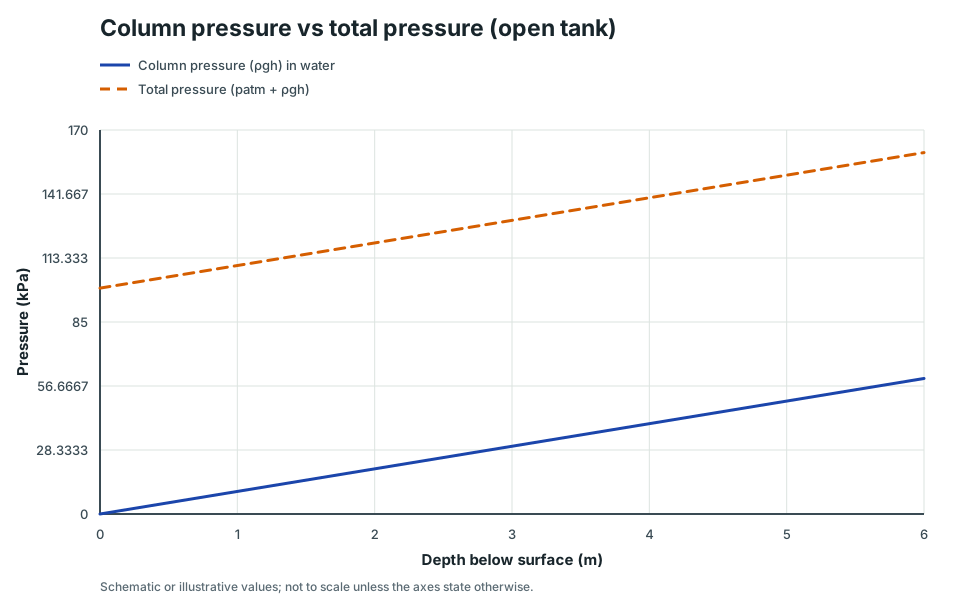
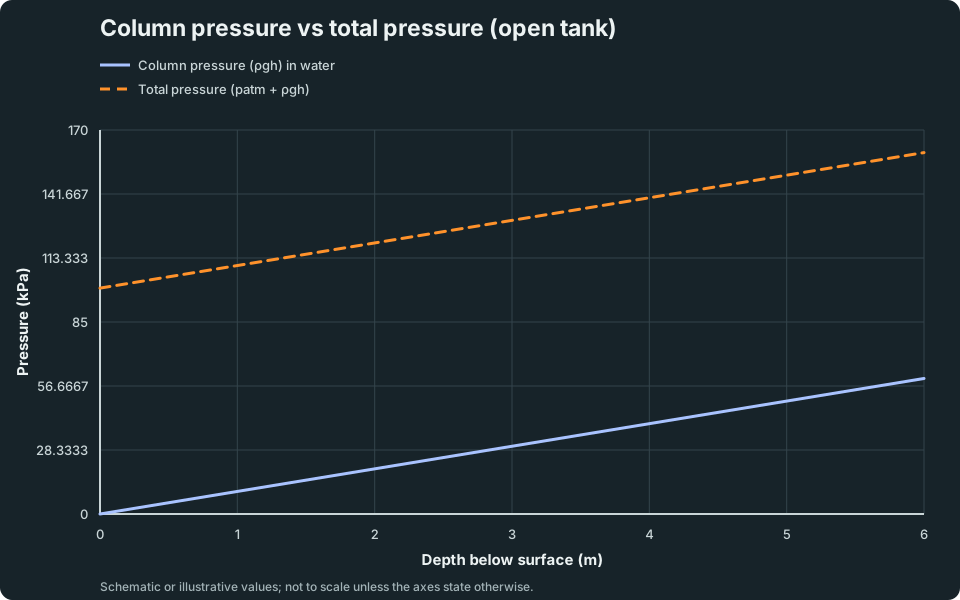
View figure data
| Depth below surface (m) | Column pressure (ρgh) in water | Total pressure (patm + ρgh) |
|---|---|---|
| 0 | 0 | 100 |
| 6 | 60 | 160 |
C. Same depth means same pressure (shape does not matter)
In a liquid at rest:
- all points at the same depth have the same pressure
- the pressure at the bottom depends on depth h, not on the container’s shape or width
D. Pressure acts in all directions
Pressure at a point in a fluid acts in all directions (not just downward). This is why water pushes:
- downward on the bottom of a tank,
- sideways on the walls of a tank.
4. Common Mistakes
- Using the wrong h (it must be the vertical depth below the surface, not the slanted distance).
- Forgetting to convert cm to m (e.g. 35 cm = 0.35 m).
- Mixing density units (use kg m⁻³ when using SI units in the formula).
- Forgetting to add atmospheric pressure when the question asks for total pressure.
5. Exam Tips
- Write the formula first (p = ρ gh or Δ p = ρ gΔ h), then substitute with units.
- Quote the correct unit at the end: Pa (or kPa).
- For water, a common value is ρ = 1000 kg m⁻³.
- If two points are at the same depth in the same connected liquid, state: “same h → same pressure”.
6. Worked Examples
Modelled example 1
Diver underwater (column pressure and total pressure)
Problem
A diver is 6.0 m below the surface of fresh water. Calculate:
- the pressure due to the water column;
- the total pressure if atmospheric pressure is 1.0 × 10⁵ Pa.
Take ρ_water = 1000 kg m⁻³ and g = 10 N kg⁻¹.
Study the worked solution
Identify the pressure requested first
Method
Calculate the extra pressure produced by the water column.Reason
The first part excludes atmospheric pressure, so use p_column = ρ gh.Working
p_column = (1000)(10)(6.0) = 6.0 × 10⁴ PaAdd the surface pressure
Reason
Total pressure at the diver includes both atmospheric pressure at the surface and the water-column increase.Working
pₜₒₜₐₗ = 1.0 × 10⁵ + 6.0 × 10⁴ = 1.6 × 10⁵ Pa
Guided practice 2
Pressure difference between two depths
Problem
Two points in the same liquid are separated vertically by 0.25 m. Find the pressure difference between them.
Take ρ = 1000 kg m⁻³ and g = 10 N kg⁻¹.
Use the vertical separation
Hints
Hint 1: choose the difference relationship
Hint 2: substitute the vertical separation
View solution step by step
Select the vertical depth difference
Method
Use the 0.25 m vertical separation as Δ h.Reason
Hydrostatic pressure differences depend on vertical height, not on the path or container shape between the points.Working
Δ h = 0.25 mCalculate the pressure difference
Reason
Both points are in the same liquid and share the stated g.Working
Δ p = (1000)(10)(0.25) = 2.5 × 10³ Pa
Common misconception 3
Different liquids, same depth
Learner response
A point is 0.40 m below the surface of water (ρ = 1000 kg m⁻³) and another point is 0.40 m below the surface of oil (ρ = 800 kg m⁻³). Take g = 10 N kg⁻¹.
A student writes: The points are at the same depth, so the two liquid-column pressures must be equal.
Locate the first error and calculate both pressures.
Diagnose the same-depth claim
View solution step by step
Locate the missing variable
Method
Compare density as well as depth.Reason
The relationship p = ρ gh contains both h and ρ; equal depth alone is insufficient for different liquids.Working
Water is denser than oil: 1000 > 800 kg m⁻³.Calculate the water pressure
Reason
Use the water density at the common depth.Working
p_water = (1000)(10)(0.40) = 4.0 × 10³ PaCalculate and compare the oil pressure
Reason
The lower oil density produces a smaller pressure for the same g and h.Working
pₒᵢₗ = (800)(10)(0.40) = 3.2 × 10³ Pa
Examiner practice 4
Find depth from pressure
Examination question
In water, the pressure due to the liquid column is 3.0 × 10⁴ Pa. Calculate the depth. Take ρ_water = 1000 kg m⁻³ and g = 10 N kg⁻¹. [3 marks]
Write your rearrangement and answer
View solution step by step
Choose the liquid-column relationship
1 markMethod
Use p = ρ gh without adding atmospheric pressure.Reason
The given pressure is explicitly due to the liquid column.Working
p = ρ ghRearrange for depth
1 markReason
Depth is the unknown, so divide the pressure by ρ g.Working
h = p/(ρ g)Calculate the depth
1 markReason
The supplied quantities are in compatible SI units.Working
h = (3.0 × 10⁴)/(1000)(10) = 3.0 m
Self-mark with the mark scheme
Compare your response with each mark point. Select a point only when your response contains that evidence.
Self-mark the relationship, rearrangement and final value separately.
Challenge 5
Find density using Δ p = ρ gΔ h
Reverse inference
In an unknown liquid, pressure increases by 5.0 × 10³ Pa when the depth increases by 0.50 m. Find the density of the liquid. Take g = 10 N kg⁻¹.
Infer the liquid property from pressure data
Hints
Hint 1: use differences rather than total pressure
Hint 2: make density the subject
View solution step by step
Rearrange the difference relationship
Method
Make density the subject.Reason
The pressure change, vertical separation and gravitational field strength are measured, while the liquid is unknown.Working
ρ = (Δ p)/(gΔ h)Infer the density
Reason
The pressure increase is caused by the additional 0.50 m liquid column.Working
ρ = (5.0 × 10³)/(10)(0.50) = 1000 kg m⁻³
7. Mind Stretchers
Mind stretcher 1: Same depth, different shapesExtension
Two tanks have different shapes but both contain water to the same depth. One tank is very wide and the other is narrow. Which tank has the larger pressure at the bottom? Explain.
Show Answer
They have the same pressure at the bottom.
Hydrostatic pressure depends on depth only: p = ρ gh
Same liquid (same ρ) and same depth h gives the same pressure, regardless of tank shape.
Mind stretcher 2: Pressure on a different planetExtension
A lake of the same depth exists on a planet where g is half of Earth’s value. How does the hydrostatic pressure due to the water column at a given depth compare with Earth? Explain.
Show Answer
It is half of Earth’s value.
Hydrostatic pressure due to the liquid column is: p = ρ gh
If g is halved while ρ and h are the same, then p is halved.
8. Practice and next step
Use the Pressure and hydraulics explorer to test depth, density, and vessel shape. Then continue to Hydraulic systems.
Continue with the next resource in this course.
Course and syllabus information
- Course
- SEC G3 Physics
- Edition
- SEC G3 Physics 2027