Wave quantities and wave speed
Key idea: A wave travels one wavelength in one period, so wave speed equals frequency times wavelength. Frequency counts cycles per second; period is the time for one cycle.
Offline pages
Saved on this device only. Connect at least once every 30 days to confirm Premium. Sign-out or a change of account removes saved copies.
Loading guide controls…
Guided lessons · coming soon
Guided lesson
Guided steps
- Locate amplitude and wavelength in the diagram.
- Count crest gaps and convert centimetres to metres.
- Find the time for one complete wave.
- Calculate frequency and period from the source count.
- Use the horizontal units to tell wavelength and period apart.
- Count complete cycles before calculating the period.
- Read amplitude and wavelength, then decide whether time is shown.
- Explain how one wavelength per period gives wave speed.
- Follow the speed calculation and rearrange for wavelength.
- Convert centimetres and kilohertz before calculating.
- Find wave speed from wavelength and period.
- Find frequency, period, converted wavelength and speed.
- Find both wavelengths using the unchanged source frequency.
- Find speed from the second snapshot and source frequency.
- Predict wavelength when frequency doubles at fixed speed.
On this page
You stopped at:
ContinueHow big a wave is, how long it is and how often it passes are described by five quantities: amplitude, wavelength, frequency, period and wave speed. They can be read from two kinds of wave graph, and one equation, wave speed = frequency × wavelength, links three of them.
Amplitude, wavelength and frequency
Amplitude, A
The maximum displacement of a particle from its rest (equilibrium) position. Measure it from the middle line to a crest, not from a trough to a crest.
Wavelength, λ
The shortest distance between two points on a wave that are at the same stage of their vibration (in phase), such as one crest and the next, or one compression and the next. Unit: metre (m).
Frequency, f
The number of complete cycles per second at a point; for these waves it equals the source frequency. Unit: hertz (Hz); 1 Hz is one complete wave per second.
The source decides the frequency: a dipper that vibrates 6 times a second makes 6 waves a second. For a given setup, a larger source vibration generally makes a larger wave amplitude. Amplitude can decrease as energy spreads or is absorbed.
Worked example 1
Counting ripples and crest intervals
Problem
In a ripple tank, a dipper makes 30 ripples in 5.0 s. Eight neighbouring crest lines cover a calibrated distance of 35 cm in the water plane. Find the frequency and the wavelength.
Show full solution
Counting ripples and crest intervals
Method
Count waves per second and the gaps between crests.Reason
Each gap between neighbouring crests is one wavelength.Working
Answer
- Frequency is waves per second: f = 30 ÷ 5.0 = 6.0 Hz.
- Count the gaps, not the crests. Eight crests have seven gaps between them, so seven wavelengths cover 35 cm.
- λ = 35 ÷ 7 = 5.0 cm = 0.050 m. Dividing by 8 would give 4.4 cm, which is too small.
Period, wave speed and wave graphs
Period, T
The time taken to produce one complete wave, which is also the time for one particle to make one complete vibration. Unit: second (s).
Wave speed, v
The distance travelled by a wavefront (such as a crest) per unit time. Unit: metre per second (m/s).
Frequency and period are linked: if 5 waves are made each second, each takes 1/5 s. So
A source vibrating at 50 Hz has a period of 1 ÷ 50 = 0.020 s.
Check your understanding 1
A source makes 160 waves in 20 s. Find the frequency and the period.
Show the steps Optional working
Show answer
f = 160 ÷ 20 = 8.0 Hz. T = 1 ÷ 8.0 = 0.125 s.
Read the axes before choosing an interval
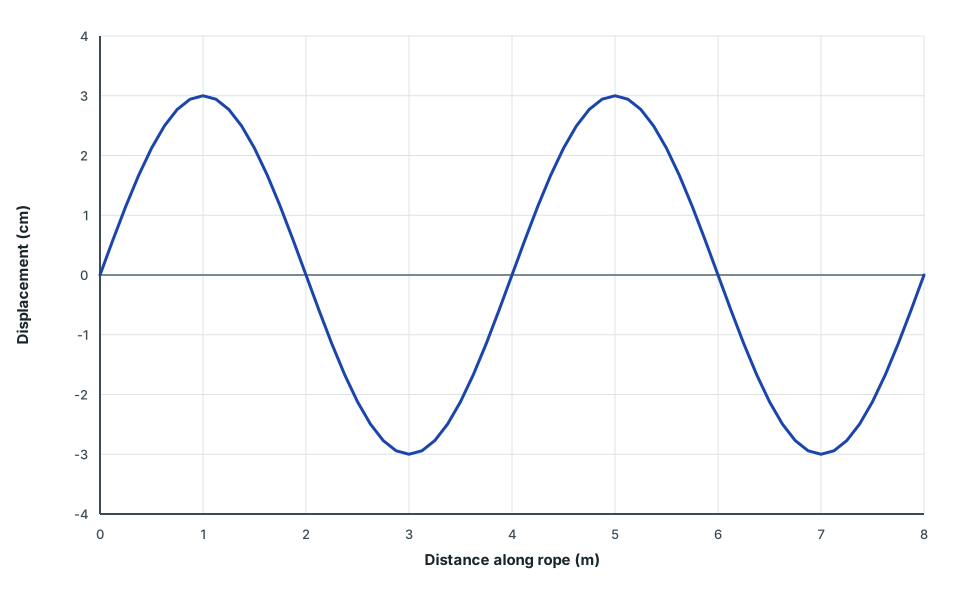
Two graphs of the same wave can look alike but mean different things.
- A displacement–distance graph is a snapshot of the whole wave at one instant. The horizontal axis is distance, so a crest-to-crest interval on it is a wavelength.
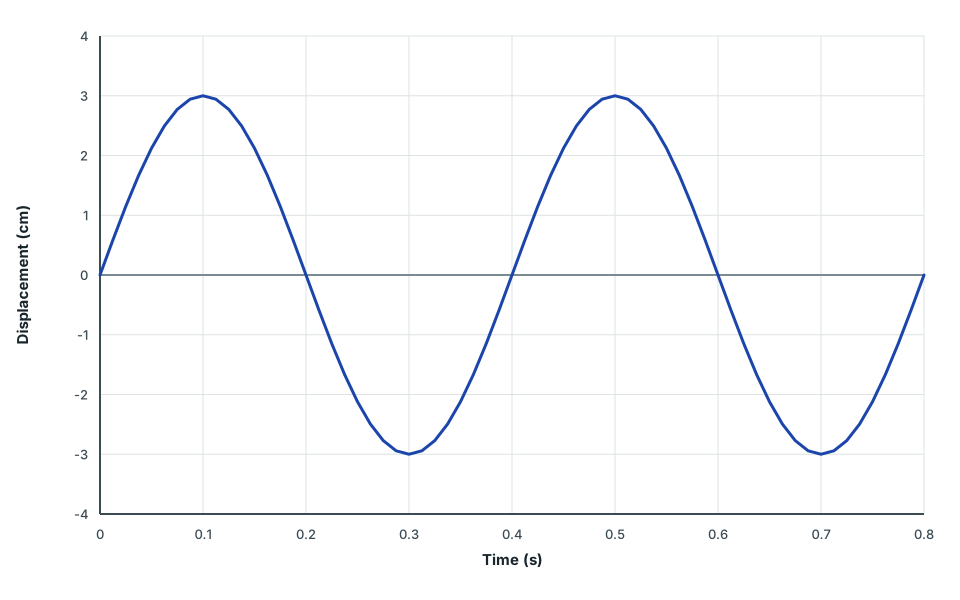
- A displacement–time graph follows one point as time passes. The horizontal axis is time, so a crest-to-crest interval on it is a period.
On either graph, read the amplitude vertically, from zero displacement to a crest.
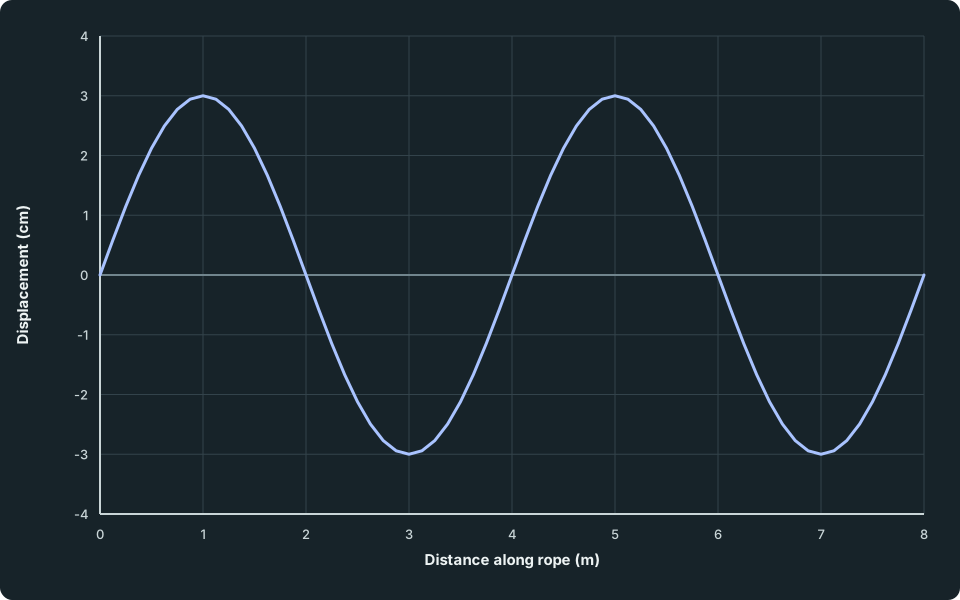
Rope displacement at one instant
Displacement in cm against distance along the rope in m, from 0 m to 8 m, at one instant. The rope has a smooth repeating shape between +3 cm and −3 cm: crests at 1 m and 5 m, troughs at 3 m and 7 m, and zero displacement at 0, 2, 4, 6 and 8 m. The wave travels towards increasing distance.
Scroll across the figure to read all labels.
View figure data
| Distance along rope (m) | Rope |
|---|---|
| 0.000 | 0.000000 |
| 0.125 | 0.585271 |
| 0.250 | 1.148050 |
| 0.375 | 1.666711 |
| 0.500 | 2.121320 |
| 0.625 | 2.494409 |
| 0.750 | 2.771639 |
| 0.875 | 2.942356 |
| 1.000 | 3.000000 |
| 1.125 | 2.942356 |
| 1.250 | 2.771639 |
| 1.375 | 2.494409 |
| 1.500 | 2.121320 |
| 1.625 | 1.666711 |
| 1.750 | 1.148050 |
| 1.875 | 0.585271 |
| 2.000 | 0.000000 |
| 2.125 | -0.585271 |
| 2.250 | -1.148050 |
| 2.375 | -1.666711 |
| 2.500 | -2.121320 |
| 2.625 | -2.494409 |
| 2.750 | -2.771639 |
| 2.875 | -2.942356 |
| 3.000 | -3.000000 |
| 3.125 | -2.942356 |
| 3.250 | -2.771639 |
| 3.375 | -2.494409 |
| 3.500 | -2.121320 |
| 3.625 | -1.666711 |
| 3.750 | -1.148050 |
| 3.875 | -0.585271 |
| 4.000 | 0.000000 |
| 4.125 | 0.585271 |
| 4.250 | 1.148050 |
| 4.375 | 1.666711 |
| 4.500 | 2.121320 |
| 4.625 | 2.494409 |
| 4.750 | 2.771639 |
| 4.875 | 2.942356 |
| 5.000 | 3.000000 |
| 5.125 | 2.942356 |
| 5.250 | 2.771639 |
| 5.375 | 2.494409 |
| 5.500 | 2.121320 |
| 5.625 | 1.666711 |
| 5.750 | 1.148050 |
| 5.875 | 0.585271 |
| 6.000 | 0.000000 |
| 6.125 | -0.585271 |
| 6.250 | -1.148050 |
| 6.375 | -1.666711 |
| 6.500 | -2.121320 |
| 6.625 | -2.494409 |
| 6.750 | -2.771639 |
| 6.875 | -2.942356 |
| 7.000 | -3.000000 |
| 7.125 | -2.942356 |
| 7.250 | -2.771639 |
| 7.375 | -2.494409 |
| 7.500 | -2.121320 |
| 7.625 | -1.666711 |
| 7.750 | -1.148050 |
| 7.875 | -0.585271 |
| 8.000 | 0.000000 |
In this snapshot, the crests at 1 m and 5 m are one wave apart, so the wavelength is 5 - 1 = 4 m. The trough at 3 m is only half a wave from the first crest: crest to trough is half a wavelength. The amplitude is 3 cm, although the crest-to-trough height is 6 cm.
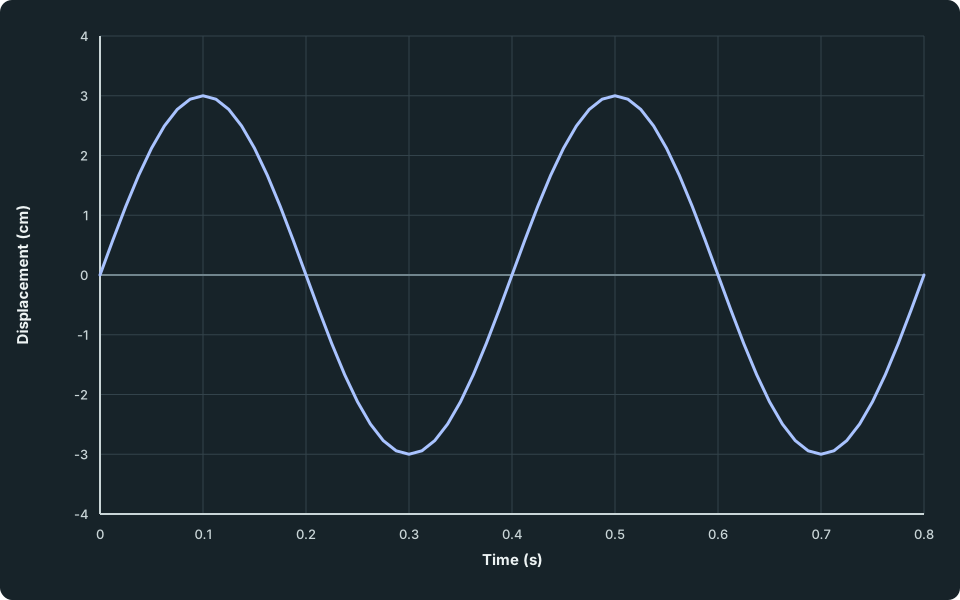
Displacement of the rope point 2.0 m along
Displacement in cm against time in s, from 0 s to 0.8 s, for the point 2.0 m along the same rope. The point starts at zero displacement moving up, reaches +3 cm at 0.10 s and 0.50 s, −3 cm at 0.30 s and 0.70 s, and passes through zero at 0, 0.20, 0.40, 0.60 and 0.80 s.
Scroll across the figure to read all labels.
View figure data
| Time (s) | Marked point |
|---|---|
| 0.0000 | 0.000000 |
| 0.0125 | 0.585271 |
| 0.0250 | 1.148050 |
| 0.0375 | 1.666711 |
| 0.0500 | 2.121320 |
| 0.0625 | 2.494409 |
| 0.0750 | 2.771639 |
| 0.0875 | 2.942356 |
| 0.1000 | 3.000000 |
| 0.1125 | 2.942356 |
| 0.1250 | 2.771639 |
| 0.1375 | 2.494409 |
| 0.1500 | 2.121320 |
| 0.1625 | 1.666711 |
| 0.1750 | 1.148050 |
| 0.1875 | 0.585271 |
| 0.2000 | 0.000000 |
| 0.2125 | -0.585271 |
| 0.2250 | -1.148050 |
| 0.2375 | -1.666711 |
| 0.2500 | -2.121320 |
| 0.2625 | -2.494409 |
| 0.2750 | -2.771639 |
| 0.2875 | -2.942356 |
| 0.3000 | -3.000000 |
| 0.3125 | -2.942356 |
| 0.3250 | -2.771639 |
| 0.3375 | -2.494409 |
| 0.3500 | -2.121320 |
| 0.3625 | -1.666711 |
| 0.3750 | -1.148050 |
| 0.3875 | -0.585271 |
| 0.4000 | 0.000000 |
| 0.4125 | 0.585271 |
| 0.4250 | 1.148050 |
| 0.4375 | 1.666711 |
| 0.4500 | 2.121320 |
| 0.4625 | 2.494409 |
| 0.4750 | 2.771639 |
| 0.4875 | 2.942356 |
| 0.5000 | 3.000000 |
| 0.5125 | 2.942356 |
| 0.5250 | 2.771639 |
| 0.5375 | 2.494409 |
| 0.5500 | 2.121320 |
| 0.5625 | 1.666711 |
| 0.5750 | 1.148050 |
| 0.5875 | 0.585271 |
| 0.6000 | 0.000000 |
| 0.6125 | -0.585271 |
| 0.6250 | -1.148050 |
| 0.6375 | -1.666711 |
| 0.6500 | -2.121320 |
| 0.6625 | -2.494409 |
| 0.6750 | -2.771639 |
| 0.6875 | -2.942356 |
| 0.7000 | -3.000000 |
| 0.7125 | -2.942356 |
| 0.7250 | -2.771639 |
| 0.7375 | -2.494409 |
| 0.7500 | -2.121320 |
| 0.7625 | -1.666711 |
| 0.7750 | -1.148050 |
| 0.7875 | -0.585271 |
| 0.8000 | 0.000000 |
Now follow the point 2.0 m along the same rope. It reaches its highest position at 0.10 s and again at 0.50 s, so one complete vibration takes 0.40 s. This is the period, not a wavelength: the horizontal unit is seconds. The frequency is f = 1 ÷ 0.40 = 2.5 Hz.
The two graphs agree with each other. In one period, 0.40 s, the crest that was at 1 m moves one wavelength, 4 m, to where the next crest was. Its speed is 4 ÷ 0.40 = 10 m/s.
Check your understanding 2
A different displacement–time record has successive peaks at 0.20 s, 0.80 s and 1.40 s. A learner takes the interval from 0.20 s to 1.40 s as the period. Which step fails first? Find the correct period and frequency.
Show the steps Optional working
Show answer
The learner has counted two complete vibrations as one: there is another peak between the chosen endpoints. Use neighbouring peaks, so T = 0.80 - 0.20 = 0.60 s. Then f = 1 ÷ 0.60 ≈ 1.7 Hz. Equivalently, divide the 1.20 s interval by two before finding the frequency.
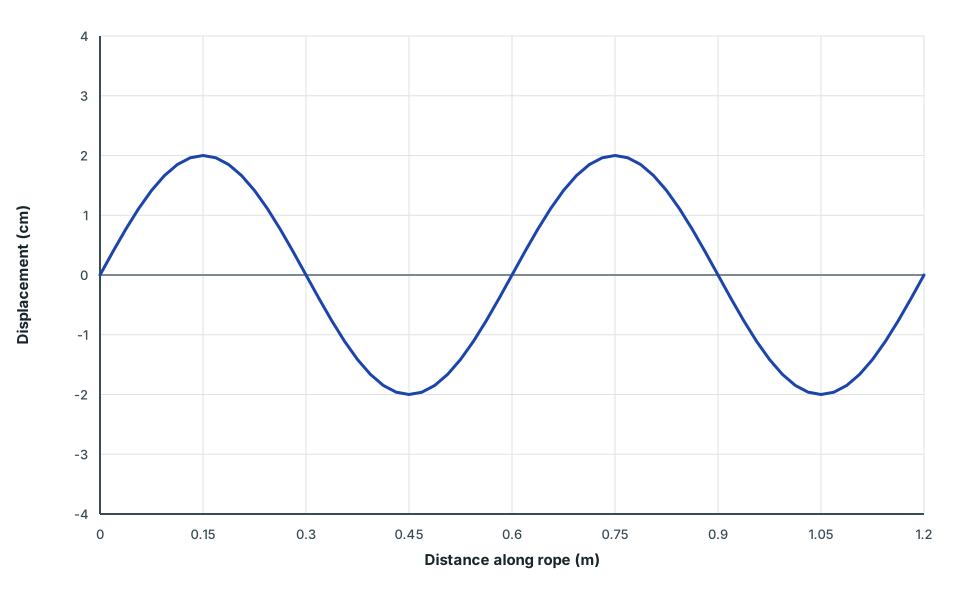
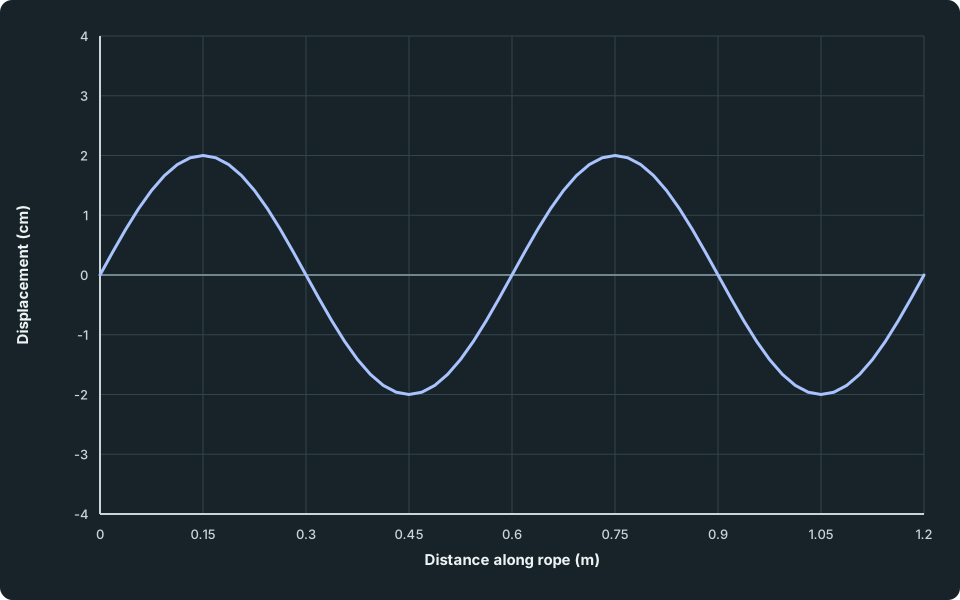
Another rope at one instant
Displacement in cm against distance along the rope in m, from 0 m to 1.2 m, at one instant. The rope has a smooth repeating shape between +2 cm and −2 cm: crests at 0.15 m and 0.75 m, troughs at 0.45 m and 1.05 m, and zero displacement at 0, 0.30, 0.60, 0.90 and 1.20 m.
Scroll across the figure to read all labels.
View figure data
| Distance along rope (m) | Rope |
|---|---|
| 0.00000 | 0.000000 |
| 0.01875 | 0.390181 |
| 0.03750 | 0.765367 |
| 0.05625 | 1.111140 |
| 0.07500 | 1.414214 |
| 0.09375 | 1.662939 |
| 0.11250 | 1.847759 |
| 0.13125 | 1.961571 |
| 0.15000 | 2.000000 |
| 0.16875 | 1.961571 |
| 0.18750 | 1.847759 |
| 0.20625 | 1.662939 |
| 0.22500 | 1.414214 |
| 0.24375 | 1.111140 |
| 0.26250 | 0.765367 |
| 0.28125 | 0.390181 |
| 0.30000 | 0.000000 |
| 0.31875 | -0.390181 |
| 0.33750 | -0.765367 |
| 0.35625 | -1.111140 |
| 0.37500 | -1.414214 |
| 0.39375 | -1.662939 |
| 0.41250 | -1.847759 |
| 0.43125 | -1.961571 |
| 0.45000 | -2.000000 |
| 0.46875 | -1.961571 |
| 0.48750 | -1.847759 |
| 0.50625 | -1.662939 |
| 0.52500 | -1.414214 |
| 0.54375 | -1.111140 |
| 0.56250 | -0.765367 |
| 0.58125 | -0.390181 |
| 0.60000 | 0.000000 |
| 0.61875 | 0.390181 |
| 0.63750 | 0.765367 |
| 0.65625 | 1.111140 |
| 0.67500 | 1.414214 |
| 0.69375 | 1.662939 |
| 0.71250 | 1.847759 |
| 0.73125 | 1.961571 |
| 0.75000 | 2.000000 |
| 0.76875 | 1.961571 |
| 0.78750 | 1.847759 |
| 0.80625 | 1.662939 |
| 0.82500 | 1.414214 |
| 0.84375 | 1.111140 |
| 0.86250 | 0.765367 |
| 0.88125 | 0.390181 |
| 0.90000 | 0.000000 |
| 0.91875 | -0.390181 |
| 0.93750 | -0.765367 |
| 0.95625 | -1.111140 |
| 0.97500 | -1.414214 |
| 0.99375 | -1.662939 |
| 1.01250 | -1.847759 |
| 1.03125 | -1.961571 |
| 1.05000 | -2.000000 |
| 1.06875 | -1.961571 |
| 1.08750 | -1.847759 |
| 1.10625 | -1.662939 |
| 1.12500 | -1.414214 |
| 1.14375 | -1.111140 |
| 1.16250 | -0.765367 |
| 1.18125 | -0.390181 |
| 1.20000 | 0.000000 |
Check your understanding 3
Read this second snapshot. Give the amplitude and the wavelength, then decide whether the period can be found from this graph alone.
Show answer
The amplitude is 2 cm, from zero to a crest. The crests at 0.15 m and 0.75 m give a wavelength of 0.75 - 0.15 = 0.60 m. A snapshot shows the wave at one instant only, so it cannot give the period or frequency. You need a displacement–time graph, or the frequency of the source.
Wave speed: v = fλ
In one period T, the source makes one complete wave, and the front of the wave moves forward by one wavelength λ. So
Because 1/T = f, this becomes the wave equation:
| Symbol | Quantity | SI unit |
|---|---|---|
| v | wave speed | metre per second (m/s) |
| f | frequency | hertz (Hz) |
| λ | wavelength | metre (m) |
Check the units: Hz × m = (1/s) × m = m/s. Rearranged, f = v ÷ λ and λ = v ÷ f.
The rope above agrees: v = fλ = 2.5 × 4 = 10 m/s, the same speed found from the crest’s movement.
Worked example 2
Finding wave speed
Problem
Water waves have a frequency of 5.0 Hz and a wavelength of 0.40 m. Find the wave speed.
Show full solution
Finding wave speed
Method
Multiply frequency by wavelength.Reason
One wave period carries the disturbance forward by one wavelength.Working
Answer
v = fλ = 5.0 × 0.40 = 2.0 m/s.
Worked example 3
Finding a sound wavelength
Problem
Sound travels through air at 340 m/s. Find the wavelength of a 680 Hz note.
Show full solution
Finding a sound wavelength
Method
Rearrange the wave equation before substituting.Reason
Speed is the product of frequency and wavelength.Working
Answer
- Choose the rearranged form: λ = v ÷ f.
- λ = 340 ÷ 680 = 0.50 m.
- Check: fλ = 680 × 0.50 = 340 m/s.
Worked example 4
Converting units before using the wave equation
Problem
A ripple tank dipper vibrates at 12 Hz and the wavefronts are 1.5 cm apart. Find the wave speed. Then find the wavelength of a 2.5 kHz sound in water, where sound travels at 1500 m/s.
Show full solution
Converting units before using the wave equation
Method
Convert centimetres to metres and kilohertz to hertz first.Reason
Consistent SI units make the equation produce metres and metres per second.Working
Answer
- Convert to SI units first: λ = 1.5 cm = 0.015 m.
- v = 12 × 0.015 = 0.18 m/s. (Using 1.5 without converting gives 18, which is in cm/s, not m/s.)
- For the sound, f = 2.5 kHz = 2500 Hz, so λ = 1500 ÷ 2500 = 0.60 m.
Worked example 5
Finding wave speed from the period
Problem
A wave on a rope has a wavelength of 1.2 m and a period of 0.40 s. Find the wave speed.
Show full solution
Finding wave speed from the period
Method
Use the distance travelled in one period.Reason
A crest travels one wavelength in the time of one complete oscillation.Working
Answer
v = λ ÷ T = 1.2 ÷ 0.40 = 3.0 m/s. Or find f = 1 ÷ 0.40 = 2.5 Hz first: v = 2.5 × 1.2 = 3.0 m/s.
Check your understanding 4
In a ripple tank the wavefronts are 2.0 cm apart, and the dipper makes 15 vibrations in 3.0 s. Find the frequency, the period and the wave speed.
Show the steps Optional working
Show the steps Optional working
Show answer
- f = 15 ÷ 3.0 = 5.0 Hz.
- T = 1 ÷ 5.0 = 0.20 s.
- λ = 2.0 cm = 0.020 m, so v = fλ = 5.0 × 0.020 = 0.10 m/s.
Check your understanding 5
The dipper keeps vibrating at 8.0 Hz, and the waves pass from deep water into shallow water, where they slow from 0.24 m/s to 0.16 m/s. Decide what happens to the frequency, then find the wavelength in each part.
Show answer
The dipper makes 8 waves each second, and every one of them reaches the shallow water, so the frequency stays 8.0 Hz. In deep water λ = 0.24 ÷ 8.0 = 0.030 m (3.0 cm). In shallow water λ = 0.16 ÷ 8.0 = 0.020 m (2.0 cm). The waves bunch up: slower waves at the same frequency have a shorter wavelength.
Check your understanding 6
The rope in the second snapshot is shaken by a source vibrating at 4.0 Hz. Find the wave speed.
Show answer
From the snapshot, λ = 0.60 m. v = fλ = 4.0 × 0.60 = 2.4 m/s. The 2 cm amplitude is not needed.
Check your understanding 7
A student doubles the frequency of the dipper in a ripple tank. The speed of the waves does not change. What happens to the wavelength?
Show answer
The wavelength halves. With v fixed, λ = v ÷ f, so doubling f halves λ.
Common mistakes
- Measuring amplitude from trough to crest. That is twice the amplitude; measure from the rest position to a crest.
- Dividing by the number of crests to find a wavelength. n crests have n - 1 gaps between them.
- Reading a wavelength from a displacement–time graph. Crest to crest on a time axis is the period.
- Taking crest to trough as one wavelength or one period. That is half a wave.
- Multiplying frequency by amplitude to find speed. Use v = fλ.
- Leaving cm or kHz unconverted. Use 1 cm = 0.01 m and 1 kHz = 1000 Hz.
- Saying a higher frequency makes the wave faster. At a fixed speed, a higher frequency gives a shorter wavelength.
Spotted an error? Report a correction
Syllabus and review details
- SEC G2 Science Physics component 2027 · 2027
Physics section, PDF pages 8–23
Last reviewed: