Electrical power, energy and cost
Key idea: Electrical power is voltage times current. Energy used is power times operating time; in kilowatt-hours, multiply kilowatts by hours, then apply the price per kilowatt-hour.
Offline pages
Saved on this device only. Connect at least once every 30 days to confirm Premium. Sign-out or a change of account removes saved copies.
Loading guide controls…
Guided lessons · coming soon
Guided lesson
Guided steps
- Follow how electrical energy heats a resistor.
- Connect current, voltage and time to power and energy.
- Find the kettle’s power before its energy.
- Find the energy, power and current.
- Explain why the cable heats less than the element.
- Convert the time before finding the iron’s energy.
- Find the resistor’s power and energy, then compare their units.
- Read what each marking on a rating plate means.
- Convert kilowatts to watts and find each current.
- Read how kilowatt-hours measure energy.
- Convert each energy to the unit asked for.
- Find the graph’s gradient and explain what happens during off-time.
- Find the energy before calculating the cost.
- Convert minutes to hours, then find the monthly cost.
- Correct the time unit and find the energy.
- Subtract the meter readings, then find the bill.
- Add the appliances’ energies and round only the final cost.
- Find both energies before deciding which is larger.
- Find the daily energy saving and the monthly money saving.
- Use the on-time and meter data to find each cost.
On this page
You stopped at:
ContinueA kettle, an oven and an electric heater all work the same way: a current through a metal element makes it hot. How much energy an appliance transfers depends on its power and how long it runs, and that energy, measured in kilowatt-hours, is what the electricity bill charges for. The calculations build on power as the rate of energy transfer from Work and power, and on Q = It and E = QV from E.m.f., potential difference and resistance.
The heating effect of a current
When a current passes through a resistor, electrical energy is transferred to the resistor’s internal energy. It gets hotter while input exceeds energy transferred to its surroundings; a hot element can stay at a steady temperature when those rates balance. This is the heating effect of electricity. A heating element is a coil or strip of metal alloy designed to get very hot without melting.
The current is not used up: the same current enters and leaves the element. What passes on is energy, from the supply to the element and then from the hot element to its surroundings.
| Appliance | Where the element is | What it heats and how |
|---|---|---|
| Kettle | inside the water, at the bottom | the water, by conduction into the water next to it and then by convection currents |
| Oven | at the top and bottom of the box | the air and the food, by convection in the air and by radiation from the element |
| Heater | behind a guard, facing the room | the air, by convection, and people and objects, by radiation |
Power and energy: P = VI and E = VIt
From E = QV to E = VIt
For a steady current I through a component with a p.d. V across it, the charge passing in time t is Q = It. Each coulomb transfers V joules, so
Power is the rate of energy transfer, P = E/t. Divide E = VIt by t:
The equations assume that the power stays the same over the time t. For the resistive mains appliances modelled here, use the stated supply voltage and the power or current on the rating plate. Use the question’s voltage if it differs from 230 V.
| Quantity | Symbol | Unit |
|---|---|---|
| power | P | watt (W) |
| potential difference | V | volt (V) |
| current | I | ampere (A) |
| energy transferred | E | joule (J) |
| time | t | second (s) |
One watt is one joule per second, and 1 V × 1 A = 1 W: one volt is one joule per coulomb, and one ampere is one coulomb per second.
Worked example 1
Energy transferred by a kettle element
Problem
A kettle element has a p.d. of 230 V across it and a current of 10 A through it. It is on for 150 s. Find the energy transferred.
Show full solution
Find the power
Method
Multiply p.d. by current.Reason
Power is the energy transferred each second.Working
Answer
P = VI = 230 × 10 = 2300 W, or 2300 J each second
Find the energy
Method
Multiply by the operating time.Reason
Energy is power × time.Working
Answer
E = Pt = 2300 × 150 = 3.45 × 10⁵ J
Say where it goes
Working
Answer
Mostly this increases the internal energy of the water. Some energy heats the kettle body and surroundings.
Check your understanding 1
A charge of 600 C passes through a resistor in 60 s on a steady D.C. supply. The p.d. across it is 12 V. Find the energy transferred, the power and the current.
Show the steps Optional working
Show answer
E = QV = 600 × 12 = 7200 J. P = E/t = 7200/60 = 120 W. I = Q/t = 600/60 = 10 A. Check: VI = 12 × 10 = 120 W.
Check your understanding 2
The cable to the kettle carries the same 10 A as the element. Why does the cable stay cool while the element gets very hot?
Show answer
The cable has a much lower resistance than the element, so almost all of the supply p.d. is across the element and only a tiny part is across the cable. With the same current, P = VI is far smaller for the cable, so it transfers much less energy each second.
Find the current: I = P/V
Divide both sides of P = VI by V:
Worked example 2
Current and energy for an iron
Problem
An iron’s resistive element is rated 920 W on the 230 V mains and stays on continuously for 5.0 minutes. Find the current and the energy it transfers.
Show full solution
Current
Method
Rearrange P = VI.Reason
The rating gives the power at the mains p.d.Working
Answer
I = P/V = 920/230 = 4.0 A
Convert the time
Method
Change minutes to seconds.Reason
E = Pt gives joules only from watts and seconds.Working
Answer
t = 5.0 × 60 = 300 s
Energy
Method
Multiply power by time.Reason
Energy is power × time.Working
Answer
E = 920 × 300 = 2.76 × 10⁵ J
Check
Working
Answer
E = VIt = 230 × 4.0 × 300 = 2.76 × 10⁵ J
A power rating alone does not tell you the energy used. A thermostat switches a heater on and off. A 2.0 kW heater whose element is on for a total of 15 minutes transfers the same energy whether it was plugged in for 15 minutes or an hour (ignoring the tiny energy used while the element is off).
Check your understanding 3
A resistor on a 12 V supply draws 2.0 A for 40 s. Find the power first, then the energy. Why do the two answers have different units?
Show the steps Optional working
Show answer
P = VI = 12 × 2.0 = 24 W: 24 J every second. E = Pt = 24 × 40 = 960 J: the total over 40 s. Power is a rate, so it is in watts; energy is an amount, so it is in joules. If you used the time to find the power, you found an energy instead.
Read an appliance’s rating plate
A rating plate states the supply and operating ratings. In this constructed example, a resistive heater shows:
| Marking | Meaning |
|---|---|
| 230 V ~ | designed for the 230 V A.C. mains (~ means A.C.) |
| 50 Hz | the frequency of that supply; not needed for P = VI |
| 1380 W | its power while the element is on at 230 V |
So in normal use it draws I = P/V = 1380/230 = 6.0 A. A plate may give power in kilowatts: 2.3 kW means 2300 W.
Check your understanding 4
Convert the kettle power to watts, then find the normal current for each rating plate: a resistive cooking element 230 V 690 W; a small resistive heater 230 V 115 W; a kettle element 230 V 2.76 kW.
Show the steps Optional working
Show answer
- Cooking element: I = 690/230 = 3.0 A.
- Small heater: I = 115/230 = 0.50 A.
- Kettle: convert to watts first, 2.76 kW = 2760 W, so I = 2760/230 = 12 A.
The kilowatt-hour and the cost of electricity
The kilowatt-hour is a unit of energy
Household appliances transfer millions of joules, so electricity companies measure energy in kilowatt-hours (kWh). One kilowatt-hour is the energy transferred by a 1 kW appliance in 1 hour.
To change kWh to joules, multiply by 3.6 × 10⁶. To change joules to kWh, divide by 3.6 × 10⁶.
| Energy | Working | Answer |
|---|---|---|
| 2.5 kWh in joules | 2.5 × 3.6 × 10⁶ | 9.0 × 10⁶ J |
| 1.8 × 10⁶ J in kWh | 1.8 × 10⁶ ÷ (3.6 × 10⁶) | 0.50 kWh |
Check your understanding 5
Convert 7.2 × 10⁵ J to kWh, and 0.050 kWh to joules.
Show answer
7.2 × 10⁵ ÷ (3.6 × 10⁶) = 0.20 kWh.
0.050 × 3.6 × 10⁶ = 1.8 × 10⁵ J.
Power, time and energy
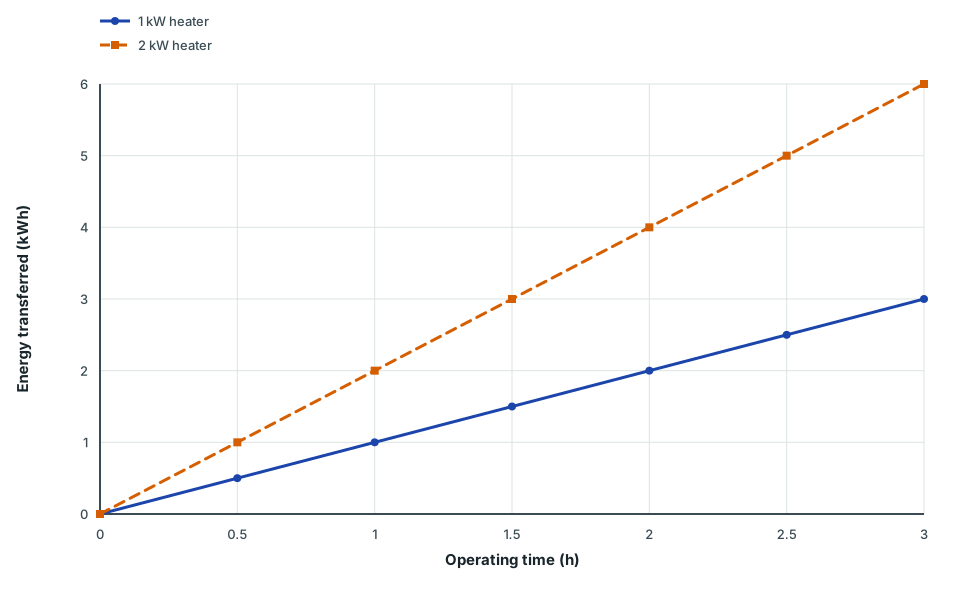
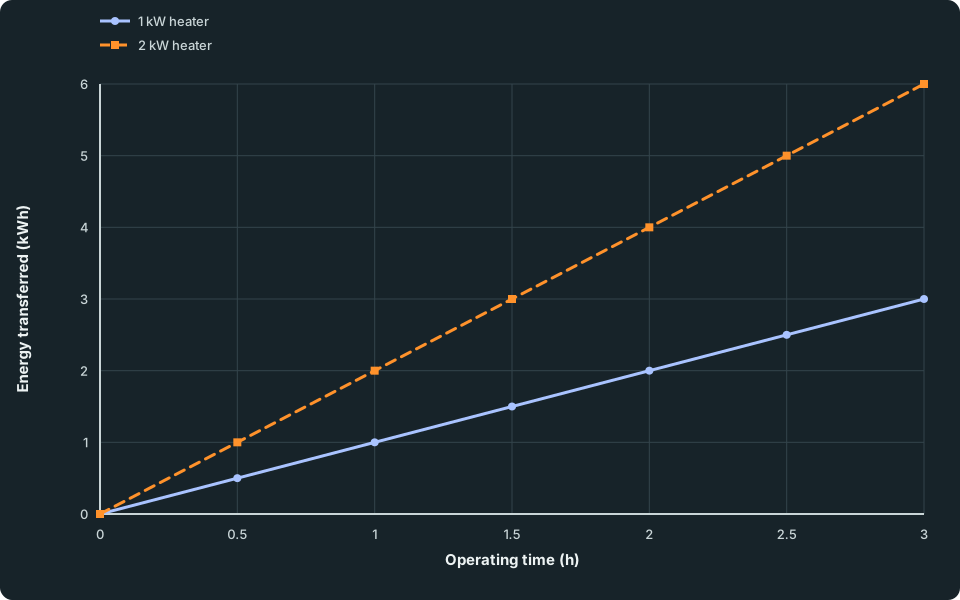
Energy in kilowatt-hours versus time in hours for 1 kW and 2 kW resistive heaters. Both start at zero; their straight-line gradients are 1 and 2 kilowatts.
Scroll across the figure to read all labels.
View figure data
| Operating time (h) | 1 kW heater | 2 kW heater |
|---|---|---|
| 0.0 | 0.0 | 0 |
| 0.5 | 0.5 | 1 |
| 1.0 | 1.0 | 2 |
| 1.5 | 1.5 | 3 |
| 2.0 | 2.0 | 4 |
| 2.5 | 2.5 | 5 |
| 3.0 | 3.0 | 6 |
The constructed graph assumes each heater stays at constant power. At 2.0 h, the 1.0 kW heater has transferred 2.0 kWh. The 2.0 kW heater transfers the same energy in 1.0 h: greater power transfers the same energy in less time.
Check your understanding 6 Read power from an energy–time graph
Use the plotted 2.0 kW line between 0.50 h and 1.50 h. Read the energy increase and calculate its gradient with units. Does the gradient give power, energy or cost? Why can a heater that cycles off not follow that same line for the whole plugged-in time?
Show the steps Optional working
Show answer
The line rises from 1.0 kWh to 3.0 kWh, an increase of 2.0 kWh in 1.0 h. Its gradient is 2.0 kWh/h = 2.0 kW, a power, not an energy or a cost. The plotted model runs continuously at 2.0 kW. An element that cycles off uses no electrical energy during each off interval, so the electrical energy used does not rise at that same rate throughout the plugged-in time. A bill also requires the stated price per kWh.
Cost = energy in kWh × price per kWh
The electricity bill charges a price for each kilowatt-hour used. The prices below are example tariffs. Where an appliance switches on and off, use its total on-time with its power, or its average power over the whole time.
Worked example 3
The cost of running a heater
Problem
A 2.0 kW heater operates continuously for 3.5 hours. Electricity costs 32 cents per kWh. Find the cost.
Show full solution
Find the energy in kWh
Method
Multiply kilowatts by hours.Reason
Power is already in kW and time in hours, so the product is in kWh.Working
Answer
E = 2.0 × 3.5 = 7.0 kWh
Find the cost
Working
Answer
7.0 × 32 = 224 cents, which is $2.24
Before you multiply, put power in kilowatts and time in hours. Watts × hours or kilowatts × minutes gives a number that is not in kWh.
Worked example 4
Several days of use
Problem
An appliance operates at a constant 1.84 kW for 15 minutes each day. Electricity costs 34 cents per kWh. Find the cost of running it for 30 days.
Show full solution
Convert the time
Method
Change minutes to hours.Reason
The kilowatt-hour needs time in hours.Working
Answer
15 min = 15/60 = 0.25 h
Energy each day
Method
Multiply power by time.Reason
kW × h gives kWh.Working
Answer
1.84 × 0.25 = 0.46 kWh
Energy for 30 days
Method
Multiply by the number of days.Reason
The same energy is used each day.Working
Answer
0.46 × 30 = 13.8 kWh
Cost
Working
Answer
13.8 × 34 = 469.2 cents, which is $4.69 to the nearest cent
Check your understanding 7
A learner finds the energy used by a 1.2 kW heater in 20 minutes as 1.2 × 20 = 24 kWh. Find the first error and correct it.
Show the steps Optional working
Show answer
The multiplication is right, but 20 is in minutes. With power in kW, the time must be in hours: 20 min = 20/60 h = 1/3 h. So E = 1.2 × 1/3 = 0.40 kWh. The answer 24 kWh would be 20 hours of heating.
Check your understanding 8
A meter reading changes from 04512 kWh to 04830 kWh in a month. Electricity costs 30 cents per kWh. Find the bill in dollars to the nearest cent.
Show the steps Optional working
Show answer
Energy used = 4830 - 4512 = 318 kWh. Bill = 318 × 30 = 9540 cents, which is $95.40.
A household’s daily use
Worked example 5
A household’s energy and cost
Problem
Electricity costs 30 cents per kWh. A household uses an air-conditioner (1.2 kW on average for 8.0 h a day), a refrigerator (150 W on average for 24 h), six LED lamps (10 W each for 5.0 h) and a kettle (2.3 kW for 12 min). Find the energy the household uses in a day, the cost per day and the cost for 30 days.
Show full solution
Energy for each appliance
Method
Convert every power to kW and every time to hours before multiplying.Reason
kW × h gives kWh: 150 W = 0.150 kW, 10 W = 0.010 kW and 12 min = 0.20 h.Working
Answer
Appliance Energy each day (kWh) air-conditioner 1.2 × 8.0 = 9.6 refrigerator 0.150 × 24 = 3.6 six LED lamps 6 × 0.010 × 5.0 = 0.30 kettle 2.3 × 0.20 = 0.46 Energy per day
Method
Add the four energies.Reason
The household’s total is the sum of its appliances.Working
Answer
9.6 + 3.6 + 0.30 + 0.46 = 13.96 kWh
Cost per day
Method
Multiply by the price.Reason
Each kWh costs 30 cents.Working
Answer
13.96 × 30 = 418.8 cents, about $4.19
Cost for 30 days
Working
Answer
Use the unrounded energy: 13.96 × 30 = 418.8 kWh, costing 418.8 × 30 = 12 564 cents, which is $125.64. Round only at the end.
The kettle has the greatest stated power, but the air-conditioner uses the most energy because its average power is sustained over a much longer time. Cost depends on energy, which is power and time.
Check your understanding 9
Which uses more energy in a day: a 2.0 kW kettle used for 6.0 minutes, or a 60 W fan used for 8.0 hours?
Show the steps Optional working
Show the steps Optional working
Show answer
Kettle: 2.0 × 0.10 = 0.20 kWh (6.0 min = 0.10 h). Fan: 0.060 × 8.0 = 0.48 kWh. The fan uses more energy, even though its power is much smaller.
Check your understanding 10
The household replaces the six lamps with ones rated 5.0 W each. How much energy does that save each day, and how much money in 30 days? Give the money saving in dollars to the nearest cent.
Show the steps Optional working
Show the steps Optional working
Show answer
New lamp energy: 6 × 0.0050 × 5.0 = 0.15 kWh each day, a saving of 0.30 - 0.15 = 0.15 kWh. In 30 days: 0.15 × 30 = 4.5 kWh, which saves 4.5 × 30 = 135 cents, or $1.35.
Check your understanding 11 Compare on-time with measured energy
A 2.0 kW heater is plugged in for 3.0 h, but a log shows its element is on for a total of 45 min. Ignore energy used while off. A separate energy meter records 1.6 kWh for a second heater over the same 3.0 h. At the example price of 30 cents/kWh, find each heater’s cost. A learner charges the first heater for 6.0 kWh. Identify the assumption that fails.
Show the steps Optional working
Show the steps Optional working
Show answer
For the first heater, 45 min = 0.75 h of on-time, so energy = 2.0 × 0.75 = 1.5 kWh, costing 45 cents. The second heater’s measured 1.6 kWh costs 48 cents, so the second costs 3 cents more. The 6.0 kWh calculation assumes continuous operation for all 3.0 h; the log contradicts it. The second heater’s measured energy already includes its actual operating pattern, so do not multiply 1.6 kWh by time again.
Common mistakes
- Calling the kilowatt-hour a unit of power. It is a power multiplied by a time, so it measures energy: 1 kWh = 3.6 × 10⁶ J.
- Multiplying watts by hours and calling the answer kWh. A 2000 W heater for 3 h uses 2.0 kW × 3 h = 6.0 kWh, not 6000 kWh.
- Writing 1 kWh = 1000 J. That forgets the hour: 1000 W × 3600 s = 3.6 × 10⁶ J.
- Multiplying watts by minutes to get joules. A watt is a joule per second, so use seconds.
- Saying the appliance with the highest power always costs the most. Cost depends on energy, so compare P × t, not P alone.
Spotted an error? Report a correction
Syllabus and review details
- SEC G2 Science Physics component 2027 · 2027
Physics section, PDF pages 8–23
Last reviewed: