I/V Graph Of Metallic Conductor
Key idea: Learn the I–V characteristic of a metallic (ohmic) conductor at constant temperature, how to sketch it, and how to find resistance from the graph.
Continue where you stopped
The core idea
On this page
Learning objectives
- State current as rate of charge flow measured in amperes
- Distinguish conventional current from electron flow
- Apply charge equals current multiplied by time
- Define source e.m.f. as work done per unit charge around a circuit
- Calculate total e.m.f. for sources in series
- Define component potential difference as work done per unit charge
- State resistance as potential difference divided by current
- Apply resistance equals potential difference divided by current
- Apply wire-resistance proportionalities for length and cross-sectional area
- Describe the effect of temperature on metallic resistance
- Sketch and interpret required current–voltage characteristics
1. Definition
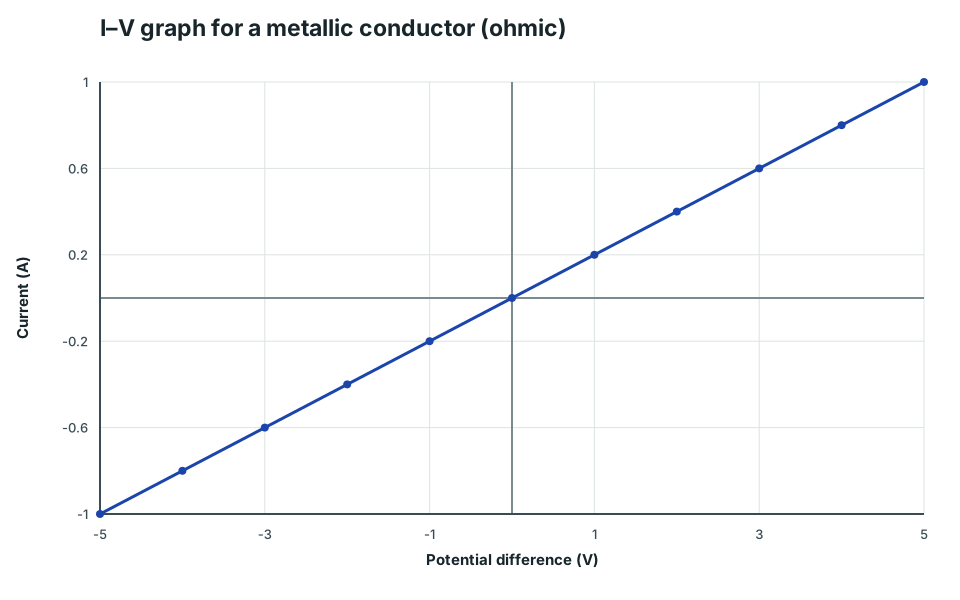
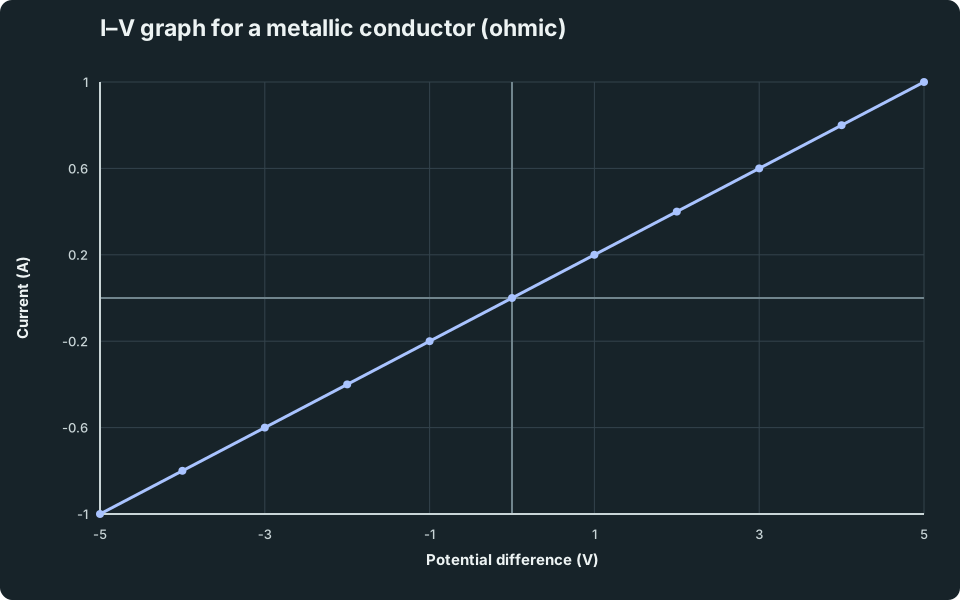
For a metallic conductor at constant temperature, current is directly proportional to voltage (Ohm’s law), so its I–V graph is a straight line through the origin.
2. Key Ideas
- Ohm’s law condition: constant temperature.
- For an ohmic conductor: I ∝ V and R is constant.
- The complete characteristic continues through the origin into the negative region because reversing p.d. reverses current.
- On an I vs V graph:
- straight line through origin ⇒ constant R
- gradient = I/V = 1/R
- To find resistance from a point on the graph: R = V/I.
You should be able to sketch and interpret the I–V characteristic of a metallic conductor at constant temperature. Draw the complete straight line through quadrants I and III unless the axes restrict the range.
3. Detailed Explanations
A. What the straight line means
If you double V, the current I doubles. This shows I ∝ V.
B. Why “constant temperature” matters
If the wire heats up, its resistance increases and the graph may stop being a straight line. In experiments, use small currents or take readings quickly to reduce heating.
C. Reading resistance from the I–V graph
Pick any convenient point on the line (not too close to the origin), then:
R = V/I
I–V graph for a metallic conductor (ohmic)
A straight-line I–V graph through the origin for an ohmic conductor at constant temperature.
Scroll across the graph to read all labels.
View figure data
| Potential difference (V) | Ohmic conductor |
|---|---|
| -5 | -1 |
| -4 | -0.8 |
| -3 | -0.6 |
| -2 | -0.4 |
| -1 | -0.2 |
| 0 | 0 |
| 1 | 0.2 |
| 2 | 0.4 |
| 3 | 0.6 |
| 4 | 0.8 |
| 5 | 1 |
Using R = V/I is covered here: Resistance (R = V/I).
4. Common Mistakes
- Forgetting “constant temperature” when stating Ohm’s law.
- Saying “the gradient is the resistance” for an I vs V graph (here gradient = 1/R).
- Using points that are not on the straight line (read the graph carefully).
5. Exam Tips
- For a metallic conductor (ohmic): draw a straight line through the origin.
- If asked for resistance, either:
- use a point: R = V/I, or
- use slope: R = 1/gradient (for I vs V).
- Always include units: V (V), I (A), R (Ω).
6. Worked Examples
Modelled example 1
Finding resistance from a point
Problem
Study the worked solution
Read the coordinates in axis order
Method
Take V = 3.0 V and I = 0.60 A.Reason
The resistance definition requires voltage divided by current.Working
Point: (V,I), not (I,V).Calculate resistance
Method
Divide voltage by current.Reason
For an ohmic conductor the same ratio applies at every point on the line.Working
R = 3.0/0.60 = 5.0 Ω
Guided practice 2
Predicting current (ohmic)
Problem
Use the constant resistance
Hints
Hint 1: use the graph condition
Hint 2: calculate current
View solution step by step
Predict the current
Method
Divide voltage by the constant resistance.Reason
The straight-line characteristic obeys I = V/R.Working
I = 2.0/5.0 = 0.40 A
Common misconception 3
Checking if data is ohmic
Learner response
Test the measured ratios first
View solution step by step
Evaluate the evidence
Method
Show that doubling V doubles I and both points give R = 10 Ω.Reason
The readings are consistent with direct proportionality over the measured range.Working
2.0/0.20 = 4.0/0.40 = 10 ΩLimit the conclusion
Method
Say the data support, but do not prove, an ohmic relationship across every voltage.Reason
More points including the origin and controlled temperature are needed to establish the full straight-line characteristic.Working
Consistent with ohmic behaviour in the tested range.
Examiner practice 4
Finding resistance from gradient
Examination question
Interpret the axes before using the gradient
View solution step by step
Relate gradient to resistance
2 marksMethod
Use gradient = Δ I/Δ V = 1/R.Reason
Current is on the vertical axis and voltage on the horizontal axis.Working
R = 1/gradientCalculate resistance
1 markMethod
Take the reciprocal of 0.25 A V⁻¹.Reason
The reciprocal unit is V A⁻¹ = Ω.Working
R = 1/0.25 = 4.0 Ω
Self-mark with the mark scheme
Compare your response with each mark point. Select a point only when your response contains that evidence.
Self-mark axis interpretation, reciprocal method and result.
Challenge 5
Using two points to find resistance
Two-point graph transfer
Separate gradient calculation from resistance conversion
Hints
Hint 1: calculate rise over run
Hint 2: then invert
View solution step by step
Find the line gradient
Method
Divide the change in current by the change in voltage.Reason
Using two separated points reduces reliance on a single coordinate.Working
(Δ I)/(Δ V) = (0.80-0.20)/(4.0-1.0) = 0.20 A V⁻¹Convert gradient to resistance
Method
Take the reciprocal.Reason
For I plotted against V, gradient is 1/R.Working
R = 1/0.20 = 5.0 Ω
7. Mind Stretchers
Mind stretcher 1: Gradient vs resistanceExtension
An I–V graph is a straight line through the origin. Line A is steeper than Line B. Which conductor has larger resistance?
Show Answer
Line A has a larger gradient (I/V), so it has smaller resistance because gradient = 1/R. Therefore Line B has the larger resistance.
Mind stretcher 2: Changing axesExtension
If you plot a V vs I graph instead, what does the gradient represent?
Show Answer
For a V vs I graph, gradient = V/I = R (so the gradient is the resistance).
8. Practice and next step
Sketch the complete line without copying, label both axes and state the constant-temperature condition. Check your reasoning in the I–V Characteristics Lab, then compare it with the filament lamp.
Continue with the next resource in this course.
Course and syllabus information
- Course
- SEC G3 Physics
- Edition
- SEC G3 Physics 2027