Power and Efficiency
Key idea: Calculate O Level power and efficiency using energy, work and time; compare devices, convert units and solve linked lifting problems with clear working.
Continue where you stopped
The core idea
On this page
Learning objectives
- Recognise kinetic, potential, nuclear and internal energy stores
- Describe mechanical energy transfer by a force acting over a distance
- Describe electrical energy transfer by an electric current
- Describe energy transfer by heating due to a temperature difference
- Describe energy transfer by electromagnetic and mechanical waves
- Recall and apply Ek = ½mv² in new situations
- Recall and apply Ep = mgh near the Earth's surface in new situations
- State and apply the principle of conservation of energy
- Recall and apply work done = force × distance moved in the force direction
- Recall and apply power = energy transfer / time taken
- Calculate efficiency as useful energy output / total energy input
- Evaluate prescribed electricity-generation resources by efficiency, cost, reliability and environmental impact
1. Definition
Power
Power is the rate of doing work, or the rate of energy transfer.
P = W/t = E/t
- P is power in watts (W), W is work done in joules (J), E is energy transferred in joules (J), and t is time in seconds (s).
- 1 W = 1 J s⁻¹
- Power is a scalar quantity.
Review Energy calculations first if finding Eₖ, Δ Eₚ or dissipated energy still feels difficult.
Power is the gradient of an energy–time graph
Two straight lines on an energy-time graph: the steeper line represents higher power (faster energy transfer).
Scroll across the graph to read all labels.
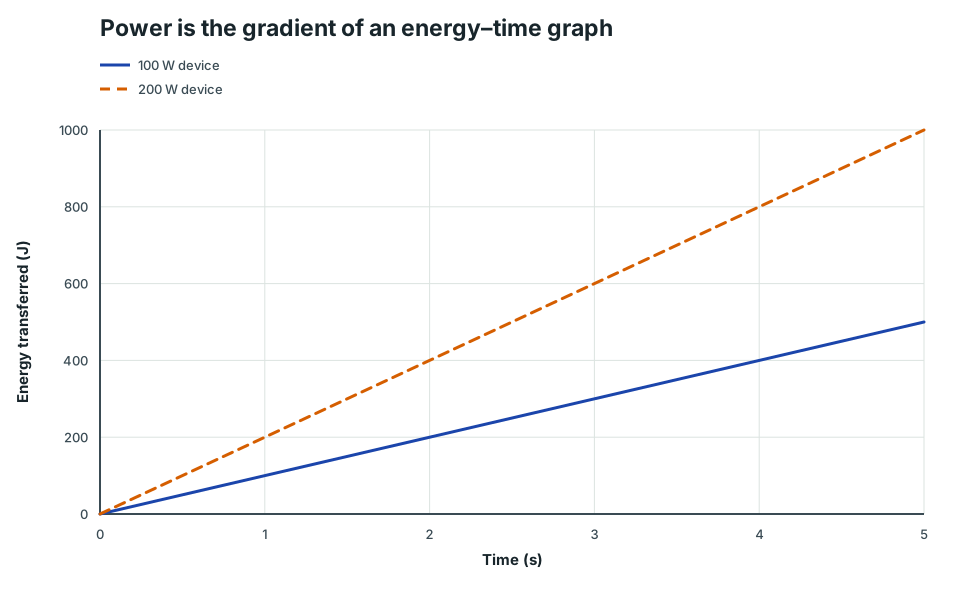
View figure data
| Time (s) | 100 W device | 200 W device |
|---|---|---|
| 0 | 0 | 0 |
| 5 | 500 | 1000 |
For the steeper line, gradient = (1000 - 0)/(5.0 - 0) = 200 J s⁻¹ = 200 W
The gradient unit confirms that the graph gives a rate of energy transfer.
2. Key Ideas
- Always convert time to seconds before using P = E/t.
- A device has higher power if it transfers the same energy in less time, or more energy in the same time.
- If a load is lifted at constant speed, the useful work done is the gain in GPE: W_useful = mgh (or Fh if weight F is given).
- Efficiency, η, compares the useful output with the total input. Use either energy values, or power values measured over the same interval, but do not mix them: η = E_useful/Eᵢₙₚᵤₜ × 100% η = P_useful/Pᵢₙₚᵤₜ × 100%
- Efficiency cannot exceed 100%.
- High power does not necessarily mean high efficiency: power describes how fast energy is transferred, while efficiency describes the useful fraction.
3. Detailed Explanations
Calculating power
To find power:
- Find the energy transferred E (or work done W).
- Convert time to seconds.
- Use P = E/t (or P = W/t).
For example, if 600 J is transferred in 3.0 s, P = 600/3.0 = 200 W
Efficiency
Energy is conserved, but not all input energy is transferred usefully. For a device:
total input energy = useful energy output + energy dissipated to the surroundings
The dissipated share commonly increases internal energy stores in the device and surroundings. Sound waves may also carry energy away, often because of friction, vibration or electrical resistance.
Efficiency of an energy transfer is:
η = E_useful/Eᵢₙₚᵤₜ × 100%
4. Common Mistakes
- Not converting minutes/hours to seconds.
- Mixing up power (W) and energy (J).
- Writing P = W/t but using W as “watt” instead of work done (J).
- Getting efficiency > 100% (usually input/output swapped).
- Forgetting to multiply by 100% when the answer is required as a percentage.
- Assuming the device with the greatest power is automatically the most efficient.
- Using useful energy over input power, or useful power over input energy. Both parts of an efficiency ratio must be the same type of quantity.
5. Exam Tips
- Start with the definition: power = energy transfer per unit time.
- Show unit conversions clearly (e.g. 10 min = 600 s).
- When comparing two power outputs, check what is the same:
- same work but different time → compare time
- same time but different work → compare work
- For efficiency questions, write input = useful + dissipated before substituting numbers.
- Convert a percentage efficiency to a decimal before rearranging an equation: 20% = 0.20.
- Sense-check the result: useful output cannot exceed total input, and efficiency cannot exceed 100%.
6. Worked Examples
Modelled example 1
Two runners climb the same hill
Problem
Runner A has twice the mass of runner B. They climb the same vertical height in the same time. Whose average useful mechanical power output is higher? Explain.
Study the worked solution
Relate climbing work to GPE
Method
Model the useful work as the gain in gravitational potential energy.Reason
Each runner raises their mass through vertical height h.Working
W = Δ Eₚ = mghCompare the average powers
Method
Divide each energy transfer by the common time.Reason
With g, h and t fixed, P = mgh/t is proportional to mass.Working
P = mgh/t ⇒ P_A = 2P_B
Guided practice 2
Power of a motor
Problem
A motor does 60 000 J of work in 10 min. Calculate its average power.
Convert time before calculating the rate
Hints
Hint 1: convert the time
Hint 2: calculate the rate
View solution step by step
Convert minutes to seconds
Method
Express the time in SI units.Reason
A watt is a joule per second.Working
10 min = 10 × 60 = 600 sCalculate average power
Reason
Average power is work done per unit time.Working
P = W/t = (60 000)/600 = 100 W
Common misconception 3
Useful energy from input power
Learner response
An electric motor has input power 1.0 kW. In half an hour, 60% of the input energy is dissipated. A student states that the efficiency is therefore 60%. Locate the error, find the useful energy transferred, and state the actual efficiency.
Separate useful and dissipated fractions
View solution step by step
Convert power and time
Method
Use watts and seconds.Reason
E = Pt requires consistent SI units.Working
1.0 kW = 1000 W, 0.5 h = 1800 sFind the total input energy
Reason
Power is the rate of input energy transfer.Working
Eᵢₙ = Pt = (1000)(1800) = 1.8 × 10⁶ JUse the complementary fraction
Method
Subtract the dissipated fraction from 100%.Reason
Input energy is split into useful and dissipated shares.Working
E_useful = 0.40(1.8 × 10⁶) = 7.2 × 10⁵ J
Examiner practice 4
Energy dissipated by a lifting motor
Examination question
An electric motor lifts a 10 N load through 5.0 m. The electrical energy input is 65 J. Calculate the energy dissipated by the motor and its efficiency. [4 marks]
Show useful energy, dissipation and efficiency
View solution step by step
Calculate useful output energy
1 markMethod
Find the work done lifting the load.Reason
The load’s gain in GPE is the useful output.Working
E_useful = Fh = (10)(5.0) = 50 JFind dissipated energy
1 markReason
Input energy equals useful output plus dissipated energy.Working
E_dissipated = 65-50 = 15 JForm the efficiency ratio
1 markMethod
Divide useful output by total input.Reason
Efficiency measures the useful fraction of the input.Working
η = 50/65 × 100%State the efficiency
1 markReason
The result must be below 100% because some energy is dissipated.Working
η = 76.9% ≈ 77%
Self-mark with the mark scheme
Compare your response with each mark point. Select a point only when your response contains that evidence.
Self-mark useful energy, dissipated energy, efficiency method and final percentage separately.
Challenge 5
Input power from efficiency
Reverse efficiency calculation
A crane raises a weight of 200 N through a vertical height of 8.0 m in 4.0 s at constant speed. The efficiency of the crane is 20%. Find the electrical input power.
Work from useful output back to total input
Hints
Hint 1: find useful output power
Hint 2: reverse the efficiency ratio
View solution step by step
Find useful output energy
Method
Calculate the work done on the load.Reason
The vertical lift is the crane’s useful transfer.Working
E_useful = Fh = (200)(8.0) = 1600 JFind useful output power
Reason
Power is energy transferred per unit time.Working
Pₒᵤₜ = 1600/4.0 = 400 WInfer the input power
Method
Rearrange the efficiency equation for input power.Reason
The 400 W useful output is only 20% of the electrical input.Working
Pᵢₙ = 400/0.20 = 2000 W = 2.0 kW
7. Mind Stretchers
Mind stretcher 1: Finding efficiency from power and workExtension
A motor takes in power 500 W for 20 s. It lifts a 100 N load through 6.0 m at constant speed. Find the efficiency of the motor.
Show Answer
Total input energy: Eᵢₙ = Pt = (500)(20) = 10 000 J
Useful output energy: E_useful = Fh = (100)(6.0) = 600 J
efficiency = 600/(10 000) × 100% = 6.0%
Mind stretcher 2: Same work, different powerExtension
Two machines each do 3000 J of work. Machine A takes 12 s, machine B takes 7.5 s. Find the power of each machine and state which is more powerful.
Show Answer
P_A = 3000/12 = 250 W P_B = 3000/7.5 = 400 W
Machine B has the higher power because it does the same work in less time.
Continue with the next resource in this course.
Course and syllabus information
- Course
- SEC G3 Physics
- Edition
- SEC G3 Physics 2027