Friction
Key idea: Learn what friction is, how it affects motion, and how to handle friction in resultant-force questions (O Level Physics 6091).
Continue where you stopped
The core idea
On this page
Learning objectives
- Distinguish contact forces from non-contact forces
- State that mass measures the amount of matter in a body
- Describe a gravitational field as a region where a mass experiences gravitational force
- Define gravitational field strength as gravitational force per unit mass
- Apply weight = mass × gravitational field strength
- Distinguish mass from weight
- Describe the effect of balanced and unbalanced forces on a body
- Describe ways a force may change motion
- Identify action–reaction pairs on interacting bodies
- Draw free-body diagrams for force systems in at most two dimensions
- Solve three-force static equilibrium graphically
- Apply resultant force = mass × acceleration
- Relate mass to resistance to change in motion
- Explain the effects of friction on motion
- Describe falling with and without air resistance, including terminal velocity
- Describe a moment as a force's turning effect in everyday examples
- Apply moment = force × perpendicular distance from the pivot
- State the principle of moments for a body in equilibrium
- apply the principle of moments to new situations or to solve related problems
- show an understanding that the weight of a body may be taken as acting at a single point known as its centre of gravity
- Explain qualitatively how centre-of-gravity position affects stability
1. Definition
Friction is a contact force that acts parallel to the surfaces in contact and opposes:
- the motion of one surface over another, or
- the tendency for motion (when the object is still at rest).
2. Key Ideas
- Friction acts opposite to the direction of motion (or opposite to the direction the object would move).
- Friction affects motion by changing the resultant force:
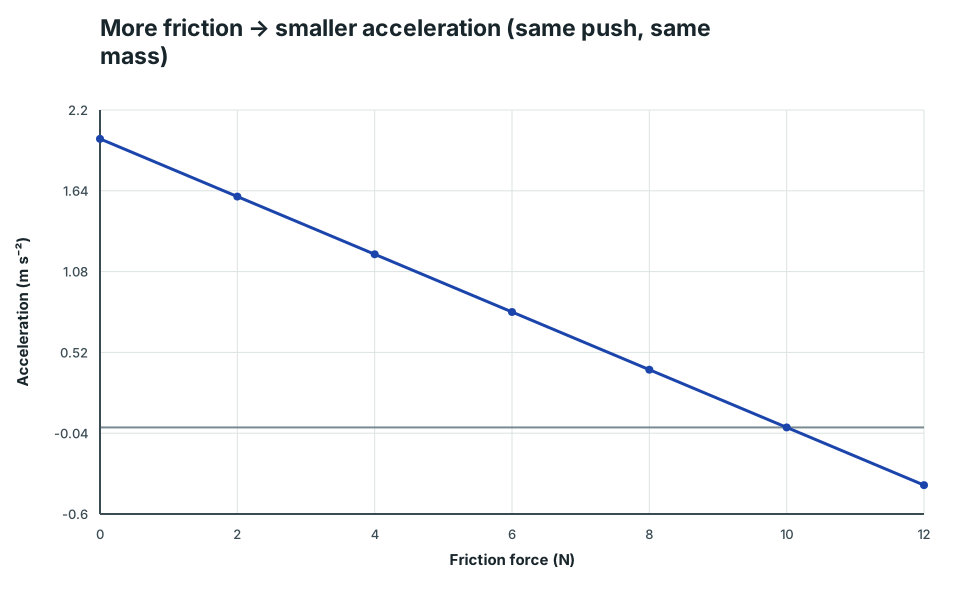
- bigger friction → smaller resultant force → smaller acceleration (see Unbalanced Force)
- if friction balances the driving force → resultant force is zero → constant velocity (see Balanced Forces and Newton’s First Law)
- Friction can be useful (walking, tyres, braking), but it also causes energy loss (heat, wear and tear).
- Friction depends on the surfaces in contact (roughness/material) and how hard they are pressed together (qualitatively).
- Air resistance (drag) is a resistive force in air; it can lead to terminal velocity: see Terminal Velocity.
More friction → smaller acceleration (same push, same mass)
Acceleration versus friction force for a fixed driving force and mass; crossing a = 0 shows the change from speeding up to slowing down.
Scroll across the graph to read all labels.
View figure data
| Friction force (N) | a = (F - f)/m |
|---|---|
| 0 | 2 |
| 2 | 1.6 |
| 4 | 1.2 |
| 6 | 0.8 |
| 8 | 0.4 |
| 10 | 0 |
| 12 | -0.4 |
3. Detailed Explanations
A. Direction of friction
If a box slides to the right, friction on the box acts to the left.
If a box is not moving but you push it to the right, friction (if present) acts to the left to oppose the start of motion.
B. Friction changes the resultant force (and therefore acceleration)
For motion in a straight line:
- resultant force forward = driving force − friction (and other resistive forces)
- then use Fᵣₑₛᵤₗₜₐₙₜ = ma
So friction can:
- reduce acceleration (when speeding up),
- cause deceleration (when slowing down),
- or prevent motion from starting (if the push is not enough).
- Draw an FBD and label all forces.
- Choose a positive direction (often the direction of motion).
- Add forces along the line of motion using signs; with forward positive, subtract friction and other backward-force magnitudes.
- Use Fᵣₑₛᵤₗₜₐₙₜ = ma (or Fᵣₑₛᵤₗₜₐₙₜ = 0 for constant velocity).
- Use the final sign to state the direction, and check units.

Static friction is not always 4 N: while the block remains at rest, it matches the applied force up to a maximum value. If the applied force exceeds that maximum, the block starts to slide.
C. Where the energy goes
When an object moves against friction, energy is transferred mechanically. The internal energy of the surfaces usually increases, so they become warmer; some energy may also be transferred by sound or used in deforming and wearing the surfaces.
D. Reducing friction vs increasing friction
| Reducing friction (when you want efficiency) | Increasing friction (when you want grip) |
|---|---|
| lubrication (oil/grease) | treads on tyres and shoes |
| ball bearings / rollers | roughening surfaces (e.g. sanding) |
| smoothing/polishing surfaces | using brake pads |
| streamlining to reduce air resistance | using chalk to improve grip |
4. Common Mistakes
- Drawing friction in the wrong direction (it should oppose motion/tendency of motion).
- Forgetting friction when finding the resultant force (using driving force as if it were the resultant).
- Assuming “no force means no motion” (objects can move at constant velocity when resultant force is zero).
- Mixing up mass and weight in F = ma calculations (use kg for mass).
5. Exam Tips
- Always draw a free body diagram first: Free Body Diagrams (FBD).
- Choose a positive direction, then write:
- resultant force = (forward forces) − (backward forces)
- If the question says “moves at constant speed”, then:
- resultant force = 0, so driving force = friction (and other resistive forces).
- If the object is slowing down, the resultant force (often friction) is opposite the motion.
6. Worked Examples
- “smooth”: friction is negligible.
- “rough”: friction acts and opposes motion (or impending motion).
- “constant velocity” / “constant speed”: Fᵣₑₛᵤₗₜₐₙₜ = 0 so forward forces balance friction/drag.
- “ignore air resistance”: do not include drag.
Modelled example 1
Resultant force with friction (acceleration)
Problem
Study the worked solution
Find the resultant force
Method
Subtract the backward friction from the forward push.Reason
Newton’s second law uses the vector sum of forces.Working
Fᵣₑₛᵤₗₜₐₙₜ = 10-7 = 3 N forwardCalculate acceleration
Reason
Divide the resultant force by mass.Working
a = 3/10 = 0.30 m s⁻² forward
Guided practice 2
Constant speed (friction equals driving force)
Problem
Translate motion into a force condition
Hints
Hint 1: use constant velocity
Hint 2: balance horizontal forces
View solution step by step
Set the resultant to zero
Method
Balance the forward pull and backward friction.Reason
Constant velocity requires zero acceleration and zero resultant force.Working
12-f = 0 ⇒ f = 12 N backward
Common misconception 3
Friction causes deceleration
Learner response
Carry force direction into acceleration
View solution step by step
Assign the force sign
Method
Write friction as a negative force.Reason
Friction opposes the positive forward motion.Working
Fᵣₑₛᵤₗₜₐₙₜ = -4.0 NCalculate signed acceleration
Reason
Acceleration points with the resultant force.Working
a = (-4.0)/5.0 = -0.80 m s⁻²
Examiner practice 4
Braking force (deceleration)
Examination question
Show sign, equation and interpretation
View solution step by step
Assign the resultant-force sign
1 markMethod
Write the braking force as negative.Reason
It acts opposite the chosen positive motion direction.Working
Fᵣₑₛᵤₗₜₐₙₜ = -2500 NApply Newton's second law
1 markMethod
Divide force by mass.Reason
a = Fᵣₑₛᵤₗₜₐₙₜ/m.Working
a = (-2500)/1000State the acceleration
1 markReason
The negative sign represents deceleration relative to the motion.Working
a = -2.5 m s⁻²
Self-mark with the mark scheme
Compare your response with each mark point. Select a point only when your response contains that evidence.
Self-mark the signed force, Newton's second law and final acceleration separately.
Challenge 5
Why you slip on ice
Everyday transfer
Identify the external forward force
Hints
Hint 1: isolate the walker
Hint 2: compare surfaces
View solution step by step
Identify the propulsion interaction
Method
State that static friction from the ground pushes the shoe forward.Reason
The walker pushes backward on the ground, and the ground’s friction acts forward on the walker.Working
Low friction on ice cannot supply enough horizontal grip, so the shoe slips.
7. Mind Stretchers
Mind stretcher 1: Braking distance idea (reasoning)Extension
Two identical cars travel at the same speed. One car brakes on a dry road, the other brakes on a wet road.
Which car needs a longer distance to stop? Explain using friction and resultant force.
Show Answer
The wet road provides less friction, so the braking force (resultant force opposite the motion) is smaller.
Since a = Fᵣₑₛᵤₗₜₐₙₜ/m, the deceleration is smaller, so it takes a longer time and distance to stop.
Mind stretcher 2: Why a parachute helps (link to terminal velocity)Extension
Explain why opening a parachute makes a skydiver slow down.
Show Answer
Opening the parachute increases air resistance (a resistive force).
This increases the upward force opposing the motion, so the resultant force becomes upward and the skydiver decelerates until a new, lower terminal velocity is reached.
See Terminal Velocity.
Continue with the next resource in this course.
Course and syllabus information
- Course
- SEC G3 Physics
- Edition
- SEC G3 Physics 2027