How To Add Forces
Key idea: Learn how to find the resultant force by adding forces in the same or opposite direction, and by using scale drawings for forces at angles (O Level Physics).
Continue where you stopped
The core idea
On this page
Learning objectives
- Distinguish contact forces from non-contact forces
- State that mass measures the amount of matter in a body
- Describe a gravitational field as a region where a mass experiences gravitational force
- Define gravitational field strength as gravitational force per unit mass
- Apply weight = mass × gravitational field strength
- Distinguish mass from weight
- Describe the effect of balanced and unbalanced forces on a body
- Describe ways a force may change motion
- Identify action–reaction pairs on interacting bodies
- Draw free-body diagrams for force systems in at most two dimensions
- Solve three-force static equilibrium graphically
- Apply resultant force = mass × acceleration
- Relate mass to resistance to change in motion
- Explain the effects of friction on motion
- Describe falling with and without air resistance, including terminal velocity
- Describe a moment as a force's turning effect in everyday examples
- Apply moment = force × perpendicular distance from the pivot
- State the principle of moments for a body in equilibrium
- apply the principle of moments to new situations or to solve related problems
- show an understanding that the weight of a body may be taken as acting at a single point known as its centre of gravity
- Explain qualitatively how centre-of-gravity position affects stability
1. Definition
A. Resultant force
The resultant force is the single force that has the same effect as two or more forces acting together on an object.
Since force is a vector, you must combine forces using magnitude and direction.
2. Key Ideas
- Force is a vector, so you must state the direction (e.g. “20 N to the right”).
- For forces in a straight line (1D), choose a positive direction and add using signs:
- Fᵣₑₛᵤₗₜₐₙₜ = ∑ F
- If forces act in the same direction, the resultant is the sum of magnitudes.
- If forces act in opposite directions, the resultant is the difference, in the direction of the larger force.
- For forces at an angle (2D), use a scale drawing (triangle or parallelogram method) and measure the resultant.
- Resultant force = 0 means forces are balanced (object at rest or moving with constant velocity).
- Sketch the forces and label directions clearly.
- 1D: choose a positive direction and add forces with signs.
- 2D: state a scale, draw vectors to scale (head-to-tail or parallelogram), then measure.
- Give the magnitude and direction of the resultant (with units).
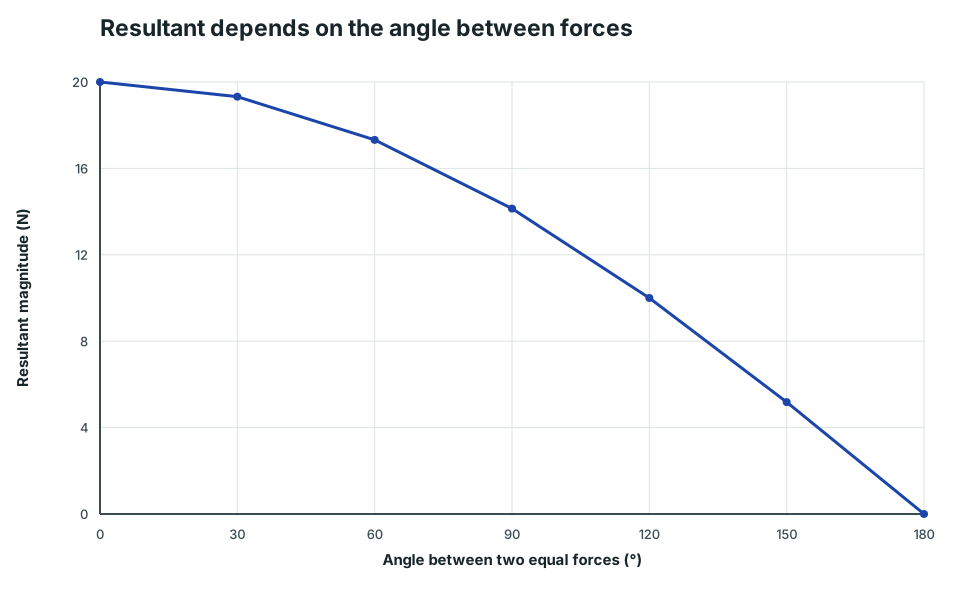
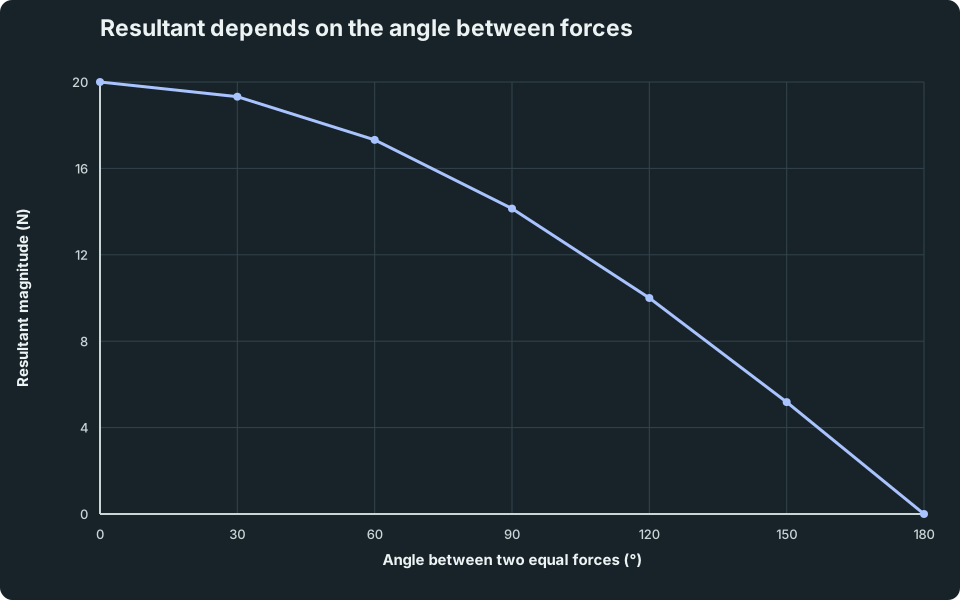
Resultant depends on the angle between forces
Resultant force magnitude versus the angle between two equal forces (10 N each).
Scroll across the graph to read all labels.
View figure data
| Angle between two equal forces (°) | F1 = F2 = 10 N |
|---|---|
| 0 | 20 |
| 30 | 19.32 |
| 60 | 17.32 |
| 90 | 14.14 |
| 120 | 10 |
| 150 | 5.18 |
| 180 | 0 |
3. Detailed Explanations
A. Why we use resultant force
When several forces act on an object, we often replace them with one force: the resultant.
This matters because motion depends on the resultant force:
- if forces are balanced (Fᵣₑₛᵤₗₜₐₙₜ = 0), there is no acceleration
- if forces are unbalanced, the object accelerates (see Unbalanced Force)
B. Forces in the same line (1D): same direction
If forces are along the same straight line and point the same way, add the magnitudes.
Example: 10 N right and 20 N right gives 30 N right.
C. Forces in the same line (1D): opposite directions
If forces oppose each other, subtract the magnitudes. The resultant is in the direction of the larger force.
Example: 40 N right and 20 N left gives 20 N right.
D. Using signs (quick method for 1D)
Choose a positive direction (e.g. right is positive). Then:
- rightward force: + F
- leftward force: -F
Example: + 40 + (-20) = +20 N (so 20 N to the right).
E. Forces at an angle (2D): scale drawing
When forces are at an angle, you cannot add or subtract magnitudes directly. Use a scale drawing (graphical vector addition).
Workflow:
- Choose a scale (e.g. 1 cm represents 5 N).
- Draw the first force as an arrow to scale.
- Draw the second force as an arrow to scale in the correct direction.
- Use either method:
- triangle method (head-to-tail), or
- parallelogram method (complete the parallelogram).
- Draw the resultant from the start point to the end point, and measure its length (then convert using the scale).
F. Special case: forces at 90°
If two forces are perpendicular, the vector diagram forms a right-angled triangle, so you can use Pythagoras’ theorem for the magnitude:
Fᵣₑₛᵤₗₜₐₙₜ = square root of (F₁² + F₂²)
4. Common Mistakes
- Adding magnitudes even when forces are in opposite directions.
- Giving a force value without a direction (e.g. writing “20 N” when “20 N to the right” is needed).
- Sign mistakes in 1D (choosing right as positive but treating a leftward force as positive).
- Drawing an inaccurate scale diagram (no scale stated, ruler not used, wrong angles).
- Treating “resultant force” as an extra force on the diagram (it replaces the forces).
5. Exam Tips
- Start with a quick sketch showing force directions.
- For 1D questions, state the sign convention (e.g. “right is positive”) and show the signed sum.
- For 2D graphical questions:
- state your scale
- use a ruler/protractor
- give the magnitude and direction of the resultant (if asked)
- If the object is at rest or moves with constant velocity, write: Fᵣₑₛᵤₗₜₐₙₜ = 0 (balanced forces).
6. Worked Examples
Modelled example 1
Same direction (1D)
Problem
Study the worked solution
Choose a sign convention
Method
Take right as positive.Reason
A declared convention makes every collinear force’s direction explicit.Working
right = +Add signed forces
Method
The signed resultant is + 20 N.Reason
Both forces point in the chosen positive direction.Working
Fᵣₑₛᵤₗₜₐₙₜ = +12 + (+8.0) = +20 NInterpret the sign
Method
The resultant is 20 N to the right.Reason
The positive result points in the declared positive direction.Working
+ 20 N ⇒ 20 N right
Guided practice 2
Opposite directions (1D)
Problem
Try this before viewing the solution
Hints
Hint 1: declare positive right
View solution step by step
Write signed components
Method
The forces are + 40 N and -25 N.Reason
Right is chosen positive and left negative.Working
F₁ = +40 N; F₂ = -25 NAdd the components
Method
Fᵣₑₛᵤₗₜₐₙₜ = +15 N.Reason
A resultant is the vector sum, not the sum of both magnitudes.Working
Fᵣₑₛᵤₗₜₐₙₜ = +40 + (-25) = +15 NState direction
Method
The resultant is 15 N to the right.Reason
The signed result is positive.Working
+ 15 N ⇒ 15 N right
Common misconception 3
Perpendicular forces (use Pythagoras for magnitude)
Learner claim
Try this before viewing the solution
View solution step by step
Diagnose the addition
Method
Directly adding 3.0 + 4.0 treats the forces as parallel in the same direction.Reason
The stated forces are perpendicular, so their vector triangle is two-dimensional.Working
3.0 N⊥4.0 NUse the right triangle
Method
Apply Pythagoras to the perpendicular components.Reason
The resultant is the hypotenuse of the vector triangle.Working
Fᵣₑₛᵤₗₜₐₙₜ = square root of (3.0² + 4.0²)Calculate
Method
The resultant magnitude is 5.0 N.Reason
9 + 16 = 25 and square root of 25 = 5.Working
Fᵣₑₛᵤₗₜₐₙₜ = 5.0 N
Examiner practice 4
Three forces in a straight line (signs)
Examination question
Try this before viewing the solution
View solution step by step
State the convention
1 markMethod
Take right as positive.Reason
The two leftward forces then carry negative signs.Working
right = +; left = -Sum the forces
1 markMethod
The signed resultant is -0.5 N.Reason
All three signed components must be included.Working
Fᵣₑₛᵤₗₜₐₙₜ = +3.0 + (-1.5) + (-2.0) = -0.5 NReport the vector
1 markMethod
The resultant is 0.5 N left.Reason
The negative sign points opposite the chosen positive direction.Working
-0.5 N ⇒ 0.5 N left
Self-mark with the mark scheme
Compare your response with each mark point. Select a point only when your response contains that evidence.
Self-mark the sign convention, signed sum and final direction.
Challenge 5
Perpendicular forces (magnitude and direction)
Independent transfer
Try this before viewing the solution
Hints
Hint 1: draw the component triangle
View solution step by step
Find the magnitude
Method
Fᵣₑₛᵤₗₜₐₙₜ = 13 N.Reason
The two perpendicular forces are the legs of a right triangle.Working
Fᵣₑₛᵤₗₜₐₙₜ = square root of (5.0² + 12²) = 13 NChoose the reference direction
Method
Measure θ north of east.Reason
The eastward component is adjacent and the northward component is opposite for that angle.Working
tan θ = Fₙₒᵣₜₕ/FₑₐₛₜCalculate and state the vector
Method
The resultant is about 13 N at 67° north of east.Reason
tan⁻¹ (12/5.0) = 67.4°.Working
θ = tan⁻¹ (12/5.0) ≈ 67°
7. Mind Stretchers
Mind stretcher 1: Find the force needed to balance (resultant = 0)Extension
Two forces act on a box: 10 N to the right and 6.0 N to the right.
What single force must you add to make the resultant force zero?
Show Answer
Current resultant is 16 N to the right, so you need 16 N to the left to balance it.
Mind stretcher 2: Link to motion (use resultant force, then F = ma)Extension
A 2.0 kg trolley is pulled with 9.0 N to the right. Friction is 3.0 N to the left.
Find the acceleration.
Show Answer
Resultant force:
Fᵣₑₛᵤₗₜₐₙₜ = 9.0-3.0 = 6.0 N to the right
Using F = ma:
a = F/m = 6.0/2.0 = 3.0 m s⁻²
Continue with the next resource in this course.
Course and syllabus information
- Course
- SEC G3 Physics
- Edition
- SEC G3 Physics 2027