Stability & States of Equilibrium
Key idea: Learn stable, unstable and neutral equilibrium, and how centre of gravity and base width affect toppling (O Level Physics 6091).
Continue where you stopped
The core idea
On this page
Learning objectives
- Distinguish contact forces from non-contact forces
- State that mass measures the amount of matter in a body
- Describe a gravitational field as a region where a mass experiences gravitational force
- Define gravitational field strength as gravitational force per unit mass
- Apply weight = mass × gravitational field strength
- Distinguish mass from weight
- Describe the effect of balanced and unbalanced forces on a body
- Describe ways a force may change motion
- Identify action–reaction pairs on interacting bodies
- Draw free-body diagrams for force systems in at most two dimensions
- Solve three-force static equilibrium graphically
- Apply resultant force = mass × acceleration
- Relate mass to resistance to change in motion
- Explain the effects of friction on motion
- Describe falling with and without air resistance, including terminal velocity
- Describe a moment as a force's turning effect in everyday examples
- Apply moment = force × perpendicular distance from the pivot
- State the principle of moments for a body in equilibrium
- apply the principle of moments to new situations or to solve related problems
- show an understanding that the weight of a body may be taken as acting at a single point known as its centre of gravity
- Explain qualitatively how centre-of-gravity position affects stability
1. Definition
A. Stability
Stability against toppling describes how readily an object remains upright when it is tilted or disturbed. A stable equilibrium is a position to which an object returns after a small displacement.
2. Key Ideas
- Stable equilibrium: returns to its original position after a small displacement.
- Unstable equilibrium: moves further away from its original position (usually topples) after a small displacement.
- Neutral equilibrium: stays in its new position after a small displacement.
- An object topples when the line of action of weight falls outside its base.
- Stability against toppling is increased by a lower centre of gravity and a wider base, when the other relevant conditions are unchanged.
3. Detailed Explanations
The weight of a body may be taken as acting at a single point called its centre of gravity: Centre Of Gravity.
A. States of equilibrium
| State | After a small displacement | What happens to the centre of gravity? | Example |
|---|---|---|---|
| Stable | returns to its original position | rises | ball in a bowl |
| Unstable | moves further away / topples | falls | ball on top of a hill |
| Neutral | stays in its new position | stays at the same height | cylinder on a flat surface |
B. When does an object topple?
An object topples when the line of action of its weight no longer passes through its base of support.
How to check stability (exam workflow):
- Draw the base (the contact area with the ground).
- Mark the centre of gravity.
- Draw a vertical line down from the centre of gravity (line of action of weight).
- If the line falls within the base, it tends to stay upright.
- If the line passes through the edge of the base, it is about to topple.
- If the line falls outside the base, it topples about the edge.
C. Why a low centre of gravity increases stability (qualitative)
If an object’s centre of gravity is lower, it must be tilted through a larger angle before the line of action of weight falls outside the base.
So it is more stable.
D. Why a wide base increases stability (qualitative)
A wider base means the line of action of weight can move more before it reaches the edge.
So the object can be tilted more without toppling.
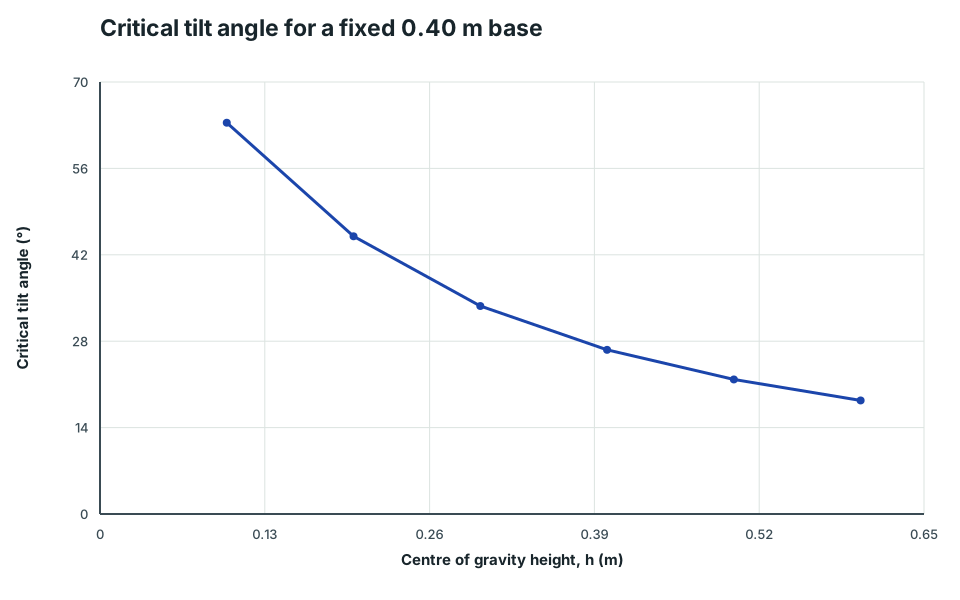
The chart applies that geometry to rectangular blocks with the same 0.40 m base width. The centre of gravity begins above the middle of the base, so its horizontal distance from either edge is 0.20 m. You do not need a new formula here: follow how the critical tilt angle changes as only the centre of gravity height changes.
Critical tilt angle for a fixed 0.40 m base
Critical tilt angle for rectangular blocks with a 0.40 metre base and centre of gravity initially above the base midpoint. The angle falls as the centre of gravity height increases.
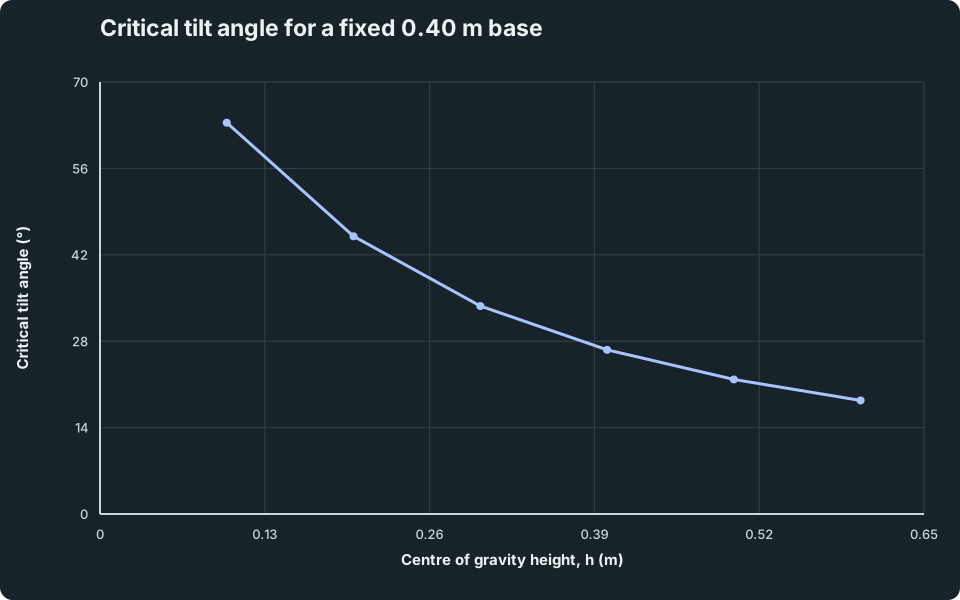
Explore three bounded base widths to see how a wider base increases the critical tilt angle at every centre-of-gravity height.
Optional interaction loads only after you choose Explore graph.
View figure data
| Centre of gravity height, h (m) | Base width 0.40 m |
|---|---|
| 0.1 | 63.4 |
| 0.2 | 45 |
| 0.3 | 33.7 |
| 0.4 | 26.6 |
| 0.5 | 21.8 |
| 0.6 | 18.4 |
4. Common Mistakes
- Mixing up the definitions of stable, unstable and neutral equilibrium.
- Thinking an object topples when the centre of gravity is outside the object (it can be outside and still be stable).
- Forgetting the “tipping rule”: check the line of action of weight against the base.
- Saying “more friction” as the main reason for better stability when the question is about toppling (use centre of gravity and base).
5. Exam Tips
- Use the key phrase: “An object topples when the line of action of its weight falls outside the base.”
- When asked “how to increase stability”, state two clear methods: lower the centre of gravity, and widen the base.
- Link your explanation to moments: once the line of action is outside the base, the weight produces a turning effect about the edge (see Moment Of A Force).
6. Worked Examples
Modelled example 1
When does an object topple?
Problem
An object is pushed sideways but does not slide. Explain the condition at which it begins to topple.
Study the worked solution
Identify the possible pivot
Method
Use the edge of the base on the side towards which the object is tipping.Reason
Once the opposite side loses contact, the object can rotate about this edge.Working
Track the vertical line of action of the weight relative to that base edge.Locate the tipping threshold
Reason
At the threshold, the line of action passes through the base edge, so the weight has no restoring moment about that edge.Working
The object is just about to topple when the line of action reaches the edge of its base.Explain why it topples beyond the edge
Reason
Once the line of action lies outside the base, the weight produces a moment that rotates the object farther over.Working
The object topples about the edge rather than returning upright.
Guided practice 2
Identify the state of equilibrium
Problem
State whether each situation shows stable, unstable or neutral equilibrium:
- a ball in a bowl;
- a ball on top of a hill;
- a cylinder lying on a flat surface.
Classify all three situations
Hints
Hint 1: use the response to a small displacement
Hint 2: compare centre-of-gravity heights
View solution step by step
Classify the ball in a bowl
Method
Classify it as stable.Reason
A small displacement raises its centre of gravity, and it then rolls back towards the lower original position.Working
Ball in a bowl: stable equilibrium.Classify the ball on a hill
Reason
A small displacement lowers its centre of gravity and makes it move farther from the top.Working
Ball on a hill: unstable equilibrium.Classify the cylinder on a flat surface
Reason
A small roll leaves its centre of gravity at the same height, so it remains in the new position.Working
Cylinder on a flat surface: neutral equilibrium.
Common misconception 3
How does a higher centre of gravity change toppling?
Learner response
Two scale vehicles have the same wheel-track width. The bus model carries much of its mass higher than the sports-car model. A student writes:
The bus is easier to topple simply because it is heavier.
Locate the first error and explain the effect of centre-of-gravity height.
Diagnose the explanation
View solution step by step
Locate the first error
Method
Reject weight magnitude as the complete explanation.Reason
A larger weight changes the size of the force but does not by itself say when its line of action crosses the base edge.Working
The toppling threshold must be explained using centre-of-gravity position and the base.Correct the centre-of-gravity reasoning
Reason
A higher centre of gravity needs a smaller tilt before the vertical line through it reaches the edge of a given base.Working
The bus model therefore reaches the toppling condition at a smaller tilt, with the wheel-track width held constant.
Examiner practice 4
Same object, different orientation
Examination question
A rectangular block is placed on a table in two ways:
- (A) standing upright on a small base;
- (B) lying on its side with a wider base.
State which position is more stable against toppling and explain using centre of gravity, base width and line of action. [3 marks]
Write your three-mark comparison before viewing the mark scheme
View solution step by step
Choose the more stable position
1 markMethod
Select position B, with the block lying on its side.Reason
This orientation changes both the centre-of-gravity height and the supporting base in stabilising directions.Working
Position B is more stable.Compare centre-of-gravity height
1 markReason
Lying on its side lowers the centre of gravity, so a larger tilt is needed to move its weight’s line of action to the base edge.Working
B has a lower centre of gravity than A.Compare the bases
1 markReason
The wider base lets the line of action move farther before it reaches an edge.Working
B must be tilted farther before the line of action falls outside its base.
Self-mark with the mark scheme
Compare your response with each mark point. Select a point only when your response contains that evidence.
Self-mark the choice, centre-of-gravity comparison and base-width explanation separately.
Challenge 5
Why do a wide track and low body resist toppling?
Design transfer
A stationary model car is placed on a platform that is slowly tilted sideways, and its tyres do not slide. It has a wide wheel track, meaning its left and right wheels are set far apart, and much of its mass is kept low. Explain how both features increase stability against toppling.
Apply both stability principles
Hints
Hint 1: separate the two design changes
Hint 2: connect both changes to toppling
View solution step by step
Explain the wide wheel track
Method
Treat the distance between the left and right wheel contact regions as a wider supporting base.Reason
A wider base lets the line of action of weight move farther sideways before it reaches an edge.Working
The car can tilt more before its weight acts outside the base.Explain the low body
Reason
Keeping mass low lowers the centre of gravity, so a larger tilt is needed to move its line of action to the same base edge.Working
Both features increase the tilt required for toppling.
7. Mind Stretchers
Mind stretcher 1: Design a more stable objectExtension
A tall, narrow object keeps toppling easily.
Suggest two design changes and explain why each change helps.
Show Answer
- Lower the centre of gravity (e.g. add mass near the bottom): it must be tilted more before the line of action of weight falls outside the base.
- Widen the base: the line of action of weight can move more before reaching the edge of the base.
Mind stretcher 2: Sliding vs toppling (which happens first?)Extension
A tall cupboard stands on a platform that is slowly tilted. It is free either to slide down the platform or to topple downhill.
Explain what determines whether it is more likely to slide or topple first.
Show Answer
Toppling begins when the vertical line of action of weight reaches the downhill edge of the base. A higher centre of gravity or narrower base makes that happen at a smaller tilt angle.
Sliding begins when the component of weight down the platform is greater than the maximum static friction. A surface with less grip reaches that condition at a smaller angle.
Whichever threshold is reached at the smaller platform angle happens first. The answer therefore depends on both the cupboard’s geometry and the friction between its base and the platform.
Continue with the next resource in this course.
Course and syllabus information
- Course
- SEC G3 Physics
- Edition
- SEC G3 Physics 2027