Distance vs Displacement
Key idea: Learn distance vs displacement (scalar vs vector), including direction, sign conventions, and exam-style worked examples for O Level Physics.
Continue where you stopped
The core idea
On this page
Learning objectives
- State what speed means
- State what velocity means, including its direction
- Calculate average speed from total distance and total time
- Calculate acceleration as change in velocity divided by time taken
- State what uniform acceleration means
- Interpret examples of non-uniform acceleration
- Plot and interpret displacement–time and velocity–time graphs in one dimension
- Deduce rest and uniform or non-uniform velocity from a displacement–time graph
- Deduce rest, uniform velocity and uniform or non-uniform acceleration from a velocity–time graph
- Use signed area under a velocity–time graph to determine displacement
- Recall constant free-fall acceleration near Earth as approximately 10 m/s²
1. Definition
A. Distance (distance travelled)
Distance travelled is the total length of the path taken, regardless of direction.
B. Displacement
Displacement is the change in position from the initial point to the final point, in a stated direction. Its magnitude is the straight-line separation between those points.
2. Key Ideas
- Both distance and displacement have SI unit m (see Base Quantities & SI Units).
- Distance is a scalar (no direction) (see Scalar & Vector Quantities) and is always ≥ 0.
- Displacement is a vector (has direction) (see Scalar & Vector Quantities) and can be positive, negative, or zero (depending on your chosen direction).
- Always true: distance travelled ≥ magnitude of displacement.
- Distance depends on the path taken; displacement depends only on the start and end positions.
- Link to next lesson:
- speed uses distance:
speed = distance / time - velocity uses displacement:
velocity = displacement / time
- speed uses distance:
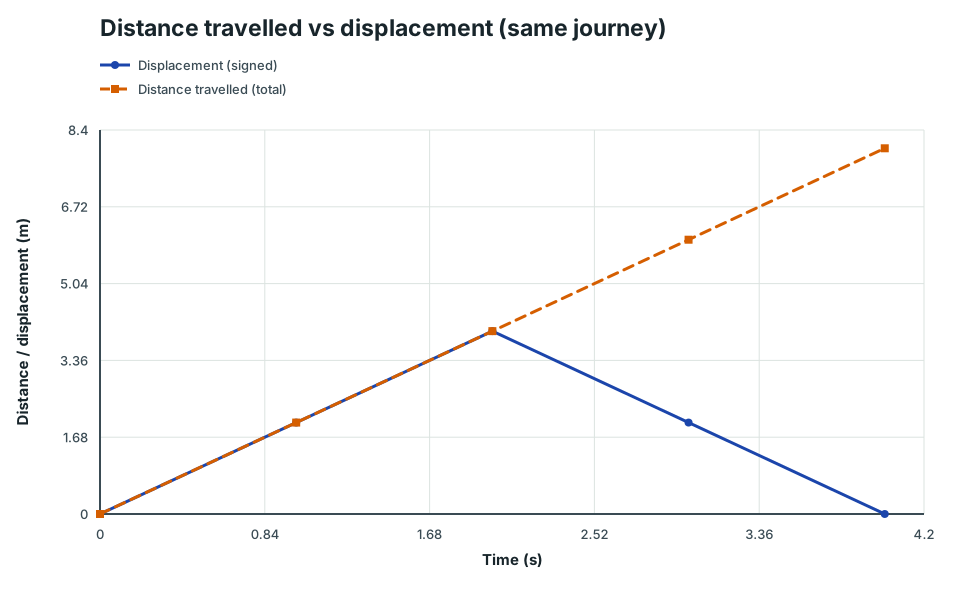
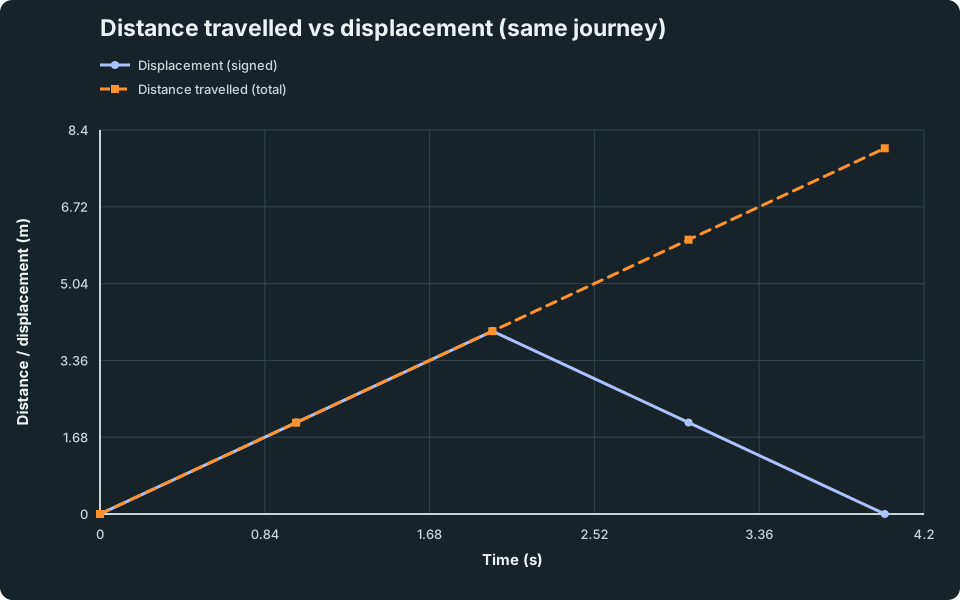
Distance travelled vs displacement (same journey)
Two lines show how distance travelled always increases while displacement can decrease if the object moves back towards the start.
Scroll across the graph to read all labels.
View figure data
| Time (s) | Displacement (signed) | Distance travelled (total) |
|---|---|---|
| 0 | 0 | 0 |
| 1 | 2 | 2 |
| 2 | 4 | 4 |
| 3 | 2 | 6 |
| 4 | 0 | 8 |
3. Detailed Explanations
A. Visual meaning (path vs straight line)
- If an object moves from B to C to D:
- distance travelled = BC + CD
- displacement = BD (from B to D)
B. When are distance and displacement equal?
Distance travelled equals the magnitude of displacement only when:
- the object moves in a straight line, and
- it does not change direction.
C. Zero displacement does not mean zero distance
If an object returns to where it started, then:
- displacement = 0
- distance travelled is usually not zero (unless it didn’t move at all)
D. Positive and negative displacement (1D)
To decide whether displacement is positive or negative, you must choose a positive direction (e.g. “to the right is positive”).
Example:
- Move 3 m to the right: displacement = +3 m.
- Move 3 m to the left: displacement = -3 m.
E. Summary table (exam-friendly)
| Feature | Distance travelled | Displacement |
|---|---|---|
| Meaning | total path length | straight-line change from start to end (with direction) |
| Type | scalar | vector |
| Can be negative? | no | yes (depends on direction chosen) |
| Can be zero? | yes (no motion) | yes (returns to start) |
| Depends on path? | yes | no |
| Key check | distance travelled ≥ magnitude of displacement | distance travelled ≥ magnitude of displacement |
4. Common Mistakes
A. Concept mix-ups
- Giving distance when the question asks for displacement (or vice versa).
- Writing displacement without direction (e.g. “5 m” instead of “5 m east”).
- Thinking displacement means “distance from the starting point along the path” (it is the straight line).
B. Sign and “zero” mistakes
- Writing distance as negative.
- Saying “displacement is zero, so distance is zero” (false).
- Not stating the chosen positive direction in 1D questions.
5. Exam Tips
A. Quick checks for marks
- Write definitions using exam keywords:
- distance: “total length of path”
- displacement: “shortest straight line from start to end, with direction”
- For multi-leg journeys: draw a quick sketch and mark the start and end points.
- Use the sanity check: distance travelled ≥ magnitude of displacement.
- If a question is 1D, state the sign convention (e.g. “right is positive”).
- If the object ends where it started, write displacement = 0 immediately, then compute distance from the full path.
6. Worked Examples
Modelled example 1
L-shaped path (distance vs displacement)
Problem
Study the worked solution
Add the complete path
Method
Add the lengths of all three legs without cancelling direction.Reason
Distance travelled is the total path length and is scalar.Working
d = 1 + 1 + 1 = 3 kmFind the net change in position
Method
Combine the directed north–south changes, then retain the remaining eastward change.Reason
Displacement depends only on start and finish, with direction.Working
The 1 km north and south legs cancel, leaving 1 km east.
Guided practice 2
Curved path vs straight-line displacement
Problem
Identify each representation
Hints
Hint 1: follow the travelled route
Hint 2: connect start directly to finish
View solution step by step
Identify the path quantity
Method
Use the length of the complete curved route for distance travelled.Reason
Distance depends on the path actually taken.Working
Trace the route from A to B and add its full length.Identify the start-to-finish vector
Method
Use the straight arrow from A to B with its north-east direction.Reason
Displacement ignores the intervening curve and records only the change in position.Working
Displacement is the directed straight-line separation A → B.
Common misconception 3
Can displacement be larger than distance?
Learner response
Diagnose before viewing the correction
View solution step by step
Use the geometric bound
Method
Compare the actual path with the straight start-to-end line.Reason
The straight line is the shortest separation between the endpoints.Working
Any bends can only make the travelled path equal to or longer than the displacement magnitude.State the invariant
Method
Write the correct inequality.Reason
It must hold for every journey.Working
distance travelled ≥ |displacement|
Examiner practice 4
1D motion (use absolute values for distance)
Examination question
Show both leg lengths and the signed change
View solution step by step
Calculate both path legs
2 marksMethod
Use absolute position changes for each travelled leg.Reason
Distance accumulates non-negative path lengths even when direction reverses.Working
d = |-5-2| + |1-(-5)| = 7 + 6 = 13 mCalculate the signed displacement
2 marksMethod
Subtract initial position from final position.Reason
Only the endpoints determine displacement.Working
Δ x = x_f-xᵢ = 1-2 = -1 mThe final position is 1 m in the negative direction from the start.
Self-mark with the mark scheme
Compare your response with each mark point. Select a point only when your response contains that evidence.
Self-mark path legs and signed endpoint change.
Challenge 5
One full lap (displacement can be zero)
Closed-path transfer
Try the closed-path case
Hints
Hint 1: separate path from endpoints
View solution step by step
Use the path length
Method
Count the full lap as distance travelled.Reason
The athlete moves along all 400 m of the track.Working
Distance travelled = 400 m.Compare start and finish
Method
Use the zero change in position.Reason
The athlete finishes exactly where the journey began.Working
Displacement = 0 m.
7. Mind Stretchers
Mind stretcher 1: A classic Pythagoras caseExtension
A student walks 3 m east then 4 m north.
- Find the distance travelled.
- Find the magnitude of displacement.
Show Answer
- Distance travelled: 3 + 4 = 7 m
- Magnitude of displacement: square root of (3² + 4²) = 5 m
Mind stretcher 2: “If displacement is zero, distance is zero.” True or false?Extension
Decide whether this statement is true or false, and explain.
Show Answer
False. Displacement can be zero if you return to your starting point, but you may have travelled a non-zero distance along the path.
Continue with the next resource in this course.
Course and syllabus information
- Course
- SEC G3 Physics
- Edition
- SEC G3 Physics 2027