Speed vs Velocity
Key idea: Understand speed vs velocity (scalar vs vector), including direction, sign conventions, unit conversions, and exam-style worked examples for O Level Physics.
Continue where you stopped
The core idea
On this page
Learning objectives
- State what speed means
- State what velocity means, including its direction
- Calculate average speed from total distance and total time
- Calculate acceleration as change in velocity divided by time taken
- State what uniform acceleration means
- Interpret examples of non-uniform acceleration
- Plot and interpret displacement–time and velocity–time graphs in one dimension
- Deduce rest and uniform or non-uniform velocity from a displacement–time graph
- Deduce rest, uniform velocity and uniform or non-uniform acceleration from a velocity–time graph
- Use signed area under a velocity–time graph to determine displacement
- Recall constant free-fall acceleration near Earth as approximately 10 m/s²
1. Definition
A. Speed
Speed is the rate of change of distance travelled with time. It is a scalar (no direction).
B. Velocity
Velocity is the rate of change of displacement with time. It is a vector (magnitude + direction).
2. Key Ideas
- Speed uses distance; velocity uses displacement (see Distance vs Displacement).
- Average speed:
- average speed = total distance travelled / total time taken
- Average velocity:
- average velocity = total displacement / total time taken, with direction
- Instantaneous speed is the speed at an instant (measured by a speedometer).
- Constant speed does not guarantee constant velocity (direction might change).
- SI unit for both is m s⁻¹.
- Common conversion:
- 1 m s⁻¹ = 3.6 km h⁻¹
km h^-1→m s^-1: divide by3.6(same as 5/18)
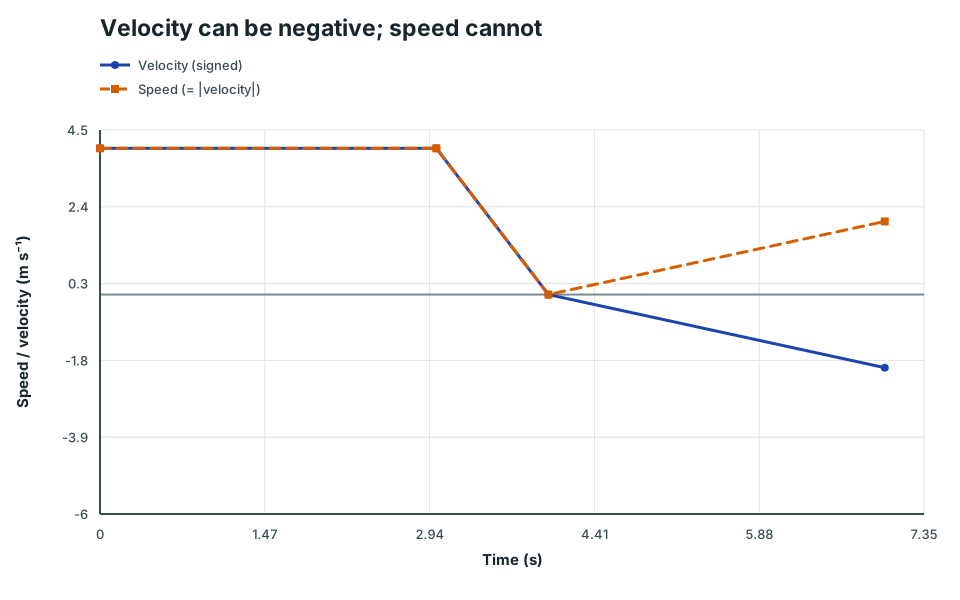
Velocity can be negative; speed cannot
Two lines compare signed velocity (which can be negative when direction reverses) with speed, which is always the magnitude of velocity and never negative.
Scroll across the graph to read all labels.
View figure data
| Time (s) | Velocity (signed) | Speed (= |velocity|) |
|---|---|---|
| 0 | 4 | 4 |
| 3 | 4 | 4 |
| 4 | 0 | 0 |
| 7 | -2 | 2 |
3. Detailed Explanations
A. Prerequisite: distance vs displacement
- Distance travelled: total path length (scalar).
- Displacement: straight-line change from start to end, with direction (vector).
If this is unclear, revise first: Distance vs Displacement.
B. Speed vs velocity (comparison table)
| Feature | Speed | Velocity |
|---|---|---|
| Uses | distance travelled | displacement |
| Type | scalar | vector |
| Direction needed? | no | yes |
| Can be negative? | no | yes (depends on chosen direction) |
| SI unit | m s⁻¹ | m s⁻¹ |
| “Constant” means | same value | same value and same direction |
C. Instantaneous vs average
Instantaneous speed is what the speed is right now. A car speedometer displays this magnitude; it does not give the car’s direction, so it does not display velocity.
Average speed and average velocity are calculated over a time interval:
- A car can have an average speed of 60 km h⁻¹ over a trip even if the speedometer does not read 60 km h⁻¹ all the time.
D. Constant speed vs constant velocity
- Constant speed: the speed stays the same, but direction may change.
- Constant velocity: both speed and direction stay the same.
Example: A runner moving around a circular track at constant speed has changing velocity because the direction keeps changing.
E. Positive and negative velocity (1D)
In one-dimensional motion, you must choose a positive direction (e.g. “to the right is positive”):
- moving right: positive velocity
- moving left: negative velocity
4. Common Mistakes
A. Concept mistakes
- Writing a velocity without direction (e.g. “5 m s⁻¹” instead of “5 m s⁻¹ east”).
- Saying “speed is constant so velocity is constant” (false if direction changes).
- Using distance when the question asks for displacement (or vice versa).
B. Calculation mistakes
- Mixing km h⁻¹ and m s⁻¹ without converting.
- Using average speed formula when asked for average velocity (or vice versa).
- Forgetting to convert minutes/hours into seconds when using SI units.
5. Exam Tips
A. How to write for full marks
- For calculations:
- write the equation
- substitute values with units
- compute
- final answer with unit (and direction for velocity)
- For explanation questions:
- always mention “velocity changes if direction changes” (even when speed is constant)
6. Worked Examples
Modelled example 1
Average speed (straight line)
Problem
Study the worked solution
Choose total distance over total time
Method
Use the average-speed relationship.Reason
Speed is based on path length and does not require a direction.Working
average speed = 100/11.32 = 8.83 m s⁻¹
Guided practice 2
Average speed vs average velocity (U-turn)
Problem
Separate path length from directed change
Hints
Hint 1: separate the numerators
Hint 2: divide by the common time
View solution step by step
Find distance and displacement
Method
Add magnitudes for distance and combine directions for displacement.Reason
The U-turn reverses direction but does not erase travelled path.Working
d = 5 + 3 = 8 km, Δ s = 5-3 = 2 km eastCalculate the two averages
Reason
Both rates use the same total journey time but different numerators.Working
v bar _speed = 8/0.30 = 26.7 km h⁻¹, vector v bar = 2/0.30 = 6.67 km h⁻¹ east
Common misconception 3
Constant speed on a curved path
Learner response
Check both parts of velocity
View solution step by step
Distinguish scalar and vector conditions
Method
Keep speed constant but track direction.Reason
Velocity is constant only when both magnitude and direction remain unchanged.Working
The cyclist’s speed is constant, but the tangent direction changes continuously, so velocity changes.
Examiner practice 4
Unit conversion
Examination question
Show the conversion factor
View solution step by step
Apply the conversion factor
1 markMethod
Divide kilometres per hour by 3.6.Reason
1 km = 1000 m and 1 h = 3600 s.Working
90÷3.6State the converted speed
1 markReason
The requested SI velocity unit is metres per second.Working
90 km h⁻¹ = 25.0 m s⁻¹
Self-mark with the mark scheme
Compare your response with each mark point. Select a point only when your response contains that evidence.
Self-mark the conversion method and final value with unit separately.
Challenge 5
Average speed vs average velocity (right-angle path)
Two-dimensional transfer
Use path length and vector displacement separately
Hints
Hint 1: find two different lengths
Hint 2: find direction
View solution step by step
Calculate average speed
Method
Divide total path length by time.Reason
Speed uses distance travelled.Working
v bar _speed = (60 + 80)/70 = 2.0 m s⁻¹Find the displacement vector
Method
Combine perpendicular components.Reason
Average velocity uses the straight-line change in position.Working
|Δ s| = square root of (60² + 80²) = 100 m, θ = tan⁻¹ (80/60) ≈ 53°Calculate average velocity
Reason
Divide displacement by the same total time and include direction.Working
| vector v bar| = 100/70 = 1.43 m s⁻¹, 53° north of east
7. Mind Stretchers
Mind stretcher 1: Can instantaneous velocity be negative if average velocity is positive?Extension
A particle moves left for a short time, then moves right and ends far to the right of its starting point. Its average velocity over the whole trip is positive.
Can its instantaneous velocity have been negative at some time? Explain.
Show Answer
Yes. While the particle is moving left, its instantaneous velocity is negative. The average velocity can still be positive if the final displacement is in the positive direction.
Mind stretcher 2: If average velocity is non-zero, must instantaneous velocity always be non-zero?Extension
If an object’s average velocity over a time interval is non-zero, does that mean its instantaneous velocity is never zero during the interval?
Show Answer
No. The object can stop temporarily (instantaneous velocity = 0) and still have a non-zero average velocity if the final displacement over the whole interval is non-zero.
Continue with the next resource in this course.
Course and syllabus information
- Course
- SEC G3 Physics
- Edition
- SEC G3 Physics 2027