Vector addition by graphical methods
Key idea: Add O-Level vectors to scale using head-to-tail and parallelogram methods, then state the resultant magnitude and direction clearly.
Continue where you stopped
The core idea
On this page
Learning objectives
- Represent a physical quantity with a numerical magnitude and unit
- Recall the six prescribed SI base quantities and their units
- Use the prescribed SI prefixes from nano to tera
- Compare orders of magnitude from a typical atom to the Earth
- Select and justify measuring instruments by range and precision
- Distinguish scalar and vector quantities and give examples
- Add two vectors graphically to determine a resultant
1. Definitions
Vector
A vector is a quantity with magnitude and direction.
Resultant
The resultant is the single vector that has the same effect as two or more vectors added together.
Quick refresher: Scalar & Vector Quantities
You may be asked to add two vectors and determine the resultant by a graphical method (draw to scale, then measure).
2. Key Ideas
- A vector is drawn as an arrow: length represents magnitude, arrowhead represents direction.
- For graphical methods, you must choose a scale (e.g.
1 cm : 2 N) and show it on your diagram. - The resultant must be stated as magnitude + direction (with units and a direction phrase).
- The order does not matter: vector A + vector B = vector B + vector A (same resultant).
- When you quote an angle, state the reference direction (e.g. “37° north of east”).
- Convert your measured length (cm) back to the real magnitude using the scale.
3. Detailed Explanations
Methods overview
| Method | How you draw | Resultant arrow | Common mistakes |
|---|---|---|---|
| Head-to-tail (triangle) | draw vector B from the head of vector A | from tail of vector A to head of vector B | drawing from the wrong point, wrong direction |
| Parallelogram | draw both vectors from the same tail, complete parallelogram | diagonal from the common tail | forgetting construction lines, measuring wrong diagonal |
Head-to-tail (triangle) method
- Draw the first vector to scale.
- From the head of the first vector, draw the second vector to scale (same direction as given).
- The resultant is drawn from the tail of the first vector to the head of the second vector.
- Measure the resultant length (convert using your scale) and measure the direction (with a protractor if needed).
Mini-example (1–2 lines): Use scale 1 cm : 1 m. Draw 4 cm east, then 3 cm north from the head. The resultant is the arrow from the starting tail to the final head.
Parallelogram method
- Draw the two vectors from the same starting point (tail).
- Complete the parallelogram.
- The diagonal from the common tail gives the resultant.
Mini-example (1–2 lines): Use scale 1 cm : 1 N. Draw 5 cm east and 5 cm at 60° north of east from the same tail. The diagonal gives the resultant.
Measuring magnitude and direction
- Measure the resultant length on the diagram using a ruler (in cm).
- Convert it back using your scale.
- Measure the angle using a protractor and state it clearly (e.g. “20° south of east”).
Mini-example: scale 1 cm : 2 N, measured resultant is 6.2 cm ⇒ magnitude is 12.4 N.
Special case: perpendicular vectors as a check
If the two vectors are at right angles, you can use Pythagoras (and basic trigonometry) to check your measured result:
R = square root of (A² + B²); θ = tan⁻¹ (B/A)
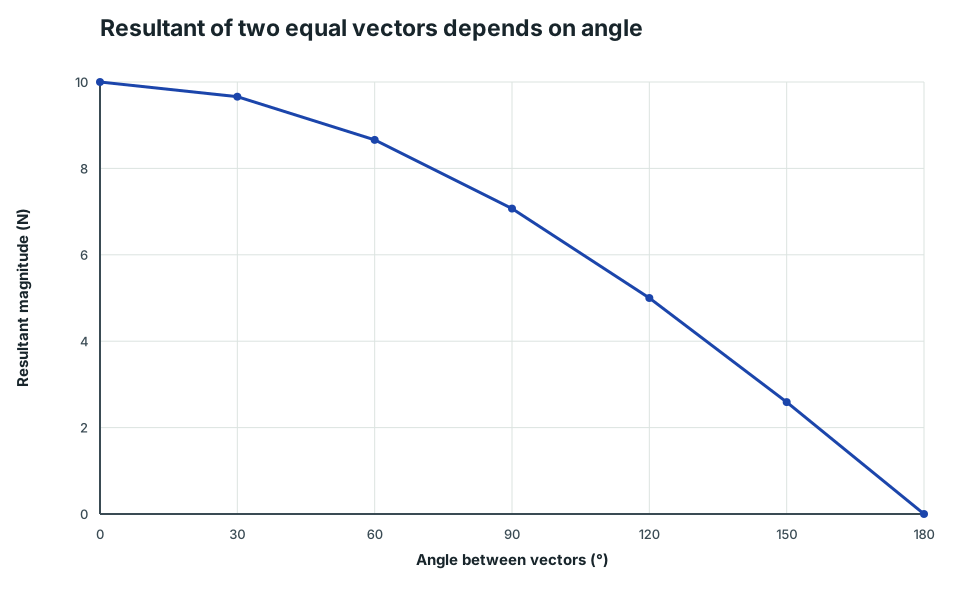
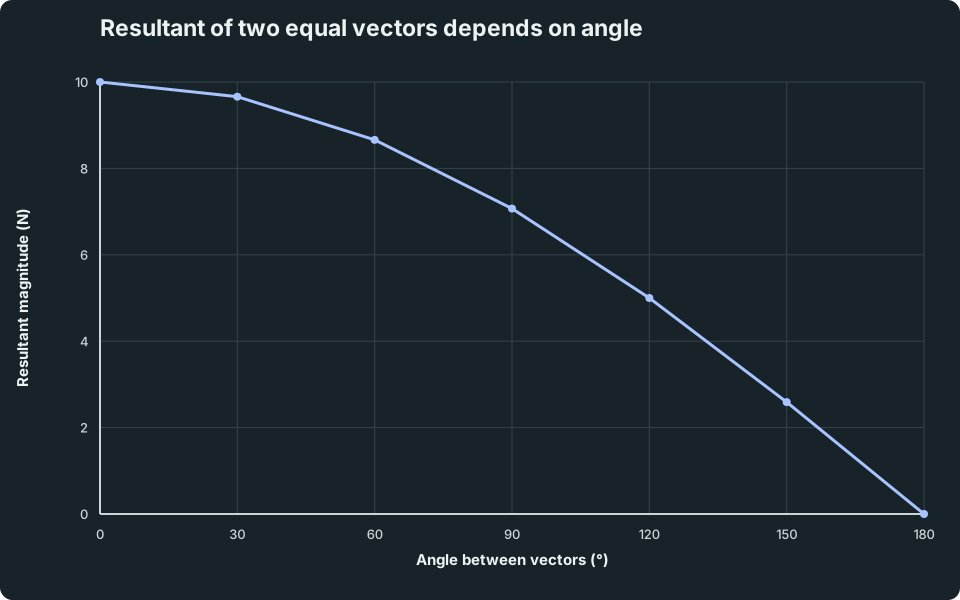
Resultant of two equal vectors depends on angle
A line plot showing how the resultant magnitude changes as the angle between two equal 5 N vectors increases from 0° to 180°.
Scroll across the graph to read all labels.
View figure data
| Angle between vectors (°) | A = B = 5 N |
|---|---|
| 0 | 10 |
| 30 | 9.66 |
| 60 | 8.66 |
| 90 | 7.07 |
| 120 | 5 |
| 150 | 2.59 |
| 180 | 0 |
4. Common Mistakes
- Not drawing vectors to scale (then your measurement is meaningless).
- Reversing a direction (e.g. drawing
eastaswest). - Drawing the second vector from the wrong point in the head-to-tail method.
- Forgetting to draw arrowheads (then direction is unclear).
- Not converting your measured cm back to the real magnitude using the scale.
- Measuring the angle from the wrong reference line (always state “from east”, “from north”, etc.).
- Reporting only a magnitude without a direction.
5. Exam Tips
- Always show your scale on the diagram.
- Label vectors clearly (including directions like east/north).
- Use a sharp pencil and ruler (messy diagrams lead to wrong measurements).
- Final answer template: “Resultant = … (unit) at …° … of …”.
- Quote a sensible number of significant figures based on your measurement (usually 2–3 s.f.).
6. Worked Examples
Modelled example 1
Two perpendicular displacements (head-to-tail)
Problem
Study the worked solution
Choose and state a scale
Method
Use, for example,1 cm : 1 m.Reason
The drawn arrow lengths must represent the physical magnitudes consistently.Working
4 m → 4 cm and 3 m → 3 cm.Draw head-to-tail
Method
Draw 4 cm east, then 3 cm north from its head.Reason
Successive displacements join head-to-tail in their stated directions.Working
Draw the resultant from the first tail to the final head.Measure magnitude and direction
Method
Measure the resultant arrow and its angle from east.Reason
A vector answer requires both magnitude and referenced direction.Working
Resultant ≈ 5.0 m at 37° north of east.
Guided practice 2
Two equal forces at 60° (parallelogram, non-right-angle)
Problem
Record measurements from your scale diagram
Hints
Hint 1: use a common tail
Hint 2: choose the correct diagonal
View solution step by step
Construct the parallelogram
Method
Use1 cm : 1 N, draw both 5 cm arrows from one tail, and complete parallel sides.Reason
This construction adds vectors that act from the same point.Working
The resultant is the diagonal starting at the common tail.Measure and report
Method
Convert diagonal length using the scale and state its referenced angle.Reason
Magnitude alone is not a complete force vector.Working
Resultant ≈ 8.7 N at 30° north of east.
Common misconception 3
Opposite directions (1D vectors)
Learner response
Carry direction into the sum
View solution step by step
Assign signed components
Method
Take east as positive and write the westward force as negative.Reason
Opposite vector directions cannot be added as two positive magnitudes.Working
F_R = 10 + (-6) = 4 NState the direction
Method
Report 4 N east.Reason
The positive resultant follows the chosen east-positive convention.Working
Resultant: 4 N east.
Examiner practice 4
Three vectors (head-to-tail)
Examination question
Show scale, construction and complete vector result
View solution step by step
Draw all three vectors
2 marksMethod
State1 cm : 1 mand draw 6 cm east, 4 cm north, then 2 cm west head-to-tail.Reason
The walk is a sequence, so every new vector begins at the previous head.Working
Draw the resultant from the original tail to the final head.Measure the resultant
2 marksMethod
Measure its length and angle from east.Reason
The final answer must include magnitude, unit and direction.Working
Resultant ≈ 5.7 m at 45° north of east.
Self-mark with the mark scheme
Compare your response with each mark point. Select a point only when your response contains that evidence.
Self-mark scale, construction, magnitude and direction.
Challenge 5
Finding a missing vector (vector subtraction, graphical)
Missing-vector transfer
Find the connector between known arrowheads
Hints
Hint 1: use the vector relationship
Hint 2: construct the missing arrow
View solution step by step
Rearrange the vector relationship
Method
Write vector B = vector R- vector A.Reason
The unknown is the vector that completes vector A to reach vector R.Working
B = 10-6 = 4 mState the constructed direction
Method
Draw from A’s head to R’s head and report east.Reason
Both known arrows lie east on the same line and R extends beyond A.Working
vector B = 4 m east
7. Mind Stretchers
Mind stretcher 1: Finding the equilibrant (the “balancing” vector)Extension
Problem 1: Two forces act at a point: 8 N east and 6 N north. Find the single force that will make the resultant force zero.
Show Answer
- Draw the resultant of the two forces by a graphical method (scale + measurement).
- The required force (equilibrant) has the same magnitude as the resultant but points in the opposite direction.
Check: resultant is 10 N at 37° north of east, so the equilibrant is 10 N at 37° south of west.
Mind stretcher 2: Converting from your diagram measurementExtension
Problem 2: A student uses a scale of 1 cm : 2 N. The resultant arrow measures 6.2 cm and is directed 20° south of east. State the resultant force (magnitude and direction).
Show Answer
- Magnitude: 6.2 × 2 = 12.4 N
- Direction: 20° south of east
Continue with the next resource in this course.
Course and syllabus information
- Course
- SEC G3 Physics
- Edition
- SEC G3 Physics 2027