Dangers Of Electricity
Key idea: O Level practical electricity hazards: damaged insulation, overheating of cables, and damp conditions (electric shock and fire).
Continue where you stopped
The core idea
On this page
Learning objectives
- Explain electrical heating in common appliances
- Apply P = VI
- Apply E = VIt
- Calculate electrical energy and cost in kWh
- Identify the hazard from damaged insulation
- Identify the hazard from overheating cables
- Identify the hazard from damp conditions
- Explain how fuses and circuit breakers protect circuits
- Choose and justify an appropriate fuse rating
- Explain why metal casings are earthed
- Explain why double-insulated appliances do not need an earth wire
- State the meanings and roles of live, neutral and earth
- Describe the wiring of a mains plug
- Explain live-wire placement of switches, fuses and circuit breakers
1. Definition
Electricity can cause hazards such as electric shock (current through the body) and electric fire (overheating / sparks).
Focus on hazards from:
- damaged insulation
- overheating of cables
- damp conditions
2. Key Ideas
- Damaged insulation can expose a live conductor → shock risk; it can also cause a short circuit → fire risk.
- Overheating of cables happens when current is too large (overloading / short circuit) → insulation melts → fire risk.
- Damp conditions lower body resistance → larger current through the body → shock risk.
3. Detailed Explanations
A. Damaged insulation
If the plastic insulation is broken, a live wire may be exposed.
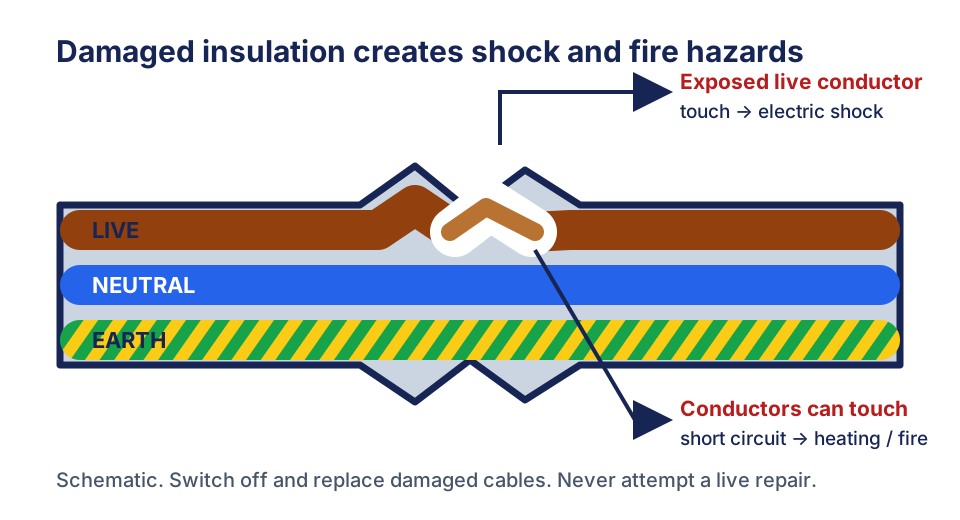
Hazards:
- Electric shock if a person touches the exposed conductor (or a metal part connected to it).
- Electric fire if the live wire touches neutral/earth or a metal casing (short circuit → very large current → heating/sparks).
B. Overheating of cables
When a cable carries too much current, it heats up. The insulation can soften or melt, which may lead to:
- exposed live wires (shock)
- short circuits and fires
Common causes:
- too many appliances on one extension cord (overloading)
- damaged wiring causing a short circuit
C. Damp conditions
Water lowers the body’s resistance (wet hands, wet floors). A lower resistance means a larger current can flow through the body, increasing the risk of a dangerous shock.
Keep mains appliances away from water and never touch plugs/sockets with wet hands.
4. Common Mistakes
- Saying cables overheat because “voltage is high” (the main cause is too much current).
- Thinking a damaged cable is safe if it “still works” (it can expose a live conductor or short circuit).
- Ignoring wet conditions (water greatly increases shock risk).
5. Exam Tips
- Name the situation (damaged insulation / overheating / damp).
- Name the hazard (shock or fire).
- Give the reason in one line (exposed live wire / too much current / lower body resistance).
6. Worked Examples
Modelled example 1
Damaged insulation
Problem
Study the worked solution
Trace the contact hazard
Method
Identify electric shock.Reason
A person may touch an exposed live conductor.Working
exposed live conductor → current through body → shockTrace the fault-current hazard
Method
Identify fire risk.Reason
Conductors may touch, causing a large short-circuit current and heating.Working
short circuit → large current → heating or sparksRemove the danger
Method
Stop using the appliance and have the cord replaced or repaired.Reason
Continued operation leaves both fault paths possible.Working
Isolate the supply before any repair.
Guided practice 2
Overheating of cables
Problem
Build a cause–effect–hazard chain
Hints
Hint 1: electrical cause
Hint 2: physical consequence
View solution step by step
Explain the danger
Method
Link overload to melting insulation and fire.Reason
Excess current heats the cable; damaged insulation can allow faults and ignition.Working
overload → I too large → heating → fire riskAct immediately
Method
Switch off and reduce the connected load.Reason
Lowering total current stops further overheating.Working
Disconnect appliances before reusing a correctly rated extension.
Common misconception 3
Damp conditions
Learner response
Keep supply voltage fixed and identify what changes
View solution step by step
Identify the changed quantity
Method
State that wet conditions lower the body’s effective resistance.Reason
The mains supply voltage is not increased by wet hands.Working
R_(body,wet) < R_(body,dry)Link resistance to danger
Method
Conclude that a larger current can pass through the body.Reason
For a fixed voltage, I = V/R increases when resistance decreases.Working
R↓ ⇒ I↑ ⇒ greater shock risk
Examiner practice 4
Overloading calculation
Examination question
Find the combined load before current
View solution step by step
Combine appliance powers
1 markMethod
Add the ratings.Reason
The extension supplies all three appliances.Working
Pₜₒₜₐₗ = 800 + 1200 + 600 = 2600 WFind current
2 marksMethod
Use I = P/V.Reason
The common supply voltage is 240 V.Working
Iₜₒₜₐₗ = 2600/240 ≈ 10.8 AState the hazard
1 markMethod
Identify overheating and fire risk if the rating is exceeded.Reason
Excess current can melt insulation.Working
Current above the cable rating can cause dangerous heating.
Self-mark with the mark scheme
Compare your response with each mark point. Select a point only when your response contains that evidence.
Self-mark combined power, current method, result and hazard.
Challenge 5
Why wet conditions are worse (numbers)
Quantitative hazard transfer
Use the same voltage for both resistance states
Hints
Hint 1: relationship
Hint 2: risk comparison
View solution step by step
Dry condition
Method
Divide 240 V by 2000 Ω.Reason
Ohm’s law estimates current for the stated effective resistance.Working
I_dry = 240/2000 = 0.12 AWet condition and comparison
Method
Calculate 0.48 A and identify wet conditions as more dangerous.Reason
The four-times smaller resistance permits four-times larger current at the same voltage.Working
I_wet = 240/500 = 0.48 A
7. Mind Stretchers
Mind stretcher 1: Fire chainExtension
An overloaded cable heats up and the insulation melts. Explain how this can lead to a fire.
Show Answer
When insulation melts, wires can touch and cause a short circuit. Very large current and sparks can occur, and nearby materials can ignite.
Mind stretcher 2: Reducing shock riskExtension
Why does standing on a dry rubber mat (or wearing rubber-soled shoes) reduce the risk of a serious electric shock?
Show Answer
Rubber is an insulator, so it increases the resistance of the path through the body to Earth. Higher resistance means a smaller current flows for the same voltage, reducing shock risk.
8. Practice and next step
- Practise naming the situation, the immediate electrical effect and the final shock or fire hazard as a three-link chain.
- Check recognition questions in the Practical Electricity Quiz.
- Next, see how Fuses & Circuit Breakers respond to excessive current.
Continue with the next resource in this course.
Course and syllabus information
- Course
- SEC G3 Physics
- Edition
- SEC G3 Physics 2027