Electricity In The Home
Key idea: O Level practical electricity: live, neutral and earth wires in household mains, and why safety devices are placed in the live wire.
Continue where you stopped
The core idea
On this page
Learning objectives
- Explain electrical heating in common appliances
- Apply P = VI
- Apply E = VIt
- Calculate electrical energy and cost in kWh
- Identify the hazard from damaged insulation
- Identify the hazard from overheating cables
- Identify the hazard from damp conditions
- Explain how fuses and circuit breakers protect circuits
- Choose and justify an appropriate fuse rating
- Explain why metal casings are earthed
- Explain why double-insulated appliances do not need an earth wire
- State the meanings and roles of live, neutral and earth
- Describe the wiring of a mains plug
- Explain live-wire placement of switches, fuses and circuit breakers
1. Definition
A. Live, neutral and earth
- Live wire (L): at high potential difference (about 230–240 V) relative to earth.
- Neutral wire (N): about 0 V relative to earth; returns current to the supply.
- Earth wire (E): safety wire connected to Earth; carries current mainly during a fault.
Do not touch any mains wiring. Faults can make metal parts live and dangerous.
You should be able to state the meaning of live, neutral and earth, and explain why switches, fuses and circuit breakers are fitted to the live wire.
2. Key Ideas
- Current normally flows from live → appliance → neutral.
- The earth wire provides a low-resistance path if the metal casing becomes live, producing a large current so the fuse/breaker disconnects the supply.
- Safety devices are connected in the live wire so the appliance is disconnected from the live supply when they open the circuit.
3. Detailed Explanations
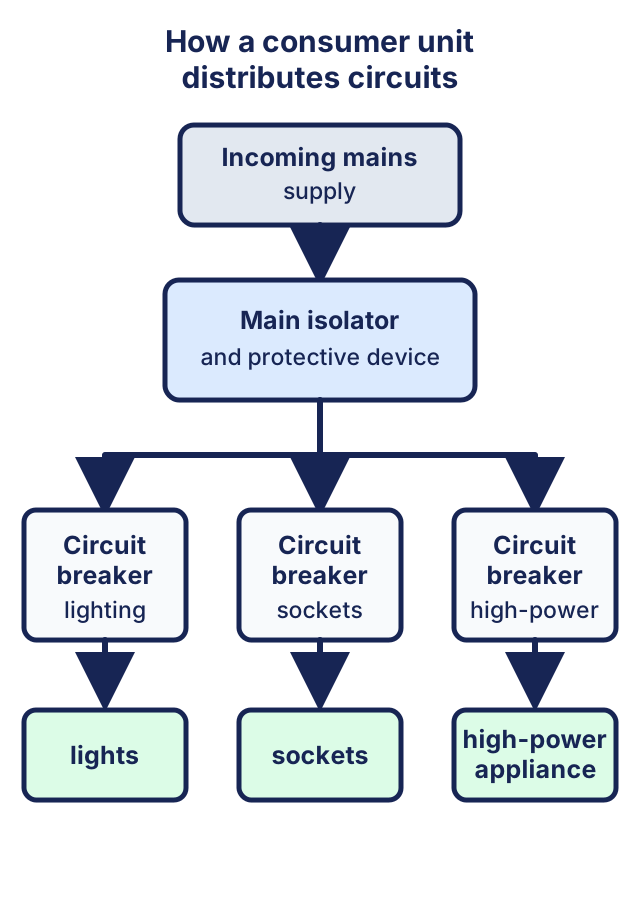
A. How electricity enters the home
Electricity enters a home through a distribution system and is then supplied to different circuits.
B. Why the earth wire improves safety
If a fault makes the metal casing live (e.g. damaged insulation inside an appliance), the earth wire provides a low-resistance path to Earth. This causes a large current, so the fuse blows or the circuit breaker trips quickly, disconnecting the supply.
C. Why safety devices are on the live wire
Switches, fuses and circuit breakers are fitted to the live wire so that when they open the circuit, the appliance is disconnected from the live supply.
If they were fitted to the neutral wire, the appliance could still be connected to the live wire and remain dangerous.
4. Common Mistakes
- Saying “neutral is always safe” (it should be near 0 V, but faults can make it dangerous).
- Thinking the earth wire is the normal return path (neutral is the normal return path).
- Placing the switch/fuse/circuit breaker on the neutral wire in explanations/diagrams.
5. Exam Tips
- Define L/N/E using potential difference and purpose.
- For earth-wire questions: “low resistance path → large current → fuse blows / breaker trips”.
- For safety-device placement: “fitted to the live wire so the appliance is disconnected from the live supply”.
6. Worked Examples
Modelled example 1
Earth wire current
Problem
Study the worked solution
Describe normal operation
Method
State that current flows through live, the appliance and neutral.Reason
The earth conductor is not part of the normal operating circuit.Working
Normal path: live → appliance → neutral.Trace a casing fault
Method
State that a large fault current flows through earth.Reason
The earth wire provides a low-resistance path when live touches a metal casing.Working
Fault path: live → casing → earth.Complete the protection chain
Method
State that the fuse blows or breaker trips.Reason
The large fault current operates the protective device and disconnects the supply.Working
Large fault current → protective device opens.
Guided practice 2
Live vs neutral roles
Problem
Give two facts for each conductor
Hints
Hint 1: live
Hint 2: neutral
View solution step by step
Live conductor
Method
State high potential and supply role.Reason
It provides the potential difference that transfers energy through the appliance.Working
Live: about 230–240 V relative to earth.Neutral conductor
Method
State near-zero potential and return role.Reason
It completes the normal circuit back to the supply.Working
Neutral: about 0 V relative to earth in normal operation.
Common misconception 3
Wire colours (modern standard)
Learner response
Correct the conductor mapping
View solution step by step
Map the modern colours
Method
Correct live to brown, neutral to blue and earth to green/yellow.Reason
The learner has swapped live and neutral while identifying earth correctly.Working
Live = brown; neutral = blue; earth = green/yellow.
Examiner practice 4
Fuse placement reasoning
Examination question
Trace what happens when the fuse melts
View solution step by step
Open the live path
2 marksMethod
State that excessive current melts the fuse and breaks the live conductor.Reason
The fuse is in series with the live connection.Working
Fuse melts → live path opens.State the safety effect
1 markMethod
State that the appliance is disconnected from the live supply.Reason
Internal parts are not left connected to live through the supply lead.Working
Live isolation reduces shock risk.
Self-mark with the mark scheme
Compare your response with each mark point. Select a point only when your response contains that evidence.
Self-mark operation, live placement and isolation.
Challenge 5
Fault to casing (what happens next?)
Fault-chain transfer
Follow current from fault to isolation
Hints
Hint 1: fault path
Hint 2: protective response
View solution step by step
Create the fault path
Method
State that current flows from live through the casing and earth wire.Reason
The earth connection has low resistance.Working
Live → casing → earth.Operate protection
Method
State that the large current blows the fuse or trips the breaker.Reason
The protective device responds to excessive current.Working
Large I_fault → circuit opens.Reduce exposure
Method
State that the live supply is disconnected quickly.Reason
This limits how long the casing can remain connected to live.Working
The earth wire carries current mainly during this fault.
7. Mind Stretchers
Mind stretcher 1: Switch on neutralExtension
A switch is placed in the neutral wire and is open (OFF). Explain why the appliance could still be dangerous to touch if there is a fault.
Show Answer
Even with the neutral wire open, the appliance can still be connected to the live wire. If a fault makes the casing live, it can be at high potential difference and give an electric shock.
Mind stretcher 2: Earth path and safetyExtension
If an appliance has a metal casing but no earth connection, why can that be dangerous during a fault?
Show Answer
Without an earth connection, there may be no low-resistance path for a large fault current. The casing can remain live, and touching it could cause a shock.
8. Practice and next step
- Rehearse each conductor as potential + normal role + fault role, rather than memorising colours alone.
- Use the Practical Electricity Structured Practice to write complete live-isolation explanations.
- Next, compare the two protection designs in Earthing & Double Insulation.
Continue with the next resource in this course.
Course and syllabus information
- Course
- SEC G3 Physics
- Edition
- SEC G3 Physics 2027