Switch
Key idea: O Level practical electricity: what a switch does in a circuit, and why household switches must be connected in the live wire for safety.
Continue where you stopped
The core idea
On this page
Learning objectives
- Explain electrical heating in common appliances
- Apply P = VI
- Apply E = VIt
- Calculate electrical energy and cost in kWh
- Identify the hazard from damaged insulation
- Identify the hazard from overheating cables
- Identify the hazard from damp conditions
- Explain how fuses and circuit breakers protect circuits
- Choose and justify an appropriate fuse rating
- Explain why metal casings are earthed
- Explain why double-insulated appliances do not need an earth wire
- State the meanings and roles of live, neutral and earth
- Describe the wiring of a mains plug
- Explain live-wire placement of switches, fuses and circuit breakers
1. Definition
A. Switch
A switch opens or closes a circuit.
B. Open vs closed
- Open switch: circuit is broken → no current.
- Closed switch: circuit is complete → current can flow (if there is a power supply).
You should be able to explain why switches are fitted to the live wire.
2. Key Ideas
- A switch controls current by breaking or completing the circuit.
- In a simple d.c. series circuit, a switch can be placed anywhere in series with the component.
- In household mains wiring, the switch is connected in the live wire for safety.
3. Detailed Explanations
A. What a switch does
When a switch is opened, there is no complete loop, so charge cannot flow around the circuit.
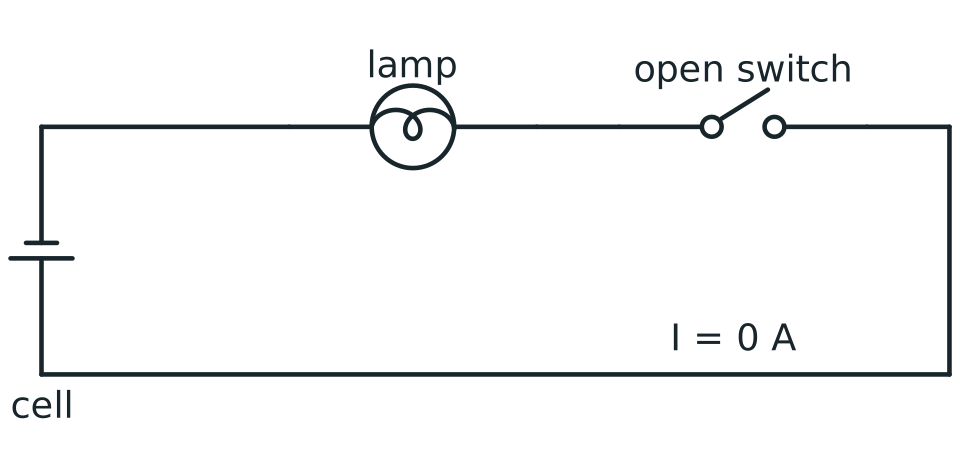
An open switch breaks a series circuit
A cell, lamp and open switch are connected in one series loop. The switch contact is open, so the conducting path is incomplete and the current is zero.
View figure data
| Part | Connection or state |
|---|---|
| Cell | Connected in series to the lamp |
| Lamp | Connected between the cell and switch |
| Switch | Open; its contact gap makes the loop incomplete |
| Current | 0 A because there is no complete conducting path |
B. Why the switch must be in the live wire (mains)
If the switch is connected to the neutral wire, opening it breaks the circuit, but the appliance can still be connected to the live wire.
During a fault (e.g. damaged insulation making a metal casing live), the casing can still be at high potential difference and become a shock hazard.
Putting the switch in the live wire disconnects the appliance from the live supply when OFF.
4. Common Mistakes
- Saying “switching the neutral wire is just as safe” (it is not).
- Thinking “no current” always means “no danger” (live parts can still be at high potential difference).
- Placing a switch in parallel across a component (can short circuit when closed).
5. Exam Tips
- Use the phrase: “switch is in the live wire so the appliance is disconnected from the live supply when OFF”.
- For circuit diagrams, show the switch in series with the load.
6. Worked Examples
Modelled example 1
Live vs neutral switch
Problem
Study the worked solution
Analyse neutral switching
Method
State that opening neutral stops normal current but can leave the appliance connected to live.Reason
The live conductor remains continuous to the appliance.Working
Neutral open: I = 0, but live connection remains.Identify the fault danger
Method
State that internal parts or a faulty casing can remain at high potential.Reason
A person could then provide a path to earth and receive a shock.Working
Live potential + contact path → shock risk.Choose live switching
Method
Place the switch in live.Reason
OFF then disconnects the appliance from the live supply.Working
Live open → live isolation.
Guided practice 2
Where to place the switch
Problem
Identify the path that must be broken
Hints
Hint 1: single path
Hint 2: control action
View solution step by step
Place it in the single loop
Method
Put the switch anywhere in series with the lamp.Reason
Opening any point on the sole current path breaks the complete circuit.Working
Open series switch → no complete loop → I = 0.
Common misconception 3
Open switch reading
Learner response
Apply the complete-loop condition
View solution step by step
Identify the broken path
Method
State that the open switch prevents a complete loop.Reason
Steady charge flow cannot continue around the circuit.Working
Open switch → incomplete circuit.State the reading
Method
Give 0 A.Reason
No steady current flows anywhere in this series loop.Working
I = 0 A
Examiner practice 4
Switch to control one component (parallel)
Examination question
Control only one branch
View solution step by step
Place the switch
2 marksMethod
Put it in series with lamp A within A’s branch.Reason
Opening it interrupts only the path containing lamp A.Working
Branch A: switch–lamp A in series.Account for lamp B
1 markMethod
State that lamp B remains connected in a complete branch.Reason
The switch is not in the common supply path or B’s branch.Working
Branch B remains closed → I_B can flow.
Self-mark with the mark scheme
Compare your response with each mark point. Select a point only when your response contains that evidence.
Self-mark branch identification, series placement and lamp-B explanation.
Challenge 5
Potential difference in an open circuit
Zero-current transfer
Treat current and potential difference as distinct quantities
Hints
Hint 1: current effect
Hint 2: voltage sum
View solution step by step
Locate the supply p.d.
Method
State that approximately the full cell p.d. appears across the open switch.Reason
The open gap is the circuit interruption; with no current, there is no appreciable p.d. across the ideal lamp.Working
V_(open switch) ≈ V_supplySeparate voltage from current
Method
State that p.d. can exist without a complete conducting path.Reason
Voltage describes energy per unit charge between points; steady current additionally requires a closed path.Working
I = 0 does not require V = 0
7. Mind Stretchers
Mind stretcher 1: Fault reasoningExtension
An appliance has its switch connected in the neutral wire. Suggest why touching the casing could still be dangerous during a fault even when the switch is OFF.
Show Answer
With the switch in neutral, the appliance can still be connected to live. If a fault makes the casing live, it can be at high potential difference and cause an electric shock even though no current normally flows in the appliance.
Mind stretcher 2: Double-pole switching (idea)Extension
Some appliances use a double-pole switch that disconnects both live and neutral. Why can this be safer than a single-pole switch?
Show Answer
It isolates the appliance more completely from the supply. Even if wiring is incorrect (e.g. live/neutral swapped) or there is a fault, disconnecting both conductors reduces the chance that parts remain at live potential difference.
8. Practice and next step
- On each diagram, trace the electrical connection from live to the appliance when the switch is open.
- Contrast “no normal current” with “isolated from live”; only the second statement establishes mains safety.
- Next, locate the live fuse and all three terminals in Wiring A Mains Plug.
Continue with the next resource in this course.
Course and syllabus information
- Course
- SEC G3 Physics
- Edition
- SEC G3 Physics 2027