G3 Physics and O-Level Radioactivity Hub
G3 Physics and O-Level Radioactivity hub: atoms and isotopes, nuclide notation, decay, half-life, detectors, hazards, fission and fusion.
Learning goals
- Describe atomic composition
- Use proton number, nucleon number and isotope
- Use and interpret nuclide notation
- Explain random and spontaneous nuclear decay
- Describe alpha, beta-minus and gamma radiation
- Compare ionising effect and penetrating power
- Use nuclide equations for radioactive decay
- Explain background radiation
- Use half-life in tables and decay curves
- State radioactivity applications and hazards
- Evaluate uses and hazards using half-life and radiation properties
- Relate fission and fusion to nuclear-energy release
This hub moves from atomic composition and nuclide notation to decay, background correction, half-life, applications, hazards, fission and fusion.
Before you begin:
- Core Exam Skills (units, graphs, command words)
- SI Units (Standard symbols and prefixes)
- Energy Stores (Nuclear energy as a store)
Follow this order:
- Atoms & Isotopes
- Nuclide Notation
- Radioactive Decay
- Alpha, Beta & Gamma
- Half-Life Calculations
- Uses & Dangers
- Radiation Detectors
- Nuclear Fission & Fusion
Simulation checkpoint: use the Radioactivity & Half-Life Explorer after step 4 to test radiation properties, absorber reasoning, half-life and background correction.
Lessons
Foundations
Atoms and isotopes
Locate protons, neutrons and electrons, then use proton and nucleon numbers to identify isotopes.
Nuclide notation
Interpret ^A_ZX, calculate neutron number, and balance radioactive-emission equations.
Decay and radiation
Radioactive decay
Explain random and spontaneous decay, balance emissions, and correct for background.
Types of emission
Compare alpha, beta-minus and gamma by nature, ionisation and penetration.
Half-life
Solve repeated-halving problems using tables, decay curves and corrected count-rate.
Applications and energy
Uses and dangers
Justify medical and industrial uses and hazards using half-life, penetration and ionisation.
Radiation detectors
Use GM readings, absorbers and cloud-chamber tracks as evidence, including background correction.
Fission and fusion
Distinguish splitting heavy nuclei from joining light nuclei and link both to energy release.
What you will learn
| You need to be able to… | Main lesson |
|---|---|
| describe atomic composition and distinguish proton number, nucleon number and isotopes | Atoms and Isotopes and Nuclide Notation |
| interpret nuclide notation and balance nuclear equations | Nuclide Notation and Radioactive Decay |
| explain random, spontaneous nuclear decay | Radioactive Decay |
| compare the nature, ionising effect and penetration of alpha, beta-minus and gamma | Characteristics of the Three Emissions |
| account for background radiation and detector readings | Radioactive Decay and Radiation Detectors |
| calculate half-life from tables or curves | Half-Life |
| justify applications and precautions using half-life, penetration and ionisation | Uses and Dangers of Radiation |
| distinguish fission from fusion and explain energy release from nuclear fuel | Nuclear Fission and Fusion |
Revision
Quick Reference
| Feature | Alpha (α) | Beta (β) | Gamma (γ) |
|---|---|---|---|
| Nature | Helium nucleus (⁴₂He) | Fast electron (⁰₋₁e) | Electromagnetic wave |
| Charge | + 2 | -1 | 0 |
| Ionising effect | high | medium | low |
| Penetrating power | low (absorbed by paper) | medium (absorbed by thin aluminium) | high (intensity reduced by thick lead or concrete) |
| Deflection (Field) | Towards Negative | Towards Positive | No Deflection |
Nuclear notation + decay changes
- Nucleon number A: protons + neutrons.
- Proton number Z: protons (sets the element).
- Alpha (α): A-4, Z-2.
- Beta minus (β⁻): A same, Z + 1.
- Gamma (γ): no change to A or Z (energy released).
Half-life equations (most used)
- After n half-lives: A/A₀ = (1/2)ⁿ
- Number of half-lives: n = t/(T_(1/2))
- Background correction: corrected count-rate = measured count-rate-background count-rate
Quick facts to remember
- Nucleon Number (A): Total number of protons and neutrons in a nucleus.
- Proton Number (Z): Number of protons in a nucleus (determines the element).
- Isotopes: Atoms of the same element with the same number of protons but different number of neutrons.
- Background Radiation: Ionizing radiation present in the environment from natural and artificial sources.
- Half-Life: The time taken for half the nuclei in a radioactive sample to decay (or for the activity to halve).
- Random & Spontaneous: Radioactive decay cannot be predicted for a single atom and is unaffected by external conditions (temperature, pressure).
Half-life questions (method checklist)
- If background is mentioned, subtract background first.
- Decide whether you are using:
- repeated halving (e.g., 800 → 400 → 200 → 100), or
- ratio form A/A₀ = (1/2)ⁿ, or
- reading half-lives directly from a decay curve.
- Convert n half-lives to time: t = nT_(1/2).
- State units clearly (count-rate in counts/s; activity in Bq).
Detectors + shielding (quick table)
| Radiation | Typical shielding | What it does well | Notes |
|---|---|---|---|
| α | paper / a few cm of air | ionises strongly | readily absorbed, but dangerous if inside body |
| β | thin aluminium | moderate penetration | absorbed by suitable aluminium thickness |
| γ | thick lead / concrete | very penetrating | shielding reduces intensity rather than guaranteeing zero transmission |
Safety (exam phrasing)
- Time: minimise exposure time.
- Distance: maximise distance from source.
- Shielding: use appropriate shielding (paper/Al/lead).
For revision links: Radiation Detectors and Uses & Dangers.
Visual Snapshots (graphs)
These are schematic. Use them to recognise decay curves and half-life quickly.
Radioactive decay curve: activity falls exponentially
A schematic radioactive decay curve plotted as activity fraction (A/A₀) versus time in half-lives, showing repeated halving.
Scroll across the graph to read all labels.
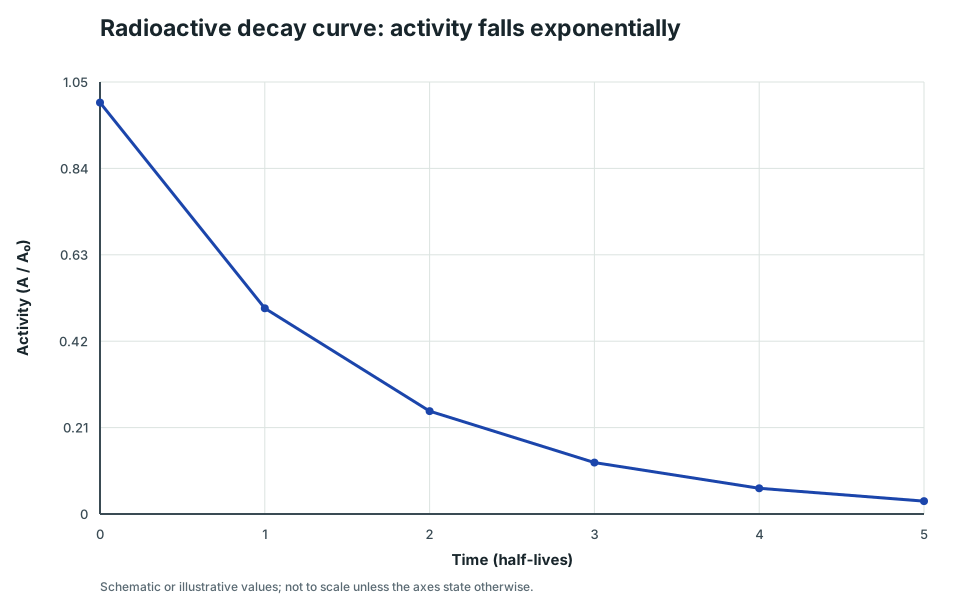
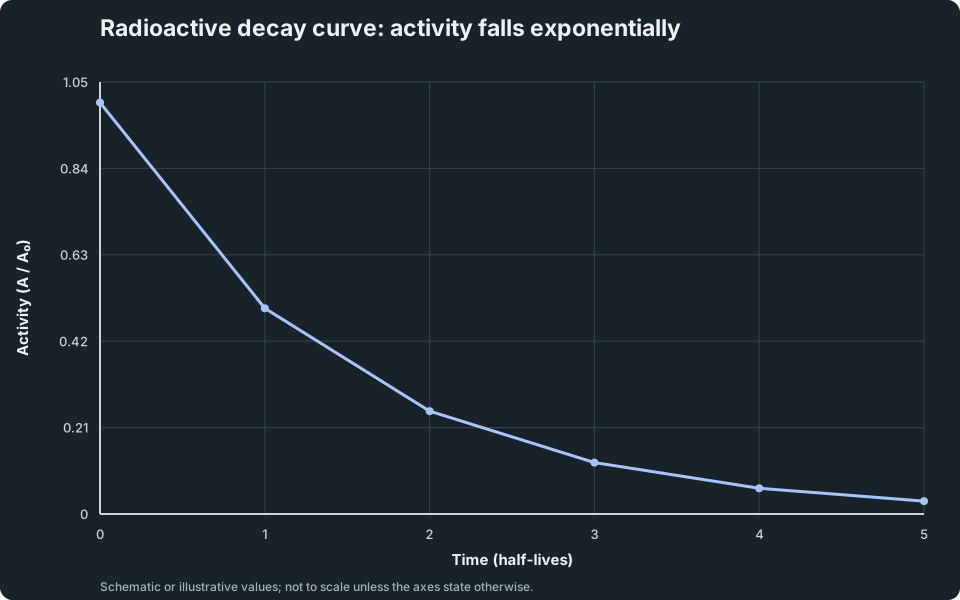
View figure data
| Time (half-lives) | Activity |
|---|---|
| 0 | 1 |
| 1 | 0.5 |
| 2 | 0.25 |
| 3 | 0.125 |
| 4 | 0.0625 |
| 5 | 0.03125 |
Top Exam Traps
- Count-Rate vs Background: If a question mentions “background radiation”, you must subtract it from the raw count-rate before doing half-life calculations.
- Beta Decay Equation: In beta decay, the proton number Z increases by 1, while the nucleon number A remains the same (n → p + e⁻).
- Alpha Decay Equation: In alpha decay, A decreases by 4 and Z decreases by 2.
- Half-Life Calculation: Don’t forget that after 3 half-lives, the activity is (1/2)³ = 1/8 of the original, not 1/6.
- Ionising vs Penetrating: These are inversely related. Alpha is the most ionising but least penetrating; Gamma is the most penetrating but least ionising.
- Activity vs count-rate: Activity is in Bq (decays/s). Count-rate is what the detector records (counts/s) and depends on geometry and absorption.
- Deflection strength: β is deflected much more than α (much smaller mass). γ is not deflected.
- “Stopped by lead”: gamma intensity decreases through shielding; avoid claiming that one layer stops every gamma ray.
Practice
G3 Physics / O-Level practice check
Use the Radioactivity check for atomic foundations, decay and equations, background and half-life, and applications and nuclear energy, then write one explanation or calculation without prompts before moving on.
- Use the Radioactivity & Half-Life Explorer to predict absorber results, compare random trials, subtract background and read half-life.
- Complete the Radioactivity Quiz for rapid checks across the whole topic.
- Finish with Radioactivity Structured Practice for decay equations, calculations and application justifications.
Continue learning
- Return to the O-Level Physics portal for mixed revision across the full syllabus.
- Continue to Nuclear Physics (A Level) for binding energy, mass defect and decay constants.
Course and syllabus information
- Course
- SEC G3 Physics
- Edition
- SEC G3 Physics 2027