Half-Life
Key idea: Learn the half-life definition, solve (1/2)^n problems, and read half-life from decay curves with background subtraction and correct units (O Level).
Continue where you stopped
The core idea
On this page
Learning objectives
- Describe atomic composition
- Use proton number, nucleon number and isotope
- Use and interpret nuclide notation
- Explain random and spontaneous nuclear decay
- Describe alpha, beta-minus and gamma radiation
- Compare ionising effect and penetrating power
- Use nuclide equations for radioactive decay
- Explain background radiation
- Use half-life in tables and decay curves
- State radioactivity applications and hazards
- Evaluate uses and hazards using half-life and radiation properties
- Relate fission and fusion to nuclear-energy release
1. Definition
The half-life, t_(1/2), is the time taken for:
- the number of undecayed nuclei to fall to half, or
- the activity to fall to half.
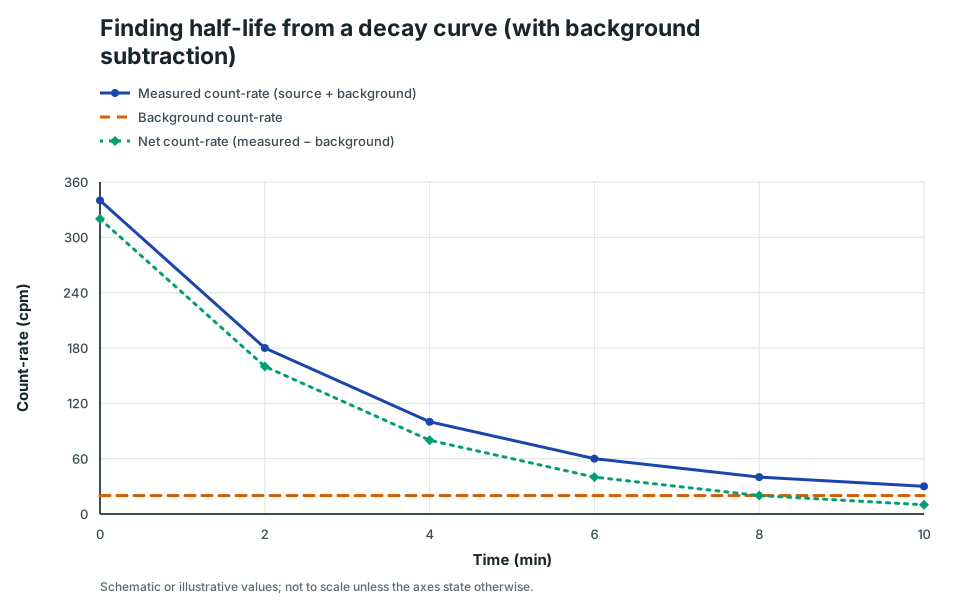
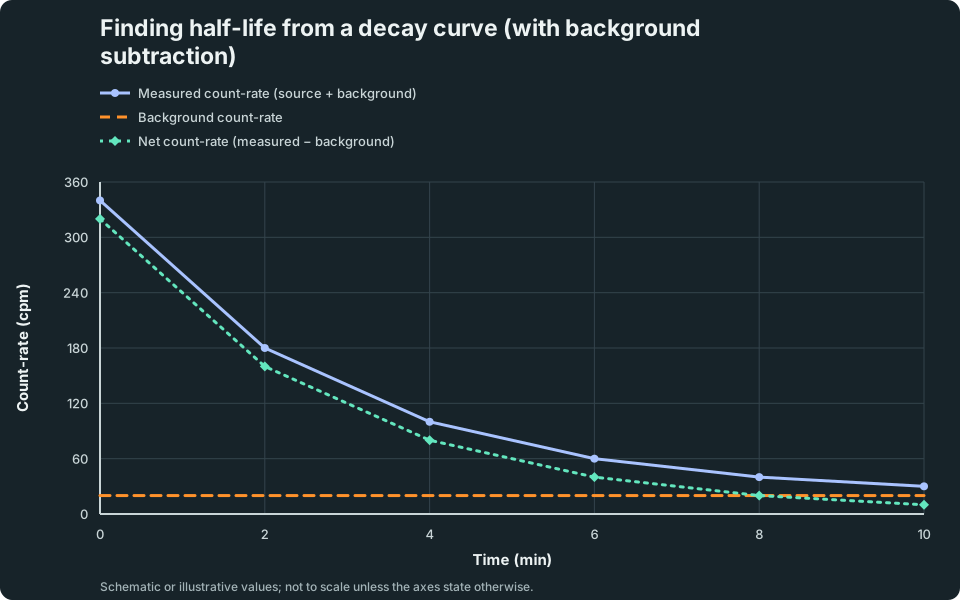
For an unchanged detector setup, the net count-rate is proportional to activity, so it also halves on average. Raw measured count-rate does not fall toward zero because background remains.
2. Key Ideas
- After each half-life, the remaining fraction halves: 1/2, 1/4, 1/8, …
- If n half-lives have passed: N_final/Nᵢₙᵢₜᵢₐₗ = (1/2)ⁿ
- If time t has passed: n = t/(t_(1/2)) (when t is a multiple of t_(1/2))
- With a GM tube, subtract background first: net count-rate = measured - background
3. Detailed Explanations
A. Half-life using repeated halving (fast method)
If the question is “after 3 half-lives”, you can do:
N → N/2 → N/4 → N/8
Same idea for activity/count-rate.
B. Finding half-life from a decay curve
- Use the net count-rate (subtract background).
- Choose an activity value A on the curve.
- Find the time for the activity to drop to A/2.
- That time difference is the half-life.
Because decay is random, real count-rate points fluctuate. Use the overall curve or repeated halving intervals rather than expecting every reading to lie exactly on a smooth line.
Finding half-life from a decay curve (with background subtraction)
A schematic decay curve showing why you subtract background first, then measure the time for the net count-rate to halve.
Scroll across the graph to read all labels.
View figure data
| Series | Time (min) | Time uncertainty | Count-rate (cpm) | Count-rate uncertainty |
|---|---|---|---|---|
| Measured count-rate (source + background) | 0 | 340 | ||
| Measured count-rate (source + background) | 2 | 180 | ||
| Measured count-rate (source + background) | 4 | 100 | ||
| Measured count-rate (source + background) | 6 | 60 | ||
| Measured count-rate (source + background) | 8 | 40 | ||
| Measured count-rate (source + background) | 10 | 30 | ||
| Background count-rate | 0 | 20 | ||
| Background count-rate | 10 | 20 | ||
| Net count-rate (measured − background) | 0 | 320 | ||
| Net count-rate (measured − background) | 2 | 160 | ||
| Net count-rate (measured − background) | 4 | 80 | ||
| Net count-rate (measured − background) | 6 | 40 | ||
| Net count-rate (measured − background) | 8 | 20 | ||
| Net count-rate (measured − background) | 10 | 10 |
4. Common Mistakes
- Using background-included readings for half-life (subtract background first).
- Halving by a fixed amount instead of a fixed fraction.
- Mixing up “half-life” with “time for all nuclei to decay” (it never reaches zero in the ideal model).
- Halving the raw measured count-rate instead of the background-corrected rate.
- Assuming the half-life changes when the starting sample size changes.
5. Exam Tips
- State the definition clearly (half of nuclei / half of activity).
- Use (1/2)ⁿ for non-trivial questions.
- In decay curve questions: show clearly where you halved the activity.
6. Worked Examples
Modelled example 1
Remaining nuclei
Problem
Study the worked solution
Count elapsed half-lives
Method
Divide elapsed time by half-life.Reason
Each 5-minute interval produces one further halving.Working
n = 15/5 = 3Apply the remaining fraction
Method
Multiply by (1/2)³.Reason
Three independent half-life intervals leave one eighth.Working
N = 800(1/2)³ = 100 nuclei
Guided practice 2
Time elapsed
Problem
Express the remaining activity as a power of one half
Hints
Hint 1: fraction remaining
Hint 2: repeated halves
View solution step by step
Form the activity ratio
Method
Divide final activity by initial activity.Reason
The remaining fraction shows how many halvings occurred.Working
200/1600 = 1/8Count the halvings
Method
Identify three half-lives.Reason
1/8 = (1/2)³.Working
n = 3
Common misconception 3
Background subtraction
Learner response
Separate detector background from source contribution
View solution step by step
Remove background
Method
Subtract 40 cpm from the measured rate.Reason
Only net source count-rate is proportional to source activity.Working
Rₙₑₜ = 260-40 = 220 cpmState the interpretation rule
Method
Use 220 cpm as the initial source rate.Reason
Raw readings approach background rather than zero as the source decays.Working
Half the source contribution is 110 cpm net, or 150 cpm measured.
Examiner practice 4
Time for an activity to drop
Examination question
Show the number of halvings before converting to time
View solution step by step
Count half-lives
2 marksMethod
Halve activity until it reaches 60 Bq.Reason
Each halving represents one half-life.Working
480 → 240 → 120 → 60: 3 half-livesFind elapsed time
1 markMethod
Multiply 3 by 2 hours.Reason
Each half-life lasts 2 hours.Working
t = (3)(2) = 6 h
Self-mark with the mark scheme
Compare your response with each mark point. Select a point only when your response contains that evidence.
Self-mark halving sequence, count and time.
Challenge 5
Finding half-life from data
Data-interval transfer
Find how many halvings fit the observed factor
Hints
Hint 1: halving count
Hint 2: time per interval
View solution step by step
Interpret the decay factor
Method
Identify two half-lives in the change from 320 to 80.Reason
The count-rate halves twice.Working
320 → 160 → 80Find one half-life
Method
Divide 12 minutes by 2.Reason
The measured interval contains two equal half-life periods.Working
t_(1/2) = 12/2 = 6 min
7. Mind Stretchers
Mind stretcher 1: Does long half-life mean “more dangerous”?Extension
A source has a very long half-life. Does that mean it is always “more dangerous”? Why/why not?
Show Answer
Not always. “Danger” depends on activity (decays per second), the type of radiation (alpha/beta/gamma), and exposure.
- For the same number of radioactive nuclei, a shorter half-life gives a higher activity because a larger fraction decays per second.
- A long-lived source may have a lower activity for the same number of nuclei, but it can remain a hazard for much longer.
Mind stretcher 2: Does half-life depend on sample size?Extension
If you start with a bigger sample of the same isotope, does the half-life change? Why/why not?
Show Answer
No. Half-life is a property of the isotope. A bigger sample may have a higher activity because there are more nuclei, but each nucleus still has the same probability of decaying per unit time, so the half-life stays the same.
8. Practice and next step
Read half-life from both tables and curves in the Radioactivity & Half-Life Explorer, then complete the Radioactivity Structured Practice.
Continue with the next resource in this course.
Course and syllabus information
- Course
- SEC G3 Physics
- Edition
- SEC G3 Physics 2027