Electrostatic Hazards (Lightning & Sparks)
Key idea: O Level electrostatic hazards: why sparks happen, examples (lightning, refuelling, dust), and how earthing reduces risk.
Continue where you stopped
The core idea
On this page
Learning objectives
- state that there are positive and negative charges and that charge is measured in coulombs
- state that unlike charges attract and like charges repel
- Describe an electric field as a region where charge experiences force
- Recall that the field lines of an isolated point charge give the direction of the force on a positive test charge
- Draw the directed electric field of an isolated point charge
- Interpret the electric-field pattern between two isolated point charges
- Draw the electric-field pattern between two isolated point charges
- Explain charging by rubbing as electron transfer
- Describe experiments that charge a conductor by induction
- Describe potential electrostatic-charging hazards
- Describe an electrostatic precipitator and transfer the principle
1. Definition
An electrostatic hazard happens when a build-up of static charge discharges suddenly (a spark), which can ignite flammable vapour/dust or damage equipment.
You should be able to describe situations where electrostatic charging creates a hazard.
2. Key Ideas
- A hazard usually needs three parts:
- charge build-up (often on insulators or isolated conductors)
- a large potential difference
- a discharge path (spark) through air or to Earth
- A spark releases energy as heat and light, which can ignite flammable mixtures.
- Earthing (grounding) reduces hazard by giving electrons a safe path to flow, preventing large charge build-up.
- Other risk-reduction methods: antistatic materials, bonding metal parts together, and reducing charge build-up (e.g. slower flow of liquids, higher humidity).
3. Detailed Explanations
A. Why can a spark start a fire?
- Static charge builds up on an object (e.g. a person, a vehicle, a pipe).
- The electric field in the air gap becomes very strong.
- Air breaks down and a spark discharge occurs.
- The discharge heats the air strongly for a very short time.
If there is flammable vapour (petrol) or flammable dust (flour) nearby, the heat from the spark can ignite it.
Sparks are more likely in dry conditions. Do not do “static electricity demos” near fuels, sprays, solvents, or dusty environments.
B. Lightning (natural electrostatic hazard)
In a thundercloud, charges separate so the cloud and the ground can become oppositely charged. When the field is strong enough, the air breaks down and a discharge occurs: lightning.
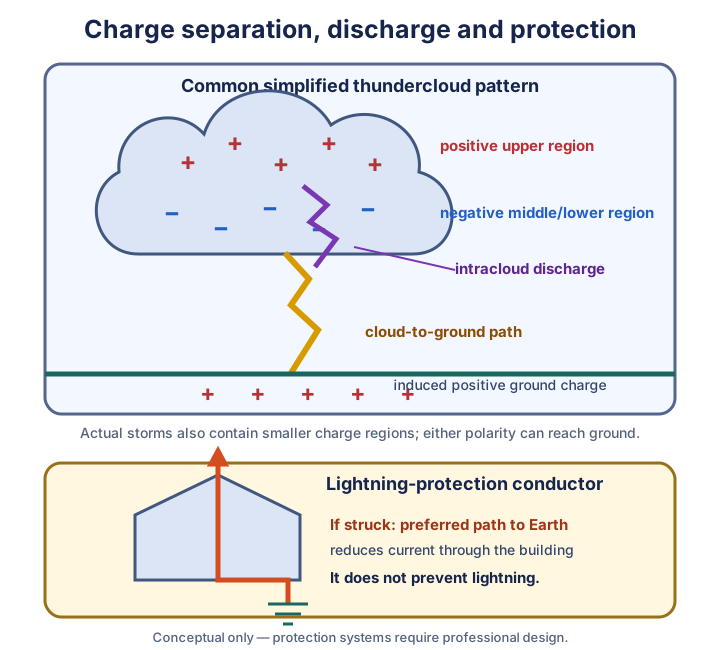
How a lightning conductor reduces risk
A lightning conductor is a metal rod connected to Earth by a thick conducting strip. It does not prevent lightning. If the system is struck, it provides a preferred conducting path to Earth, reducing current through the building and therefore reducing fire and structural-damage risk. Real protection systems require professional design and installation.
C. Sparks during refuelling / fuel transfer
When fuel flows through a pipe, friction can cause charge build-up. A spark between the nozzle, vehicle, or person can ignite petrol vapour.
Ways to reduce risk:
- bond and earth the tanker/pipework (so charge cannot build up to a large value)
- keep the nozzle in contact with the tank opening (reduces air gaps where sparks form)
- avoid actions that increase charging (e.g. rapid flow, rubbing synthetic clothing)
D. Dust explosions (factories)
In places like flour mills or grain silos, fine dust can be suspended in air and can ignite easily. A small spark can trigger a large explosion.
Risk reduction:
- control dust levels (good ventilation and cleaning)
- use antistatic/earthing where appropriate
E. Electrostatic discharge (ESD) damage to electronics
A small discharge from a charged person can damage sensitive electronic components.
Prevention:
- antistatic wrist straps (earthed)
- antistatic bags and mats
4. Common Mistakes
- Saying “earthing stops charging” (earthing reduces build-up by letting charge flow away).
- Forgetting the ignition condition: sparks are hazardous mainly when flammable vapour/dust is present.
- Mixing up “charge build-up” (static) with “current in a circuit” (continuous flow).
5. Exam Tips
- Use the keywords build-up, discharge, spark, ignite, earthing/bonding.
- For lightning conductors, write: “provides a low-resistance path to Earth so current does not pass through the building”.
- If asked for examples, give at least two (e.g. lightning + refuelling).
6. Worked Examples
Modelled example 1
Refuelling
Problem
Study the worked solution
Build the hazard chain
Method
Link fuel flow to charge build-up, a large potential difference and spark discharge.Reason
Flow and friction can separate charge on isolated metal parts or people.Working
Charge build-up → spark.Name the harm and control
Method
State that the spark can ignite petrol vapour and that earthing lets charge flow away.Reason
Removing accumulated charge reduces the potential difference and likelihood of air breakdown.Working
Earthing → less build-up → lower ignition risk.
Guided practice 2
Lightning conductor
Problem
Choose the protection mechanism
Hints
Hint 1: follow the discharge current
Hint 2: avoid an absolute claim
View solution step by step
Describe the protected path
Method
Connect a metal rod to Earth through a thick conductor.Reason
The system offers a preferred low-resistance route for the large discharge current.Working
Strike point → conductor → Earth.State the benefit precisely
Method
Reduce current through the building and hence fire or structural damage.Reason
Current diverted into the designed route is less likely to heat or break building materials.Working
Damage risk reduced, not eliminated.
Common misconception 3
Dusty factory
Learner response
Identify the immediate ignition source
View solution step by step
Correct the trigger
Method
State that accumulated charge can produce a sudden spark discharge.Reason
A strong enough electric field breaks down the air gap.Working
Charge build-up → spark.Connect to the explosion
Method
State that spark heating can ignite fine flour dust suspended in air.Reason
The combustible dust-air mixture can burn rapidly and cause an explosion.Working
Spark + suspended dust → ignition/explosion.
Examiner practice 4
Electronics (ESD)
Examination question
Give build-up, harm and control mechanism
View solution step by step
State the hazard
2 marksMethod
Describe charge build-up on the technician and sudden electrostatic discharge into a component.Reason
Sensitive electronic structures can be damaged by the brief discharge.Working
Charged person → ESD → component damage.Explain the strap
1 markMethod
Provide a controlled conducting path to Earth so charge does not accumulate.Reason
Keeping the technician near Earth potential reduces the chance of a damaging discharge.Working
Wrist strap → gradual charge flow to Earth.
Self-mark with the mark scheme
Compare your response with each mark point. Select a point only when your response contains that evidence.
Self-mark charge build-up, component damage and earthing mechanism.
Challenge 5
Bonding and earthing
Combined-control transfer
Explain both controls separately before combining them
Hints
Hint 1: bond the metal parts
Hint 2: then connect Earth
View solution step by step
Explain bonding
Method
Connect the metal parts so they remain at nearly the same electric potential.Reason
Reducing the potential difference reduces the electric field across gaps between them.Working
Bonding → smaller inter-part potential difference.Explain earthing
Method
Provide a path for accumulated charge to flow to or from Earth.Reason
Preventing large net charge build-up further reduces air breakdown and sparking.Working
Earthing → charge drains safely → lower spark risk.
7. Mind Stretchers
Mind stretcher 1: Dry vs humid dayExtension
Electrostatic sparks are more common on dry days than humid days. Suggest why.
Show Answer
Moist air allows charge to leak away more easily (it is slightly more conducting), so large charge build-up is less likely. In dry air, charge remains on surfaces longer, increasing the chance of a spark.
Mind stretcher 2: “Isolated” metal objectExtension
A metal fuel tank is insulated from the ground. Why can this increase hazard, and what is the fix?
Show Answer
If it is isolated, charge can build up on it to a large value because it cannot flow to Earth easily. Bonding and earthing provide a conducting path to ground so charge does not accumulate.
8. Practice and next step
For each hazard, write the complete causal chain: charge build-up → spark discharge → stated harm → control. Test this in Static Electricity structured practice, then compare a beneficial use in Electrostatic Applications.
Continue with the next resource in this course.
Course and syllabus information
- Course
- SEC G3 Physics
- Edition
- SEC G3 Physics 2027