Kinetic and gravitational potential energy
Key idea: Kinetic energy grows with mass and the square of speed; gravitational potential energy grows with mass and vertical height. During a fall, energy transfers between these stores and the surroundings.
Offline pages
Saved on this device only. Connect at least once every 30 days to confirm Premium. Sign-out or a change of account removes saved copies.
Loading guide controls…
Guided lessons · coming soon
Guided lesson
Guided steps
- Compare how mass and speed affect kinetic energy.
- Read two energies, then predict the third.
- Follow the speed and mass conversions.
- Rearrange for speed squared, then take its square root.
- Convert kilojoules and find the sprinter’s speed.
- Use the change in vertical height.
- Follow the height, mass and distance conversions.
- Convert kilojoules and find the skier’s vertical rise.
- Compare vertical height with distance along the track.
- Follow the falling ball’s energy account.
- Compare the pendulum and slope energy accounts.
- Find the greatest height reached by the swing.
- Find the energy lost from the child’s motion.
- Subtract dissipated energy, then find the trolley’s speed.
- Find the final speed when the block is already moving.
On this page
You stopped at:
ContinueA roller coaster climbs slowly to the top of its first hill, then races down the other side. On the way down, energy leaves its gravitational potential store and fills its kinetic store. Two equations give the energy in each store, and conservation of energy links them, so you can find how fast something moves after a fall or how high it can rise. Take g = 10 N/kg unless a question gives another value.
Kinetic energy
A moving object has energy in its kinetic store. At the same speed, a greater mass gives more kinetic energy. At the same mass, a greater speed gives more kinetic energy.
| Symbol | Quantity | SI unit |
|---|---|---|
| Eₖ | kinetic energy | joule (J) |
| m | mass | kilogram (kg) |
| v | speed | metre per second (m/s) |
Only the speed is squared. At the same speed, doubling the mass doubles the kinetic energy. At the same mass, doubling the speed makes it 2² = 4 times as large, and tripling the speed makes it 3² = 9 times as large. Doubling both mass and speed makes it 2 × 4 = 8 times as large.
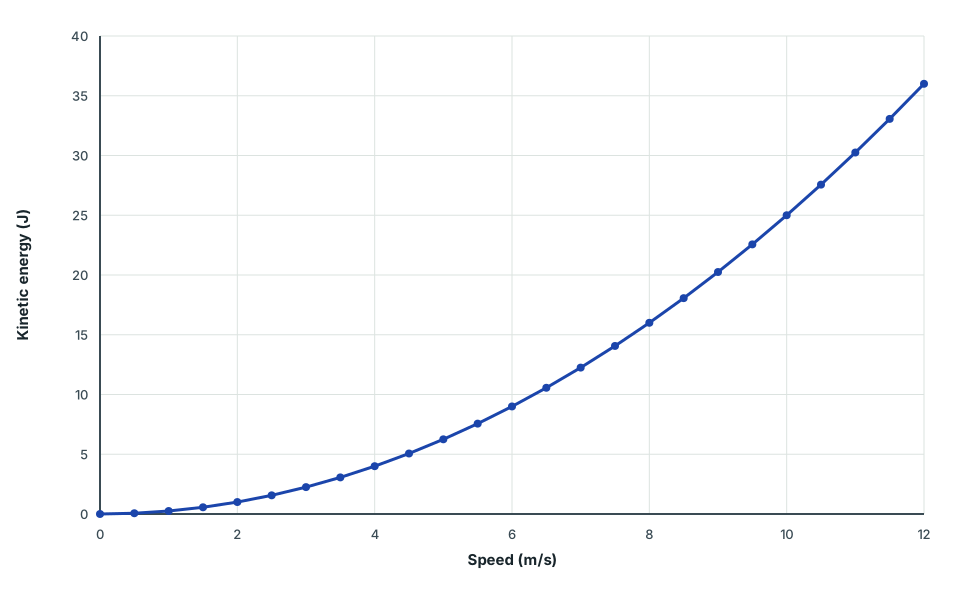
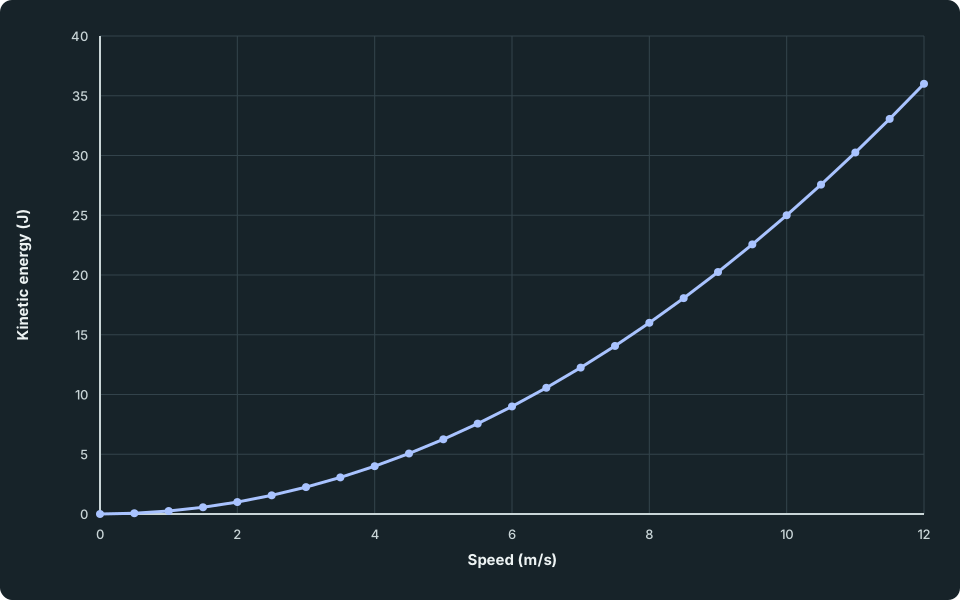
Kinetic energy and speed for a 0.50 kg object
Speed in metres per second on the horizontal axis and kinetic energy in joules on the vertical axis. The plotted values rise more steeply at higher speeds: 2 m/s gives 1 J, 4 m/s gives 4 J, and 8 m/s gives 16 J.
Scroll across the figure to read all labels.
View figure data
| Speed (m/s) | 0.50 kg object |
|---|---|
| 0.0 | 0.0000 |
| 0.5 | 0.0625 |
| 1.0 | 0.2500 |
| 1.5 | 0.5625 |
| 2.0 | 1.0000 |
| 2.5 | 1.5625 |
| 3.0 | 2.2500 |
| 3.5 | 3.0625 |
| 4.0 | 4.0000 |
| 4.5 | 5.0625 |
| 5.0 | 6.2500 |
| 5.5 | 7.5625 |
| 6.0 | 9.0000 |
| 6.5 | 10.5625 |
| 7.0 | 12.2500 |
| 7.5 | 14.0625 |
| 8.0 | 16.0000 |
| 8.5 | 18.0625 |
| 9.0 | 20.2500 |
| 9.5 | 22.5625 |
| 10.0 | 25.0000 |
| 10.5 | 27.5625 |
| 11.0 | 30.2500 |
| 11.5 | 33.0625 |
| 12.0 | 36.0000 |
Read the points for one fixed mass: at 4 m/s the energy is 4 J, while at 8 m/s it is 16 J. Twice the speed gives four times the kinetic energy. The increasing steepness shows why equal increases in speed do not give equal increases in energy. Changing the mass would give a different curve.
Check your understanding 1 Read the curve before predicting
For the fixed mass in the graph, read the energies at 4 m/s and 8 m/s. Predict the energy at 12 m/s. Which relationship explains the curve?
Show the steps Optional working
Show answer
The graph gives 4 J at 4 m/s and 16 J at 8 m/s. Doubling speed multiplies kinetic energy by 2² = 4. From 4 to 12 m/s the speed triples, so the energy is 4 × 3² = 36 J. A straight line would assume a constant increase in energy per increase in speed; the squared-speed relationship gives increasing steepness. The prediction keeps the mass fixed, as in the plotted curve.
Worked example 1
Convert the speed first
Problem
A 1500 kg car travels at 72 km/h. Find its kinetic energy.
Show full solution
Convert the speed
Method
Change km/h to m/s.Reason
The equation needs metres per second.Working
Answer
72 km/h = (72 000 m)/(3600 s) = 20 m/s
Square the speed
Method
Square v before multiplying.Reason
Only the speed is squared, not the mass.Working
Answer
v² = 20² = 400 m²/s²
Find the kinetic energy
Method
Substitute into Eₖ = (1/2)mv².Reason
Half the mass times the speed squared.Working
Answer
Eₖ = 1/2 × 1500 × 400 = 3.0 × 10⁵ J (300 kJ)
Check
Working
Answer
Using 72 without converting would give 3.9 × 10⁶ J, about 13 times too large.
Worked example 2
Convert the mass first
Problem
A 60 g tennis ball is served at 25 m/s. Find its kinetic energy.
Show full solution
Convert the mass
Method
Change grams to kilograms.Reason
The equation gives joules only from kilograms.Working
Answer
m = 60 g = 0.060 kg
Find the kinetic energy
Working
Answer
Eₖ = 1/2 × 0.060 × 25² = 0.030 × 625 = 18.75 J ≈ 19 J
Finding a speed from kinetic energy
Rearrange in two steps: v² = 2Eₖ/m, then v = square root of (2Eₖ/m).
Worked example 3
Speed from kinetic energy
Problem
A 0.50 kg ball has 16 J of kinetic energy. Find its speed.
Show full solution
Rearrange for v²
Method
Make v² the subject of Eₖ = (1/2)mv².Reason
The unknown is inside the square.Working
Answer
v² = 2Eₖ/m = (2 × 16)/0.50 = 64 m²/s²
Take the square root
Working
Answer
v = square root of 64 = 8.0 m/s. Remember the square root: 64 is v², not v.
Check your understanding 2
A 70 kg sprinter has 3.5 kJ of kinetic energy. Find the sprinter’s speed.
Show the steps Optional working
Show the steps Optional working
Show answer
Eₖ = 3500 J. v² = (2 × 3500)/70 = 100 m²/s², so v = 10 m/s.
Gravitational potential energy
Lifting an object increases the energy in its gravitational potential store. Near the Earth’s surface the gravitational field strength is almost constant, so
where m is the mass in kg, g is the gravitational field strength (10 N/kg) and h is the height in m above a chosen reference level. Notice that mg is the object’s weight, so Eₚ is weight × height.
Only a change in height matters. Choose a convenient zero, such as the floor or the bottom of a slope. The change in gravitational potential energy is
A rise increases this store; a fall decreases it. Moving the zero changes both heights equally, so Δ h and Δ Eₚ do not change.
Worked example 4
Climbing stairs
Problem
A 45 kg student climbs stairs that rise 3.2 m. Find the increase in her gravitational potential energy.
Show full solution
Choose the height
Method
Use the vertical rise of the stairs.Reason
Gravitational potential energy depends on the change in height only.Working
Answer
Δ h = 3.2 m
Find the increase
Working
Answer
Δ Eₚ = mgΔ h = 45 × 10 × 3.2 = 1440 J ≈ 1.4 × 10³ J
Worked example 5
Grams and centimetres
Problem
A 250 g book is lifted 80 cm onto a shelf. Find the increase in its gravitational potential energy.
Show full solution
Convert first
Method
Change grams to kilograms and centimetres to metres.Reason
The equation gives joules only from kilograms and metres.Working
Answer
m = 0.250 kg, Δ h = 0.80 m
Find the increase
Working
Answer
Δ Eₚ = 0.250 × 10 × 0.80 = 2.0 J
Finding a height
Rearrange to h = Eₚ/mg. A 2.5 kg rock gains 150 J of gravitational potential energy when it is carried up a hill. It rises by h = 150/(2.5 × 10) = 6.0 m.
Check your understanding 3
A 50 kg skier gains 7.5 kJ of gravitational potential energy on a ski lift. How far does she rise vertically?
Show the steps Optional working
Show answer
h = 7500/(50 × 10) = 15 m.
On a slope, use the vertical height
A 40 kg child walks 25 m up a ramp. The top of the ramp is 3.0 m higher than the bottom.
- The height in mgh is the vertical rise, 3.0 m. The gravitational force acts vertically, so only vertical movement changes this store.
- Δ Eₚ = 40 × 10 × 3.0 = 1200 J.
- Using the 25 m along the ramp would give 10 000 J, more than eight times too much.
Solving problems with conservation of energy
As an object falls, its gravitational potential store decreases and its kinetic store increases. As it rises, the reverse happens. Use this method:
- Choose the system and the start and end points.
- Name the stores that decrease and increase.
- Write the energy account. With no energy dissipated: loss of Eₚ = gain of Eₖ. With energy dissipated: loss of Eₚ = gain of Eₖ + energy dissipated.
- Substitute in SI units, solve, and check that the answer is reasonable.
Worked example 6
A falling ball, no dissipation
Problem
A 0.40 kg ball is dropped from rest 3.2 m above the ground. Ignore air resistance. Find its speed just before it hits the ground.
Show full solution
Set up the account
Method
Choose the system, the start and the end.Reason
Conservation applies to a defined system between two moments.Working
Answer
System: the ball and the Earth. Start: at rest, 3.2 m up. End: just above the ground.
Name the stores that change
Method
Say which store decreases and which increases.Reason
With no air resistance, no energy is dissipated.Working
Answer
The gravitational potential store decreases; the kinetic store increases.
Find the energy transferred
Method
Calculate the loss of Eₚ.Reason
The loss of Eₚ equals the gain of Eₖ.Working
Answer
mgh = 0.40 × 10 × 3.2 = 12.8 J
Find the speed
Working
Answer
1/2 × 0.40 × v² = 12.8, so v² = 64 and v = 8.0 m/s
The mass cancels: mgh = (1/2)mv² gives v² = 2gh = 2 × 10 × 3.2 = 64. Without air resistance, a heavy ball and a light ball dropped from the same height land at the same speed.
Worked example 7
A pendulum
Problem
A pendulum bob is pulled aside so that it is 0.20 m above its lowest point, then released. Ignore air resistance and friction at the pivot. How fast does it move through the lowest point?
Show full solution
Name the stores that change
Method
Follow the bob from release to the lowest point.Reason
As it swings down, it loses height and gains speed.Working
Answer
The gravitational potential store decreases; the kinetic store increases.
Check the string
Method
Ask whether the string’s force transfers energy.Reason
The string pulls at right angles to the bob’s motion.Working
Answer
The string transfers no energy.
Find the speed
Method
Equate mgh and (1/2)mv²; the mass cancels.Reason
All the Eₚ lost becomes Eₖ.Working
Answer
v² = 2gh = 2 × 10 × 0.20 = 4.0, so v = 2.0 m/s
Follow the swing
Working
Answer
The bob then rises to 0.20 m on the other side, where it stops for an instant before swinging back.
Worked example 8
Down a slope
Problem
A 0.20 kg block slides from rest down a frictionless track 1.8 m long. Ignore air resistance. The top of the track is 0.45 m above the bottom. Find its speed at the bottom.
Show full solution
Choose the height
Method
Use the vertical drop, 0.45 m.Reason
Gravitational potential energy depends on vertical height, not on the path.Working
Answer
h = 0.45 m; the 1.8 m length is not needed
Find the speed
Working
Answer
v² = 2gh = 2 × 10 × 0.45 = 9.0, so v = 3.0 m/s
Check your understanding 4
A swing passes its lowest point at 4.0 m/s. Ignore air resistance and pivot friction. Which energy store increases as it rises? Find its greatest height above the lowest point.
Show answer
As the swing rises, the kinetic store decreases and the gravitational potential store increases. At the highest point the swing stops for an instant, so all the kinetic energy has been transferred: (1/2)mv² = mgh. The mass cancels, so h = v²/2g = 4.0²/(2 × 10) = 0.80 m.
When energy is dissipated
With friction or air resistance, not all of the gravitational potential energy lost reaches the kinetic store. Total energy is still conserved; the energy in the kinetic and gravitational potential stores together is not.
Worked example 9
A playground slide
Problem
A 30 kg child slides from rest down a slide whose top is 2.0 m above the bottom. At the bottom her speed is 4.0 m/s. How much energy is dissipated?
Show full solution
Loss of Eₚ
Method
Calculate mgh.Reason
This is the energy the gravitational store gives up.Working
Answer
30 × 10 × 2.0 = 600 J
Gain of Eₖ
Method
Calculate (1/2)mv² at the bottom.Reason
This is the part that ends up in the kinetic store.Working
Answer
1/2 × 30 × 4.0² = 240 J
Energy dissipated
Method
Subtract.Reason
Energy is conserved, so the difference went somewhere else.Working
Answer
600 - 240 = 360 J. Friction transferred it to the internal store of the child and the slide, which warm slightly.
Check
Working
Answer
With no friction she would reach v = square root of (2 × 10 × 2.0) ≈ 6.3 m/s. Her actual speed is lower, as it should be.
Check your understanding 5
A 2.0 kg trolley starts from rest 5.0 m above a track’s bottom. During its descent, 19 J is dissipated. Ignore energy in the turning wheels. Find its kinetic energy and speed at the bottom.
Show the steps Optional working
Show the steps Optional working
Show answer
The account is mgh = (1/2)mv² + 19. The loss of gravitational potential energy is 2.0 × 10 × 5.0 = 100 J, so the kinetic energy at the bottom is 100 - 19 = 81 J. Then 1/2 × 2.0 × v² = 81 gives v² = 81 and v = 9.0 m/s. Writing (1/2)mv² = mgh puts all 100 J into the kinetic store and ignores the 19 J that was dissipated.
Check your understanding 6 Keep the initial kinetic energy
A 0.50 kg block is moving at 2.0 m/s before descending through 0.60 m. Friction and air resistance are negligible. Take g = 10 N/kg. Find its speed at the bottom. Which energy must be included as well as the gravitational potential energy lost?
Show the steps Optional working
Show answer
The block starts with ½ × 0.50 × 2.0² = 1.0 J of kinetic energy. The gravitational potential store decreases by 0.50 × 10 × 0.60 = 3.0 J, so final kinetic energy is 4.0 J. Thus ½ × 0.50 × v² = 4.0, giving v² = 16 and v = 4.0 m/s. The earlier equation omitted the initial kinetic energy and assumed release from rest. The correct account uses the change in gravitational potential energy; changing the zero leaves the 0.60 m drop unchanged and cannot remove the initial 1.0 J.
Common mistakes
- Working out ½ × m × v without squaring v. Find v² first, then multiply by (1/2)m.
- Using a mass in grams or a speed in km/h. Convert to kg (divide by 1000) and m/s (divide by 3.6) first.
- Using the length of a slope as h. Only the vertical height change alters the gravitational potential store.
- Stopping at v². If v² = 64, then v = 8, not 64.
- Always writing ½mv² = mgh. That assumes a release from rest and no energy dissipated; include the energy dissipated by friction or air resistance when it is given.
Spotted an error? Report a correction
Syllabus and review details
- SEC G3 Combined Science Physics component 2027 · 2027
Physics section, PDF pages 8–24
Last reviewed: