Balanced and unbalanced forces investigation
Key idea: Vary a trolley system's driving force while keeping its total moving mass fixed, and measure acceleration. Plot acceleration against force to test whether they are proportional.
Offline pages
Saved on this device only. Connect at least once every 30 days to confirm Premium. Sign-out or a change of account removes saved copies.
Loading guide controls…
Guided lessons · coming soon
Guided lesson
Guided steps
- Choose the trolley or connected system before applying force rules.
- Describe the forces during steady motion.
- Follow mass transfer, timing, controls and safety in the apparatus.
- Calculate acceleration for a release from rest.
- Explain the graph’s offset using the stated friction model.
- Find both accelerations and choose how to control moving mass.
On this page
You stopped at:
ContinueA trolley rolling along a runway shows both halves of Newton’s ideas about force. When the forces on it balance, it keeps moving at a steady speed; when a falling weight pulls it, it speeds up, and a bigger pull makes it speed up faster. The investigation tests that idea, F = ma, by changing the pull while keeping the mass that moves fixed. Clamp the pulley securely, put a buffer at the end of the runway and a box under the hanger, and keep fingers and feet clear of moving loads.
Investigate balanced and unbalanced forces
Balanced forces give a resultant force of zero. The object then stays at rest or keeps moving at constant velocity. An unbalanced force changes the velocity. For a fixed mass, F = ma predicts that the acceleration is proportional to the resultant force. First identify which object, or connected set of objects, the force and mass refer to.
Check your understanding 1 Does steady motion need a forward resultant?
Show answer
The straight-runway motion is at constant velocity, so acceleration and resultant force are zero. Forces still act: weight, support and any compensated horizontal effects. Balanced forces do not mean that every force is absent or that the trolley must be at rest.
A falling hanger pulls the trolley through a string. The trolley and hanger accelerate together, so the total moving mass includes the trolley, hanger and all added masses. The string tension pulls the trolley; it is not equal to the weight of an accelerating hanger. In the ideal low-friction model for the connected system, the hanger’s weight provides the driving force. Friction, the slope and the pulley can change that model.
Worked example 1
A plan for the trolley investigation
Problem
Plan an investigation to show the effect of balanced and unbalanced forces on a trolley, and how its acceleration depends on the driving force when the total moving mass is fixed. Treat the string as light and taut and the pulley as freely turning. Use a runway, a pulley, string, a hanger with slotted masses, a newton-meter (spring balance), a metre rule and a stopwatch.
Show full solution
Balance friction first
Method
Raise one end of the runway until the trolley, given a small push, takes the same time to cover two successive 0.50 m sections.
Reason
Equal times over equal distances are a useful check for steady motion along a straight runway. Repeat over several sections; short-term speed changes can be hidden by one pair of equal average times.
Working
Answer
This shows that balanced forces do not have to mean “at rest”.
Set the variables
Method
Independent: hanger weight F. Dependent: acceleration a. Control: total moving mass, distance, starting position and release method. Keep the runway setting fixed after checking friction compensation.
Reason
Keep other relevant conditions unchanged so their effects do not obscure the change in the driving force. Recheck steady motion for each trolley loading; if compensation no longer holds, correct the method before collecting data.
Working
Answer
Transfer slotted masses from the trolley to the hanger, rather than adding new masses to the system. Include the empty hanger in both its weight and the total moving mass. For the illustrative data, the total is 1.00 kg.
Measure
Method
Measure the weight of the hanger plus its loads with the newton-meter while it hangs at rest to get F. This is the driving force for the whole system in the compensated model, not the string tension on the trolley. Release the trolley from rest and time it over d = 1.00 m three times.
Reason
From rest with uniform acceleration, the distance is the area under the speed–time graph, d = 1/2 a t², so a = 2d/t².
Working
Answer
Use several hanger weights, such as 0.20 N to 1.00 N. Check that the hanger remains in the air and the string stays taut throughout the measured run.
Analyse and stay safe
Method
Plot a against hanger weight F. Points near a straight line through the origin support the compensated model a ∝ F for a fixed total mass.
Reason
A graph uses all the readings and shows whether the relationship holds.
Working
Answer
Put a buffer at the end of the runway and a box under the hanger.
Quick check
A complete plan names the variables, how each is controlled or measured, the repeats, the graph and a safety step.
The readings below are an illustrative data set, not results from a reported experiment. Repeated hand timing reduces scatter but does not remove a shared timing bias.
| F / N | t₁ / s | t₂ / s | t₃ / s | mean t / s | a / m/s² |
|---|---|---|---|---|---|
| 0.20 | 3.21 | 3.12 | 3.21 | 3.18 | 0.198 |
| 0.40 | 2.19 | 2.28 | 2.22 | 2.23 | 0.402 |
| 0.60 | 1.81 | 1.88 | 1.83 | 1.84 | 0.591 |
| 0.80 | 1.59 | 1.52 | 1.60 | 1.57 | 0.811 |
| 1.00 | 1.46 | 1.38 | 1.42 | 1.42 | 0.992 |
For the first row, a = 2 × 1.00 ÷ 3.18² = 0.198 m/s².
Check your understanding 2 Process a uniformly accelerating run
Show answer
For the stated release from rest and uniform acceleration, a = 2d/t² = 2 × 0.80/2.00² = 0.40 m/s². Use the interval’s measured distance and time; the formula does not apply unchanged after the hanger lands or if the trolley already has an initial speed.
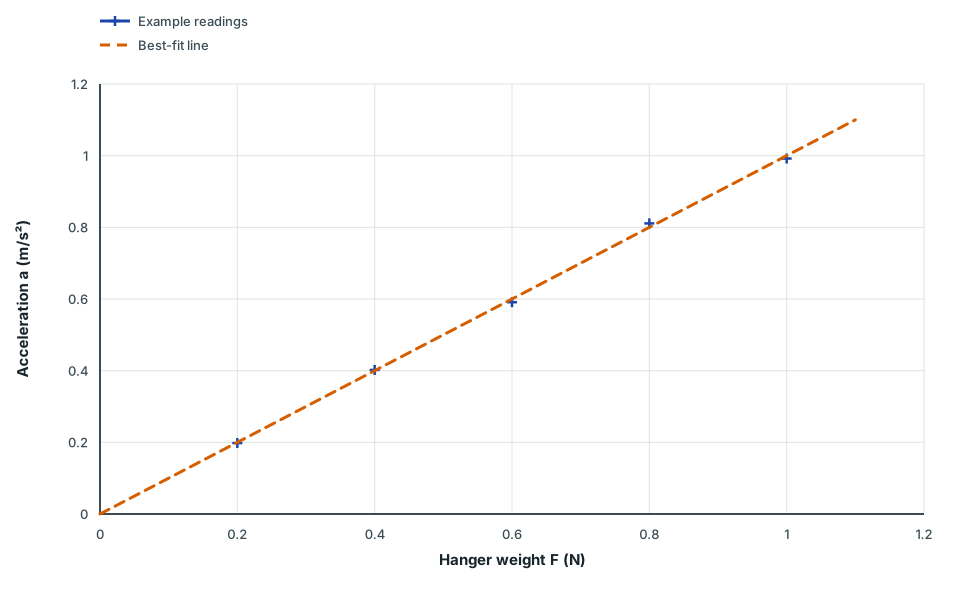
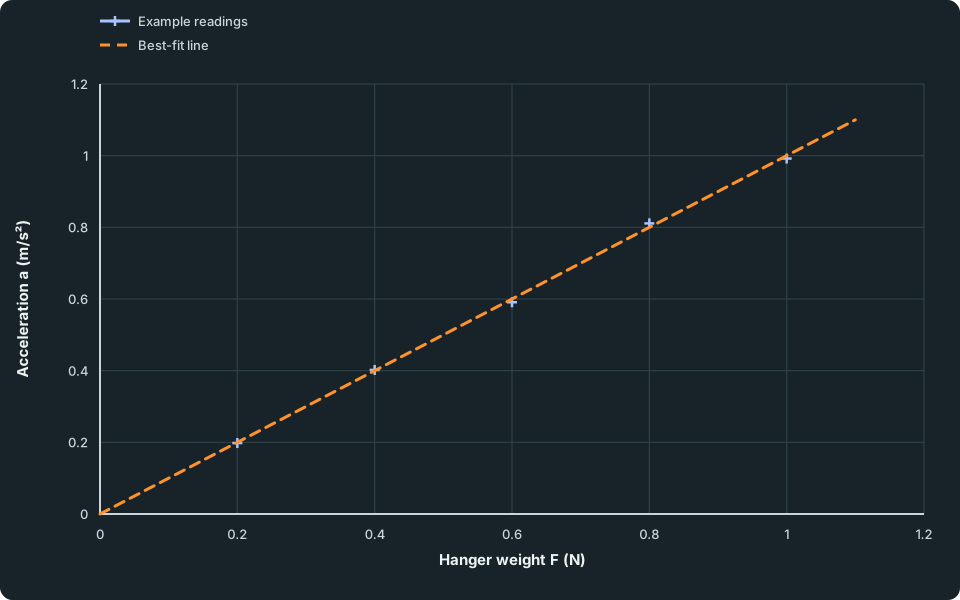
Trolley–hanger acceleration against hanger weight
Acceleration a in m/s² plotted against hanger weight F in N, from 0.20 to 1.00 N. A dashed straight-line model has gradient 1.0 per kilogram. The hanger weight is the driving force for the connected system under the stated approximation, not the tension on the trolley.
Scroll across the figure to read all labels.
View figure data
| Series | Hanger weight F (N) | Acceleration a (m/s²) |
|---|---|---|
| Example readings | 0.2 | 0.198 |
| Example readings | 0.4 | 0.402 |
| Example readings | 0.6 | 0.591 |
| Example readings | 0.8 | 0.811 |
| Example readings | 1.0 | 0.992 |
| Best-fit line | 0.0 | 0.000 |
| Best-fit line | 1.1 | 1.100 |
The points lie close to a straight line through the origin, which is consistent with acceleration proportional to the driving force under the stated model. The gradient is about 1.0 m/s² per newton. For the ideal compensated system, a = F/M, where M is the total moving mass. The gradient is 1/M, so it suggests M ≈ 1.0 kg. This interpretation depends on negligible residual friction and pulley effects.
Guided practice 2
A line that misses the origin
Problem
On a level runway, a moving trolley experiences approximately constant opposing friction. Its graph of a against hanger weight F, fitted to runs where the trolley accelerates forwards, crosses the F-axis at 0.10 N. Explain the intercept under this model and suggest an improvement.
Explain the intercept
Hints
Hint 1
what is the resultant?
Under this model, how much of the system’s driving force is used to overcome the opposing friction?
Show solution step by step
Explain the intercept
Method
About 0.10 N of the pull is needed just to balance friction.
Reason
For the moving system in this model, a = (F - 0.10 N)/M. The fitted line reaches zero acceleration at F = 0.10 N. Do not extend this moving-friction model to claim that all smaller forces are balanced: starting from rest involves static friction.
Working
Answer
The line is shifted along the F-axis, but its gradient is unchanged.
Improve
Method
Tilt the runway until a pushed trolley moves at constant velocity before adding the pull.
Reason
Check that the gravitational effect along the slope balances friction for each trolley loading and over the relevant speed range. With that compensation and negligible pulley effects, the hanger weight F and total moving mass M give the approximate relation a = F/M.
Working
Answer
“Check friction compensation before each loading series. If the approximation holds, the acceleration graph should be consistent with a line through the origin.”
Quick check
A stable intercept is a reason to investigate a systematic effect. Friction is the interpretation under the stated assumptions; calibration, slope and timing errors can also affect a real graph.
Other limitations. Hand timing matters most for the shortest times (about 1.4 s at 1.00 N). Use a longer runway, or light gates if your laboratory has them. If the string is not parallel to the runway, part of the pull acts up or down instead of along the track, so keep the pulley level with the trolley.
Check your understanding 3 Does this comparison isolate the driving force?
A trolley investigation uses 0.40 N on a total moving mass of 0.500 kg, then 0.80 N on 0.540 kg. Calculate both predicted accelerations. Which change would keep mass constant while increasing the driving force?
Show answer
a₁ = 0.40/0.500 = 0.80 m/s² and a₂ = 0.80/0.540 ≈ 1.48 m/s². The second acceleration is less than twice the first because the moving mass also increased. Transfer existing slotted masses from the trolley to the hanger to change the driving force while keeping the combined moving mass fixed. Include the hanger and all loads in that total.
Common mistakes
- Saying balanced forces mean the trolley must be at rest. It can move at constant velocity.
- Taking the hanger’s weight as the tension in the string pulling an accelerating trolley.
- Adding new masses to the hanger, which changes the total moving mass. Transfer masses from the trolley instead.
- Timing past the moment the hanger lands or the string goes slack.
- Forgetting to recheck the friction compensation when the trolley’s load changes.
Spotted an error? Report a correction
Syllabus and review details
- SEC G3 Combined Science Physics component 2027 · 2027
Physics section, PDF pages 8–24
Last reviewed: